

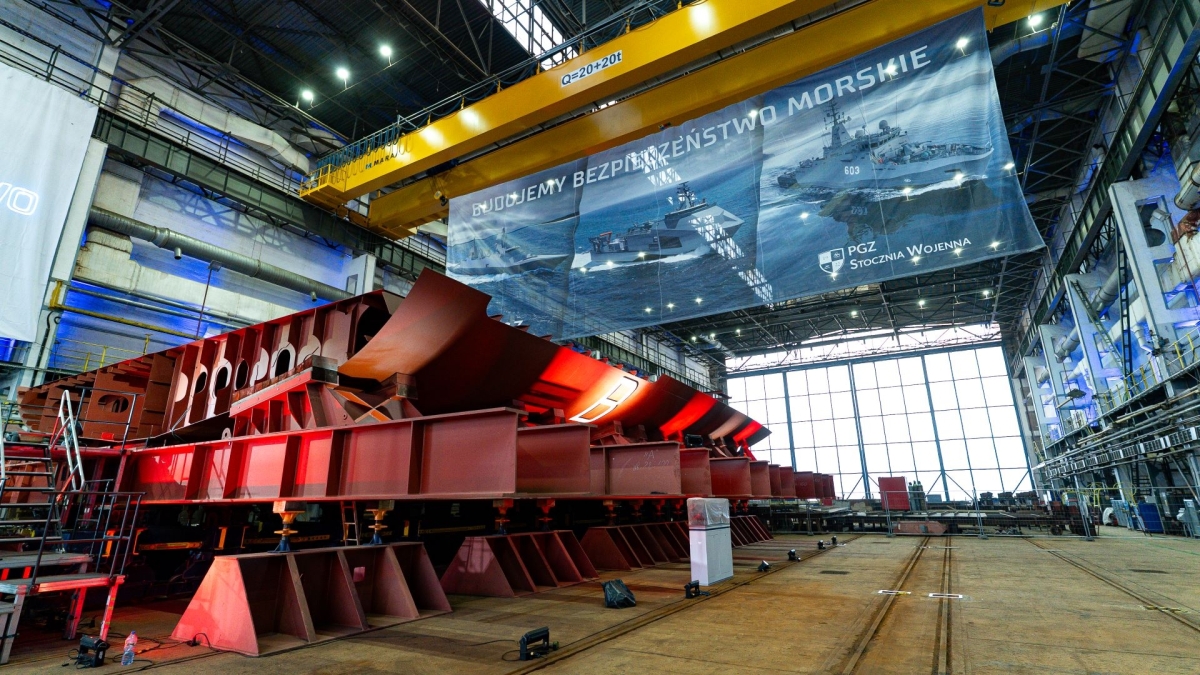


PGZ Naval Shipyard (PGZ Stocznia Wojenna) in Gdynia was the site of another important milestone for the shipbuilding industry and maritime defense. On December 18, with representatives of the authorities, military command, and the shipbuilding sector present, the keel-laying ceremony for the second of three planned frigates under the “Miecznik” program, Burza, took place. Intensive work is also ongoing on its sister ship, Wicher, whose hull has taken full shape and is scheduled to be launched next year.
The end of 2025 has seen numerous events demonstrating that Poland’s shipbuilding industry is developing at its fastest pace in decades. Notably, at the end of November, steel cutting took place for the rescue ship under the “Ratownik” program. This vessel, like the “Miecznik” frigates, will contribute to the development of the national maritime industry and represent a significant advancement for Poland’s naval forces.
Next Stage of Construction
The ceremony was attended by government representatives, including the Ministry of Defense and local authorities, members of the Polish Armed Forces command, and representatives from the maritime and technology sectors. Shipyard workers involved in the project, as well as international partners in the construction of ships for the Polish Navy, were also present. Among the attendees were Deputy Minister of National Defense and Secretary of State Paweł Bejda, Undersecretary of State in the Ministry of State Assets Konrad Gołota, Vice President of Polska Grupa Zbrojeniowa S.A. Jan Grabowski, Inspector of the Navy Vice Admiral Jarosław Ziemiański, Commander of the 3rd Naval Flotilla Rear Admiral Andrzej Ogrodnik, Head of Naval Technology at the Armaments Agency Commander Piotr Skóra, and President of PGZ Naval Shipyard Marcin Ryngwelski.
“I am proud to be part of this well-functioning system of military-industrial construction and modernization of the Polish army. As Deputy Minister of National Defense, appointed by the Prime Minister, I am responsible for modernization and procurement for the Polish armed forces. Our goal is for at least 50% of defense spending to remain in Polish defense plants. This is one such example. It proves that the Polish defense industry is not inferior, and in some cases even superior, to many foreign counterparts,” said Paweł Bejda.
“We need security, and that means a strong and well-equipped navy. Today, we are laying another important cornerstone in building that security. Each frigate will be equipped with advanced combat and technical observation systems, enhancing the Navy’s ability to protect Polish interests at sea. Today we begin construction of the second frigate. The first frigate, ORP Wicher, is already at an advanced stage,” added Marcin Ryngwelski.
“The Navy has long been the least funded branch of the armed forces, as we all know. This year shows that we finally have a clear path in the strategic role of our Navy. We have the ‘Ratownik,’ whose construction started 2–3 weeks ago. A strategic partner has been selected for the ‘Orka’ program. Without these effective tools, there will be no navy. The new ships are exactly the tools needed for protection. Laying the keel for the second frigate symbolically tells us that next year we will do the same for the third vessel. We are on schedule,” said Jan Grabowski.
This milestone was also an opportunity to present the history of the “Miecznik” program, which has had a major impact on the shipyard itself. Many new shipyard facilities were constructed as part of this project, including the towering hull hall, the tallest of its kind in Poland. The infrastructure expansion also involved modernizing the quays and repositioning the floating dock, which will be used for launching future Polish ships.
Materials were also presented on the first frigate, ORP Wicher, which has been under construction since August 2023. At the end of November, the bow section was transported from CRIST Shipyard to PGZ Naval Shipyard via the Bay of Gdańsk. All hull blocks are now in the hull hall, where they will be assembled. The footage highlighted the ship’s impressive length and width. Construction of the superstructure is also ongoing. Next year, the blocks will be joined, and the completed hull is scheduled to be launched in August 2026.
Following the speeches, the formal readiness report for keel-laying was presented. Shipyard workers then placed a commemorative medal in the lower hull block and welded it in place, following the ancient tradition of placing coins in a ship’s keel to bring good fortune to the vessel and its crew. A formal act confirming this stage of the project had also been signed.
Work on the “Miecznik” program began in 2021 with a contract signed with the Armament Inspectorate for the construction and delivery of frigates. The PGZ-Miecznik Consortium, comprising Polska Grupa Zbrojeniowa S.A. and PGZ Naval Shipyard sp. z o.o., is responsible for the project. International strategic partners include Babcock, Thales UK, and MBDA UK. Among the subcontractors is CRIST Shipyard in Gdynia, where blocks and sections of the future frigates are built. All ships will form part of the 3rd Naval Combat Squadron, stationed at the Gdynia Naval Base, with service entry scheduled for 2029, 2030, and 2031.
The launch of ORP Burza is planned for 2027. Construction of the third frigate, named Huragan, is scheduled to begin in 2026, with keel-laying and eventual launch two years later. According to the current schedule, the prototype Wicherwill take approximately six years to build, while the two serial ships will be completed within five years, in line with the pace of other European shipyards. Delays have been influenced by shipyard modernization and international events, including the COVID-19 pandemic and Russia’s invasion of Ukraine. It should be noted that the original plan for the “Miecznik” program assumed deliveries between 2031 and 2034.
The Future Backbone of the Polish Navy
“Miecznik” frigates will measure 138.7 meters in length, with a maximum displacement of 7,000 tons, making them the largest ships ever built in Poland’s shipbuilding history. Maximum speed will be 26 knots, cruising speed 12 knots, and range 8,000 nautical miles. The crew will consist of up to 187 personnel. Propulsion is provided by four CODAD (Combined Diesel and Diesel) engines, with some operating at economic speed and additional engines engaged at higher speeds or under heavier load.
The ships will be equipped with an integrated mission system, including an integrated bridge, communications system, platform management, and combat management system. The full combat system, sensors, and effectors will include anti-aircraft, anti-missile, surface-to-surface, surface-to-land, and anti-submarine torpedoes. The intended air-defense setup will feature VLS Mk41 vertical launchers with CAMM and CAMM-ER missiles.
Surface and land targets will be engaged using RBS15 missiles. Artillery will include a 76 mm OTO Melara Super Rapid Straus naval gun, two 35 mm OSU-35K guns, remotely operated weapon stations with multi-caliber machine guns, and manually operated machine guns. Torpedo armament will consist of two torpedo launchers.
The ships will have medium- and long-range multifunction radars, fire-control radar, visual reconnaissance systems, as well as hull-mounted and towed sonars. Electronic warfare systems will also be installed. They will be armed to defend against attacks from any domain, operating in a multi-domain threat environment, countering attacks from land, sea, underwater, and air.
Polish frigates are based on the Arrowhead 140 platform, derived from the Danish Iver Huitfeldt-class frigates. This platform also serves as the model for five British Type 31 ships and two Indonesian “Red-and-White Frigates” (Fregat Merah Putih). In June this year, the future HMS Venturer, the first ship for the Royal Navy, was launched. Despite some differences, observing an already launched ship provides a good indication of how the Polish frigates will look.
 DOWNLOAD PDF