

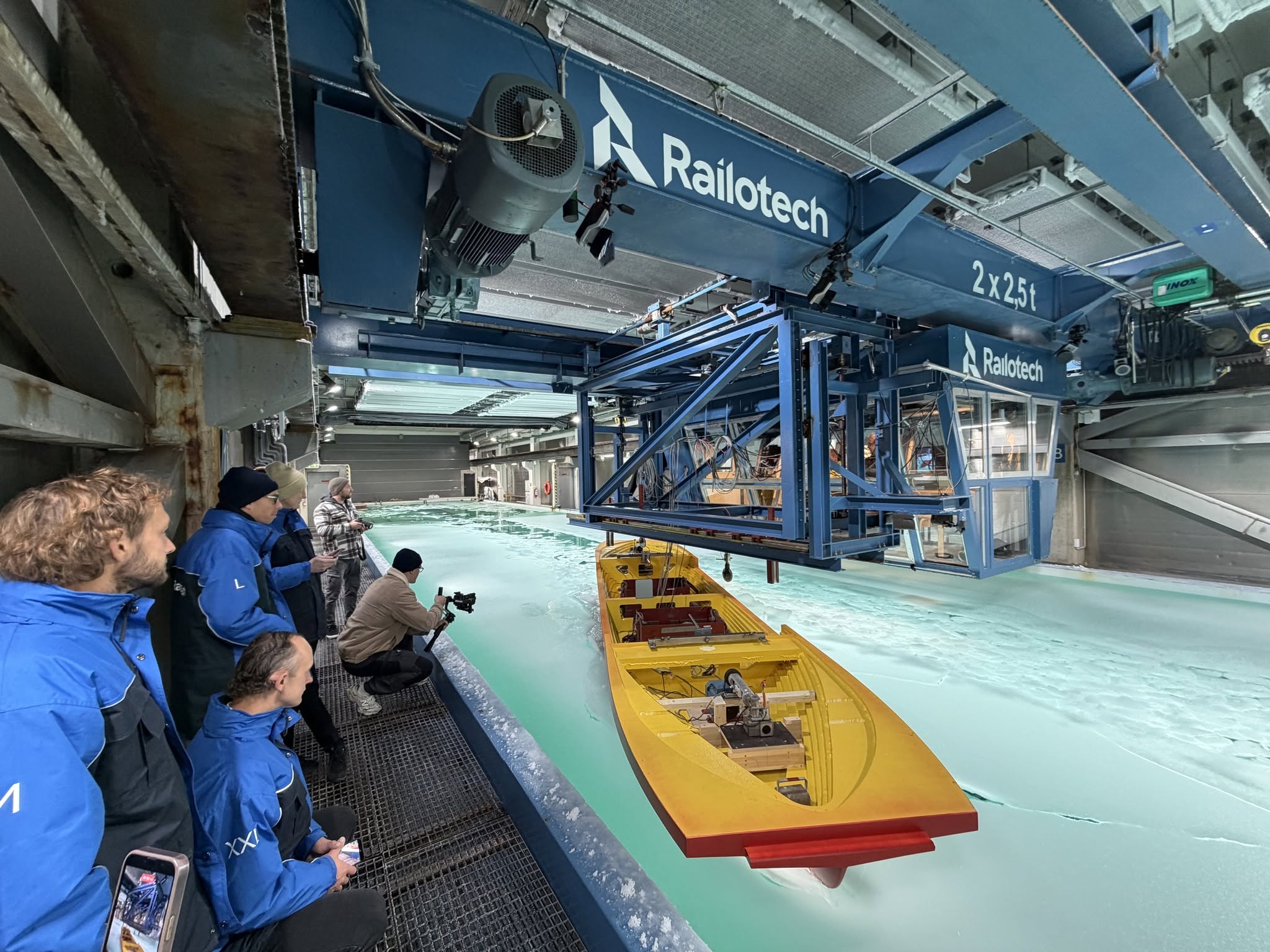


Ice Model Tests have been carried out at the Railotech laboratory in Finland on a new electric ferry to be built for Estonia’s Riigilaevastik. The tests were observed by representatives of Gdynia-based shipyard CRIST S.A., where the vessel will be constructed.
The planned tests covered navigation through ice 20 and 60 cm thick, as well as through a channel filled with 80 cm of broken ice. An 8.2-metre model of the ferry was used, with as much as 13 m³ of ice employed in one of the simulations. The aim is also to meet the requirements for the planned year-round ferry connection between Estonia’s islands and the mainland.
Tests of this kind make it possible to assess a future vessel’s ability to navigate in challenging ice conditions, as well as its manoeuvrability and energy efficiency. The results also provide designers with important information when developing the shape of the ship’s hull and selecting propulsion solutions.
The tests in Finland were observed by representatives of CRIST S.A. They emphasised that this was an important stage in verifying the design solutions before construction begins on the ferry, which is intended to operate in Estonian waters during the winter months as well. The vessel will be operated by TS Laevad, the ferry subsidiary of the Port of Tallinn.

“The connection between the islands and the mainland is essential to the daily lives of tens of thousands of people and to businesses on the islands. People need to be certain that they can get to work, school or a doctor, regardless of the season or weather conditions. It is the state’s responsibility to provide a reliable and functional connection between the islands and the mainland, even in difficult winter conditions,” said Kuldar Leis, Estonia’s Minister of Infrastructure.
The planned ferry will be approximately 100 metres long. It will accommodate up to 380 passengers and either 110 passenger cars or eight lorries. The ice tests in Finland were related to the vessel’s planned Ice Class 1B certification, which will allow it to operate in ice up to 60 cm thick while maintaining normal speed in lighter ice conditions. To improve manoeuvrability and energy efficiency, the ferry will also be equipped with modern azimuth thrusters at both ends of the hull.
The design is being developed by Norwegian naval architecture firm LMG Marin. Importantly, the vessel will be the first of its kind in Estonia to operate on a daily basis using 100% electric power. It is planned to be charged using electricity supplied from shore and stored in a battery system with a capacity of 3 MWh. This will enable fully electric operation on the main Virtsu–Kuivastu route. The design also places emphasis on functionality, passenger comfort and modern styling. Facilities on board will include a restaurant, while the crew will have dedicated social and recreational spaces. The vessel is also being designed to accommodate passengers with disabilities.
It is worth recalling that the shipyard signed a contract in May this year for the design and construction of a fully electric passenger ferry for Estonia’s state maritime authority. The vessel is due to enter service in 2028. The total contract value is €49.93 million, of which €28 million comes from the European Union’s Modernisation Fund. According to Riigilaevastik, the first steel cutting ceremony marking the start of construction is scheduled for February next year.

Photos: CRIST
 DOWNLOAD PDF
