

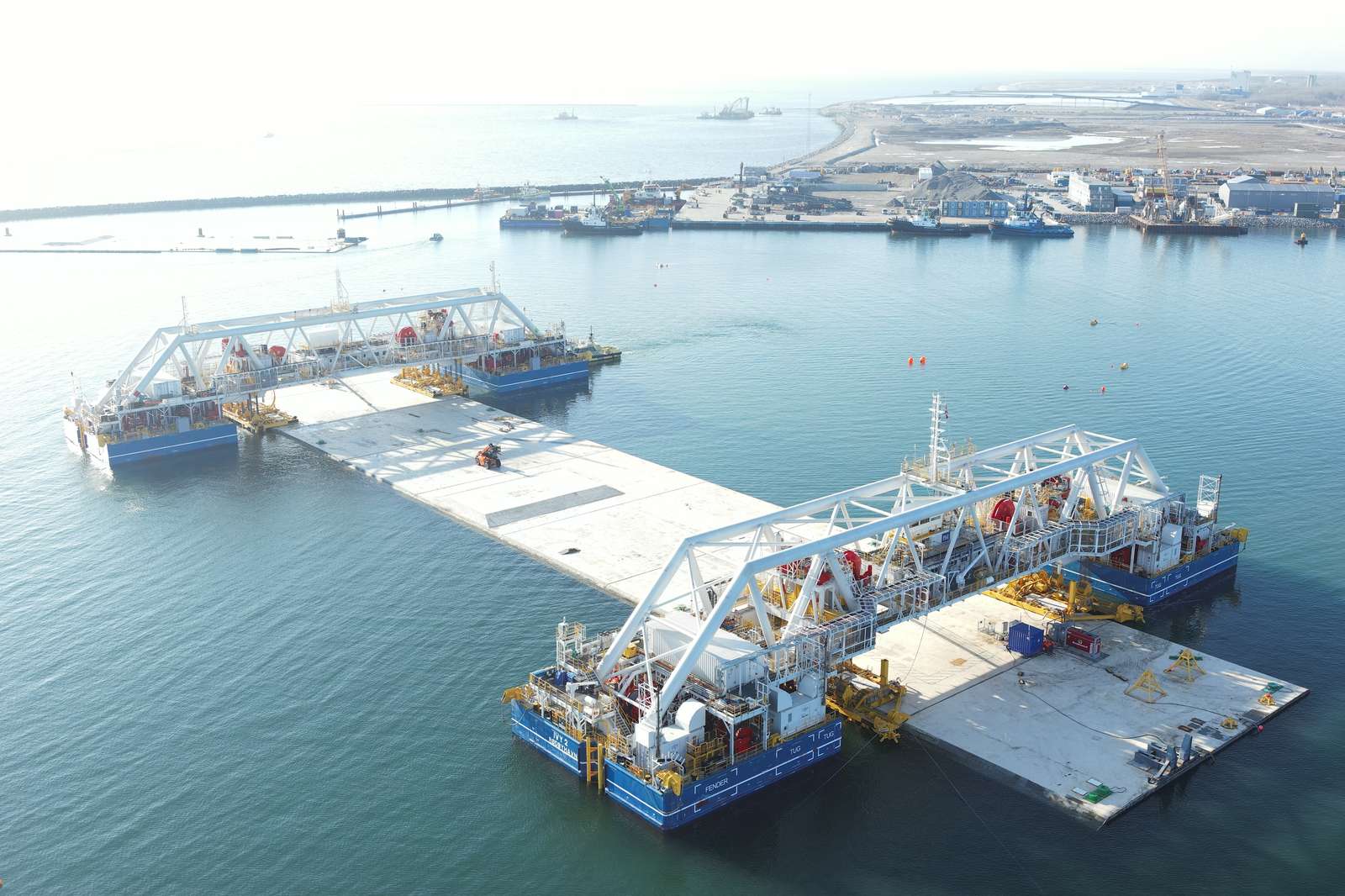


IVY, a specialised pontoon built at the CRIST shipyard in Gdynia, is preparing to lower to the seabed the first special element of the tunnel under the Fehmarnbelt, which also includes a special underground technical level.
Construction of the Fehmarnbelt tunnel linking Denmark and Germany is progressing. Two units built at the CRIST shipyard in Gdynia specifically for the project are key to this complex operation – the specialised pontoons IVY1 and IVY2, which together form a single system simply known as IVY.
The Femern Link Contractors (FLC) consortium said that the IVY immersion pontoon recently successfully completed a key load test ahead of the operation to place the first special element, equipped with an underground technical level, on the seabed. IVY has already placed three tunnel elements on the seabed, in a specially prepared tunnel trench. The fourth element was used for the load tests. IVY1 and IVY2, which together form the IVY system, are currently in the work harbour at Rødbyhavn with the fourth tunnel module attached. Once it has been placed on the seabed, the tunnel section will already be approximately 900 metres long.
The successful load tests allow preparations to begin for the installation of the next element – the fifth, but the first special one. It has different dimensions from the other modules already installed. It is shorter, but has an additional underground technical level, which will house the tunnel's necessary technical installations. This special tunnel module is 39 metres long, 47 metres wide and 13 metres high.

“The first special element is the size of a multi-storey building and has to be positioned at a depth of more than 20 metres. Lowering such a large structure is a demanding operation, which is why it was necessary to thoroughly test IVY before sending the vessel to work,” explains Lasse Vester, Deputy Director for Contracts at Sund & Bælt, the state-owned group that owns Femern A/S, the company responsible for constructing and subsequently operating the tunnel.
The load test itself involved simulating the additional load carried by IVY. The section of tunnel attached to the unit was additionally loaded with 1,600 tonnes. The weight was distributed between large water tanks placed on top of the element and tanks inside it. IVY was able to lift the structure with this additional load to the same height that will be required during transport to the installation site. The additional loads are currently being removed in the work harbour at Rødbyhavn so that the fourth section of the tunnel can be lowered underwater.
The main character in this operation, IVY, is a unique unit. It consists of two pontoons, known as IVY1 and IVY2. Both can also operate separately. They were built at the Polish CRIST shipyard, in what was one of the most spectacular and interesting shipbuilding projects carried out in Poland in recent years.
IVY was designed specifically for the construction of the Fehmarnbelt tunnel. The two pontoons making up the system work together to transport and lower tunnel elements to the seabed, which in their standard version are 217 metres long. The pontoons themselves are approximately 105 metres long and 45 metres wide each. Together, IVY is equipped with 66 winches and approximately 23 kilometres of steel cables, enabling prefabricated tunnel elements to be lowered to a depth of around 40 metres. According to FLC, the operation of lowering the tunnel elements will have to be carried out as many as 89 times before the entire tunnel is completed.
“The project is packed with equipment. Everything is one big open gym. There are nearly 60 winches on board. Each winch weighs more than 40 tonnes. The unit is equipped with two yellow lowering frames. Each frame weighs more than 300 tonnes. Everything is suspended on steel cables. It is designed to operate automatically 45 metres underwater,” Łukasz Topa, Director of Project Execution at CRIST shipyard, told Gospodarka Morska during the handover ceremony.
It should be added that, apart from IVY, another unique unit was built at the CRIST shipyard for the construction of the Fehmarnbelt tunnel: the specialised multi-purpose pontoon Maya, whose task is to precisely lay gravel on the seabed, on which IVY subsequently places the tunnel sections. During construction, Maya was known as NB131 and later under the temporary name MPP (Multi Purpose Pontoon). Work on the unit began in Gdynia in 2021. The vessel was equipped with a special backfilling tool, also designed and manufactured in Poland (the design was carried out by the StoGda design office, while the structure was built by CRIST shipyard). The remotely operated device can be lowered beneath the vessel's hull to as much as 46 metres below the waterline. The pontoon's hull itself is 130 metres long, but with its conveyor belts its overall length reaches 149 metres. Its two gravel compartments can hold a combined 14,000 tonnes.

The construction of IVY and Maya is by no means the end of CRIST shipyard's involvement in the tunnel project. The Gdynia shipyard also converted the Helen barge for the project, with the task of supporting IVY1 and IVY2. The barge is 60 metres long and 4 metres wide.
Moreover, the TSHD-type dredger Breydel, which took part in the tunnel construction project, recently arrived at Gdańsk Shiprepair Yard. The impressive 121.5-metre-long vessel arrived in Gdańsk for previously scheduled work, the scope of which the shipowner did not wish to disclose.
The Fehmarnbelt tunnel, which is already known as the Fehmarn Link, will be the world's longest road-and-rail tunnel, the world's longest underwater road tunnel, the world's deepest road-and-rail tunnel and the world's second-deepest-buried concrete tunnel. It will run between Puttgarden in Germany and Rødbyhavn in Denmark. It will consist of 89 prefabricated concrete elements produced at a temporary factory built specifically for the project. Seventy-nine of them are standard elements, while the remaining ones are special elements that will be positioned at intervals of approximately two kilometres.
As reported by the Polish Press Agency (PAP), the majority of the 1,500 workers employed on the construction site are Poles. The Impostal Group is among the companies involved in the works, responsible for a significant part of the work related to the prefabrication and assembly of steel structures. These include steel piles and pipes used to expand quays and create berthing positions for prefabricated tunnel elements awaiting the immersion process, namely being submerged and connected to the structure under construction. The company also manufactures structural steel frames and a range of auxiliary components necessary for the operation of the construction facilities.
Once the route opens, cars will be able to cross the Baltic Sea between Puttgarden and Rødbyhavn in 10 minutes, while trains will take seven minutes. The two towns are 18 km apart, which will also be the length of the tunnel. At present, the route is served by a ferry, with the crossing taking around 45 minutes.
According to the schedule, work on the tunnel is due to be completed by 2029, but the consortium has already announced delays. The total cost of the project is estimated at approximately €7 billion.
Photos: GospodarkaMorska.pl; Sund & Bælt Holding A/S press release
 DOWNLOAD PDF