

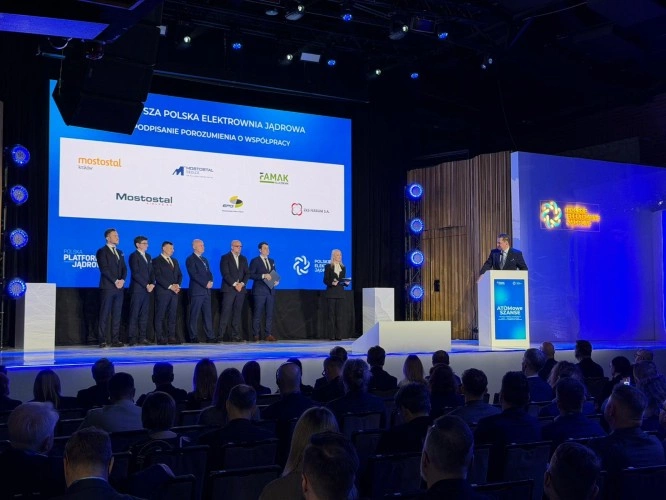


“Nuclear prospects” for Poland and Polish industry are no longer a slogan but an emerging reality. That was the principal conclusion of the “Nuclear Opportunities” conference in Gdańsk, devoted to nuclear power, the first plant to be constructed near Choczewo, and the supply chain for Poland’s civil nuclear programme.
Marek Woszczyk, President of Polish Nuclear Power Plants (PEJ), the investor behind the country’s first nuclear facility, stressed that after 2025 the project has passed a point of no return. Decisions by the European Commission and the Polish government on the financing model for the investment in Pomerania, near Choczewo, have ensured that construction will proceed. Wojciech Wrochna, the Government Plenipotentiary for Critical Infrastructure, underlined that the aim is to provide stable electricity for the Polish economy — and more besides. “A few years ago nuclear power had little favourable press, with greater emphasis placed on renewables. Today it is clear that without secure, stable baseload generation the system will not function. Nuclear power is also becoming an opportunity for Polish enterprise,” he said.
“If we all engage fully in the construction process and in certification, this will offer Polish companies an opportunity to enter global markets and global supply chains. The project will enable firms to acquire new competences. Its success may in time open the way for similar schemes internationally, with the participation of Polish industry,” Minister Wrochna added.
He called on business to provide feedback on construction and regulatory procedures, emphasising the government’s and the investor’s openness to suggestions regarding project delivery. “The government wishes to give preference to Polish companies, but not unconditionally. There must be quality and competitive pricing. The government and the investor want to support domestic business, yet considerable work remains on the part of industry,” he said.
Forty per cent — but not a dogma
In an interview, Marek Woszczyk indicated that the participation of Polish manufacturers and service providers in the project is estimated at around 40 per cent of its value, though this should not be regarded as a rigid target. “It may prove higher, or it may not be fully achieved, though I consider it a realistic figure,” he said. “There will be no procedure under which a Polish firm must win. We operate within the European Union, with approval for the financing system and defined rules. Polish companies must therefore compete for contracts on equal terms.” He added that PEJ remains an active investor, conducting information campaigns and dialogue with industry to maximise domestic industrial and service involvement.
To date, at the preliminary stage of the nuclear power station’s development, around 400 contracts have been signed with Polish entities, with a combined value of approximately PLN 1 billion. This, he noted, represents only the initial phase of works.
Leszek Hołda, President of Bechtel Polska — responsible for preparatory works at the future nuclear site — stated that the investment process is proceeding in line with the agreed schedule. “We are entering subsequent stages, including geodetic and geophysical surveys both on the site and in the adjacent marine area. Research works beneath the three nuclear islands were completed last year,” he said.
A contract for further stages of investigation was signed with the Gdańsk-based company Doraco and announced during the Gdańsk meeting.
During the “Nuclear Opportunities” conference, six Polish metal manufacturing companies signed a cooperation agreement covering participation and the exchange of experience in nuclear projects. Among them was Grupa Przemysłowa Baltic, previously known for shipbuilding production and involvement in onshore and offshore energy. “Given our competences, entry into nuclear projects is a natural extension of our earlier experience,” said Tomasz Szymczak, Vice-President of the group. “In future, we would like work on nuclear schemes to become a significant element of the Group’s development, including in export markets.”
GP Baltic is currently undergoing certification for the civil nuclear sector and has also signed a letter of intent expressing readiness to cooperate with the French utility EDF on Poland’s proposed second nuclear power station.
 DOWNLOAD PDF