

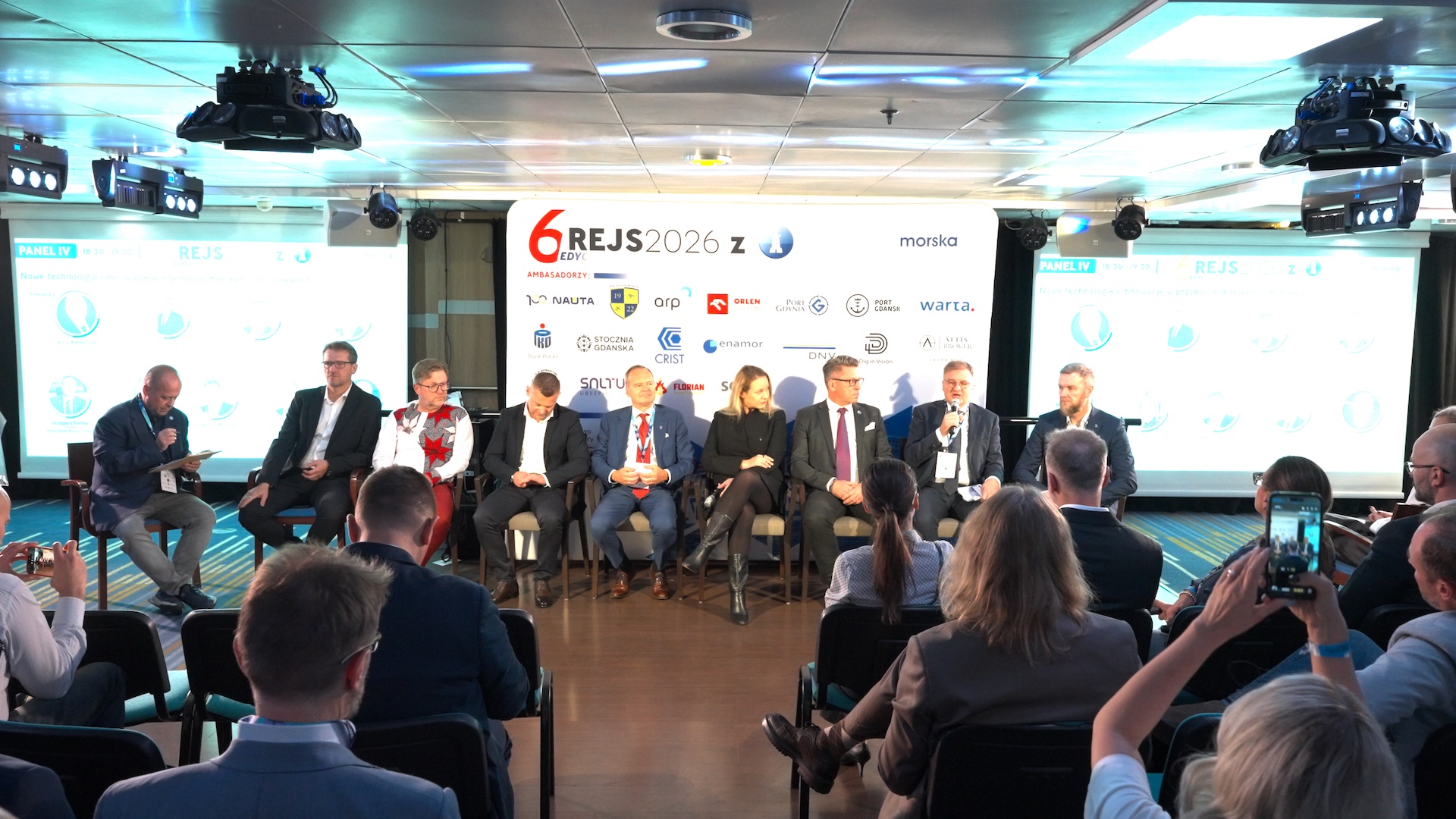


The second day of the Rejs z GospodarkaMorska.pl conference featured a session dedicated to technology and innovation in the maritime industry. It was introduced by a presentation on decarbonisation by Paweł Grobelny, Senior CMC Surveyor at DNV.
When Will Net Zero Be Achieved — If at All?
Grobelny outlined the current regulatory position of the maritime industry on shipping decarbonisation. The International Maritime Organization (IMO) aims to achieve net-zero emissions by around 2050, although there is still no consensus on the matter. The exact means of achieving this goal remain unclear. While the proposed Net-Zero Framework has been discussed, its final form, adoption date and potential costs are still unknown.
The DNV analyst discussed four possible scenarios for the Net-Zero Framework, developed by the company and presented in its latest Maritime Podcast report. Two envisage an optimistic outcome, with the regulations adopted by the IMO in the near future and individual measures subsequently phased in over time.
The third scenario considers the possibility that the Net-Zero Framework will be rejected at the IMO in December this year. In simple terms, this would mean starting the entire process again from scratch. The fourth scenario envisages a decision-making deadlock at the IMO, with discussions and negotiations dragging on indefinitely and the impasse becoming increasingly difficult to break.
Grobelny warned that the longer the IMO delays action and the further the introduction of top-down regulations is postponed, the greater the risk of regulatory fragmentation. Individual countries or groups of countries could introduce their own versions of the rules, potentially making shipping more complicated and creating regulatory chaos.
Each of these hypothetical scenarios would, of course, lead to different levels of demand for low-emission fuels. If the regulations are adopted relatively quickly, demand could rise significantly over the next two and a half decades. Otherwise, fossil fuels are likely to remain dominant.
Paweł Grobelny nevertheless made one point clear: there will not be enough alternative fuels to meet everyone’s needs, regardless of the scenario. Other technologies will therefore be needed to reduce vessels’ fuel consumption and emissions. One option is the use of systems that improve onboard energy efficiency.
Grobelny presented the case of a 15-year-old container ship that underwent a retrofit during its third classification survey. The investment delivered a double-digit percentage improvement in energy efficiency, reducing energy consumption and therefore fuel use and emissions. Interestingly, the payback period was measured in years of the vessel’s operation rather than decades, as had previously been the case.
According to Grobelny, the shipping industry’s main problem today is not cost but regulatory uncertainty, which leaves shipowners trying to anticipate rules whose final form they do not know. In the future, a further challenge could be the availability of alternative fuels — a concern that has been discussed across the industry for some time.

We Have LNG — Now We Need Bunkering Vessels
The panel discussion, moderated by Artur Kiełbasiński of GospodarkaMorska.pl and ZielonaGospodarka.pl, began with the question of fuels. One of the panellists was Dariusz Wieloch of Gas-Trading, part of the Orlen Group. The company is involved, among other activities, in building regasification facilities and LNG, CNG and bio-LNG refuelling stations — although, as Wieloch acknowledged, none of the latter has yet been built for a number of reasons — as well as bunkering vessels.
Wieloch calculated that a single road tanker can carry 50 cubic metres of gas, enough to supply 12 households for a year. If the tanker were replaced once a month, the supply could serve 100 households; if a new tanker arrived every day, it could provide enough gas for approximately 3,000 households, or around 12,000 people. Two such stations, supplied with a new tanker every day, could serve a town of 30,000 people.
By comparison, the ferry Jantar Unity, which began LNG bunkering in January this year, has already undergone 220 bunkering operations. Another vessel, Bursztyn Unity, is due to enter service shortly. Both ferries have tanks with a capacity of 300 cubic metres. Filling them completely would therefore require six road tankers, although Wieloch stressed that this is not how bunkering is normally carried out: each operation involves between two and five tankers. Even so, this means the trucks are travelling to the port almost continuously.
Dariusz Wieloch said plainly that bunkering vessels from a dedicated bunkering ship, rather than from road tankers, would make operations considerably easier.
“But Poland has been discussing a bunkering vessel for around nine years. We are now, however, closer to a situation in which one vessel is to be built for Świnoujście and another for the Tricity area,” he said.
According to Wieloch, the bunkering vessel serving Szczecin and Świnoujście is expected to be ready in 2029. No contracts have yet been signed, but the Gas-Trading executive said that “from the discussions, 2029 looks quite likely”.
It would be a relatively small vessel. By way of comparison, Wieloch cited SeaGas, described as the world’s smallest bunkering vessel, which operates in the ports of Nynäshamn and Stockholm and supplies ferries. Its tank capacity is equivalent to that of 3.5 road tankers.
A second, larger vessel intended to serve the ports of the Gulf of Gdańsk is expected to be completed in 2032. Wieloch believes that the two vessels together “would provide a certain standard for a country whose economy is based on the sea”.
Polish Company Helps Build Danish-German Tunnel
A complex and innovative offshore infrastructure project is also under way west of Polish waters: the Fehmarn Belt tunnel, which will connect Denmark and Germany.
Gospodarka Morska has reported on several occasions on two key vessels involved in the project, Ivy and Maya, both built at the Gdynia-based Crist shipyard. However, the Polish Impostal Group is also involved in the project, responsible for the prefabrication and assembly of sections of the steel structures.
Dariusz Woźniak, President of Impostal, explained that the company is building steel structural frames, auxiliary components for the construction site’s support facilities, and steel piles and pipes required for the expansion of quays.
Woźniak described how Impostal became involved in such a large-scale project, outlining the company’s progression from securing relatively small contracts that helped it build up its portfolio and expertise. This led, among other things, to a contract with Deutsche Bahn ten years ago. Pleased with the cooperation, the German partner subsequently recommended Impostal to the tunnel’s developer.
The workforce was crucial. Over 15 years, the Impostal Group has grown from 10 employees to nearly 300. Polish engineers, technologists, fitters and welders are now working on the Danish-German tunnel project, all holding international qualifications and certificates.
The experience and references gained from the Fehmarn Belt tunnel project could well lead to further contracts in the bridge-building, tunnelling and offshore sectors in the near future.

Welders from Afar
Large-scale projects such as Fehmarn Belt, in which Impostal is involved, require substantial and highly skilled workforces. However, the maritime industry and Polish industry more broadly are facing growing difficulties in this area. Polish shipyards are bringing in workers from Asia and South America on temporary contracts.
Dig in Vision has set out to address this challenge, as explained by its President, Radosław Gałka.
“We have no choice. We have to train welders and look for them all over the world. Poland’s specialist welders, technicians and inspectors are getting older,” Gałka said.
Dig in Vision uses a virtual-reality system of its own design to train welders. The immersive technology creates a digital environment that reproduces real processes, working conditions and infrastructure.
The project began in 2018, when EU Workers started discussions with the Naval Shipyard about employing welders from Vietnam. Ten people were recruited locally, but the plans were derailed by the COVID-19 pandemic. The experience nevertheless made the company realise that tools were needed to assess prospective employees’ skills remotely. This led to the creation of Dig in Vision, which developed VR technology for assessing and training welders.
“The technology in VR is so precise that it can track movements in three dimensions with an accuracy of 0.2 mm,” Gałka said.
Virtual reality provides a safe learning environment for young people, while immersive technologies are estimated to reduce training time by 70%. Dig in Vision is currently developing a virtual welding academy in line with a new standard for engineers.
A Ship in Digital Form
The shipbuilding and shipping industries are also using modern technologies in other ways. Sławomir Bałdyga, President of Sea Domain Group, explained the benefits of ship scanning and how the process works.
“A scanner is just a tool. It allows us to collect real-world data and transfer it into the virtual world, creating a digital twin that we can then work on,” Bałdyga said.
He illustrated the process with one of the company’s recent projects: scanning a dredger. Thanks to the latest equipment, which offers accuracy of up to 0.1 mm, the entire scanning process can be completed within a single day.
But what is the purpose of this virtual replica of a vessel? It can save time and allow the technologies needed for repairs and routine maintenance to be developed more quickly. Certain processes, upgrades and retrofits can be designed and tested on a digital copy of the ship without the need to dry-dock or otherwise take the actual vessel out of service. The physical ship is then needed only to implement the changes developed digitally.
For shipowners, design offices and shipyards, this means saving time while maintaining or even improving quality, often at a lower overall cost.
Bałdyga draws on his many years of experience at Sea Domain Group. He has had the opportunity to observe technological processes at some of the world’s most advanced shipyards and industrial facilities. His company is a new entrant to the market and, as he acknowledged, does not even have a website yet. It already has, however, a portfolio of orders and contracts.
“Clients have put their trust in us. We deliver and solve their problems quickly. We put the latest technology to work — technology that, in fact, each of us already carries in our pocket. We can deliver data straight to a phone, anywhere in the world, using technology that already exists,” Sławomir Bałdyga explained.
The Sea Domain Group President added that the company’s ambitions do not end there. Plans include robotic solutions, among them the introduction of robotic laser welding, which could provide another way to address workforce shortages.
Easing the Burden on Port Workers
It is inevitable that new technologies will also find their way into ports. As hubs for shipping, ports must develop in step with the maritime transport sector. They also have their own processes and are constantly seeking ways to optimise operations and improve efficiency.
Time is critical for ports. The faster a ship is unloaded, the sooner another vessel can use the same berth. The faster cargo is cleared from a storage yard or quay, the sooner another shipment can occupy that space. And the sooner a lorry driver or train can enter the port, complete all the necessary technical and administrative procedures and leave, the sooner the way is clear for the next vehicle or train.
One way to improve these processes is through partial automation. Tria, represented on Artur Kiełbasiński’s panel by its President, Łukasz Zaborny, has introduced an AI-powered virtual kiosk designed to simplify procedures and assist drivers entering ports.
Zaborny explained that, as an IT company involved in processes taking place in the port, Tria had identified an opportunity to reduce cargo-handling times. This led to the development of an automated self-service kiosk.
The external access point allows drivers to complete certain procedures independently, whereas previously they required the assistance of a terminal or port employee. Drivers can register in the system, weigh their vehicles, collect the relevant documentation and receive directions for the next stages of the process.
“The device has genuinely reduced the time needed to weigh a vehicle from 12 to 2.5 seconds. This translates into a greater volume of cargo handled by a ship and reduces the workload on staff,” Zaborny explained.
The head of Tria said that the kiosk monitors itself and sends out the relevant notifications, but does not store information locally. For security reasons, the data remain within the client’s infrastructure.
The kiosk incorporates an AI agent capable of communicating in natural language. As Zaborny noted, it cannot solve problems itself, but it can answer basic and frequently asked questions and guide drivers through the relevant procedures. It can explain what to do if a red warning light comes on, an error appears on the weighbridge or a barrier remains closed. If a more difficult question arises and the AI agent cannot find an appropriate solution, it directs the driver to the relevant employee.
What About Cybersecurity?
All devices and systems operating in the digital environment also create opportunities for abuse and even criminal activity on a new, virtual front. During the discussion, Artur Kiełbasiński noted that reports of cyberattacks on companies and institutions, large-scale personal data leaks, and the compromise of systems and servers are becoming increasingly frequent.
The moderator asked how organisations should protect themselves and whether software and hardware alone are sufficient, or whether changes in employees’ mindsets and skills are also necessary.
Piotr Żurawlow, President of Softiq, said that the attacks were being carried out by “criminals who want money and know-how”.
“These are organised corporations with enormous budgets, as well as entire states such as North Korea and Russia. For the past five to seven years, there has been a regular war in cyberspace, and it is continuing to escalate,” Żurawlow said.
He added that, in recent years, “criminals have been given an atomic bomb” in the form of artificial intelligence. AI-supervised algorithms are now attempting to break into systems almost constantly, wherever they can, to cause damage, steal data, trade it and then sell decryption keys back to the victims.
Żurawlow explained how to build a digital organisation that is as resilient as possible. He discussed both the physical protection of IT infrastructure — through access keys, strong computer passwords and other safeguards implemented in accordance with established methodologies — and the importance of properly segmenting computer networks.
He compared the approach to a modern office building with several access-control points designed to prevent unauthorised entry: first a barrier at the car park, then access passes for the building, followed by restricted zones on each floor. Further authorisation is required to enter each area.
The same principle should apply to IT networks containing computers, sensors, databases and Internet of Things (IoT) devices. Some systems should be isolated, and devices that cannot be adequately secured should not have access to the core network.
Żurawlow stressed that proper cybersecurity is now also a legal obligation.
“The law has changed and imposes liability, including criminal liability, on members of company management boards,” he said.
He agreed that employees should be properly trained and aware of the risks, but added that a two-hour remote training session is often sufficient.

The Skills Are There
Dorota Morka-Umerska, President of HMB Lintec, discussed the skills available in Polish industry. In her view, limited capital and internal competition are not such significant barriers for Polish companies. Substantial investment by foreign capital in Polish maritime businesses has brought benefits to the economy.
“We do not lack expertise. When Polish capital was not investing in people, foreign investors helped maintain these skills. Welders and engineers worked for foreign companies for many years. Now that expertise is returning to our country,” Morka-Umerska said.
She argued, however, that Polish companies still lack adequate support. Micro-enterprises and small businesses predominate. They have ambitions, ideas and interesting projects, but often lack the financial and human resources needed to deliver them.
“We are a strong subcontractor, an integrator and sometimes the driving force behind projects, but, in the end, the intellectual property is often not Polish,” she said.
HMB Lintec itself is involved in major, multi-sector projects in Poland. The company supplies equipment for, among other things, the Ratownik project, which requires a whole range of safety systems. Morka-Umerska also pointed out that the cranes manufactured by the company can be equipped with digital twins to support their subsequent operation.
“This technology is desirable in every aspect of development,” she said.
PRS Ready for the World
The final panellist was Grzegorz Pettke, President of the Polish Register of Shipping (PRS). Like any classification society, PRS must take a relatively cautious approach because it certifies safety and has implications for liability and financial interests. At the same time, it must keep pace with rapid technological change.
“During my tenure, PRS’s guiding principle has been to deliver on schedule and within budget,” Pettke began.
The head of Poland’s classification society confirmed that PRS had responded to a request from two ministries to expedite amendments to regulations concerning bunkering vessels. Ultimately, the legislation governing these vessels was amended through PRS’s involvement.
PRS also wants to expand its international presence. In addition to its existing offices around the world, the organisation is looking at less obvious markets, including Ghana, Kenya and Tanzania. Pettke said that an agreement with Tanzania had been signed the previous week, covering, among other things, the development of education and training to raise awareness of regulations, safety culture and environmental protection.
“PRS is a small classification society, but we have no inferiority complex. We are active in the IACS forum and work with DNV. We are not afraid of innovative solutions; we are developing our workforce and expanding internationally. PRS is not just about ships, but also about manufacturing. For economic reasons, manufacturing is often located outside Europe, while European requirements call for products to be certified against various standards — a service that PRS provides,” Pettke said.
The ambassadors of the sixth edition of the event were TUiR WARTA, the Port of Gdańsk Authority, PGZ Naval Shipyard, Attis Brokers, the Polish Register of Shipping, SALTUS Insurance, the Industrial Development Agency, Nauta Shiprepair Yard, PKO Bank Polski, Gdańsk Shipyard, Crist Shipyard, DNV, Dig in Vision, PSP Florian, Softiq and WUŻ.
The conference is organised by the publisher of GospodarkaMorska.pl, MarinePoland.com and ZielonaGospodarka.pl.
Photos: GospodarkaMorska.pl
 DOWNLOAD PDF