

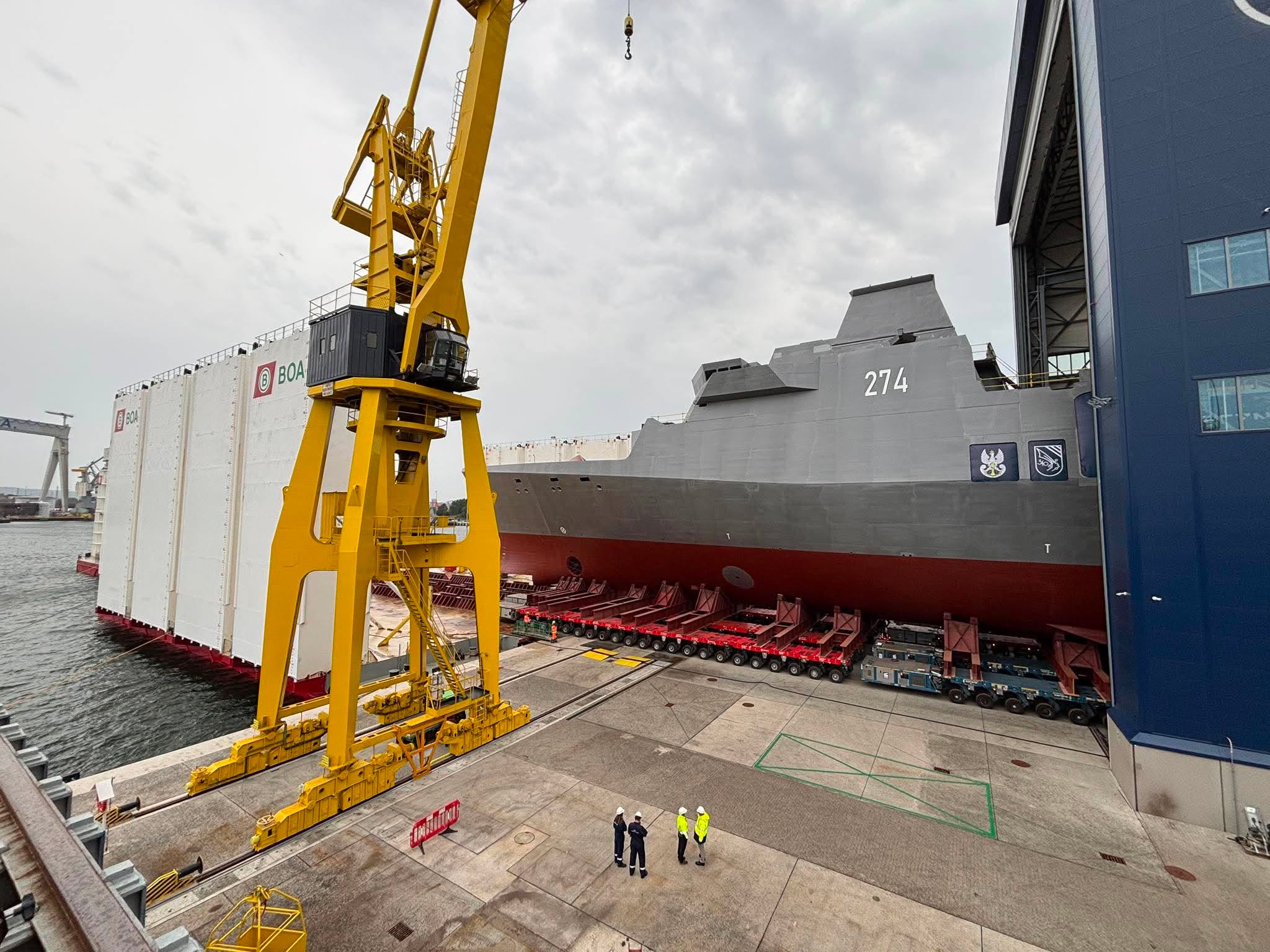


On Sunday evening, the completed and painted hull, with the name “Wicher” emblazoned across its midships section, was partially moved out of the hull construction hall and illuminated with multicoloured lighting. This provided an opportunity to see the frigate, which has been under construction since 2023. It is the first of three vessels being built under the “Miecznik” programme that will join the 3rd Flotilla of Ships’ Combat Ship Squadron.
The authorities of PGZ Stocznia Wojenna (Naval Shipyard) in Gdynia stressed that transporting the vessel and its controlled transfer into the water using a semi-submersible barge is now one of the most demanding engineering operations being carried out by the Polish shipbuilding industry. The entire operation will take place over several days. The christening and naming ceremony will be attended by state officials, led by President Karol Nawrocki, as well as the senior command of the armed forces, including the Polish Navy. It is scheduled for 11.30 a.m. on 12 August. The actual launch will take place the following day, on 13 August.

The Miecznik programme is currently the largest modernisation programme being undertaken by the Polish Navy. Its aim is to build three modern multi-role frigates that will become the principal combat force of the Polish fleet, replacing two ageing Oliver Hazard Perry-class vessels. The decision that the naval branch of the armed forces would receive these vessels was announced as early as 2021, while construction of the first frigate began two years later. Work is currently under way on all three ships, with their entry into service planned for 2029–2032.
In addition to ORP Wicher, the Polish Navy will also receive ORP Burza and ORP Huragan, which will be launched at a later date. Construction of the third and final frigate began in April this year, with commissioning planned for the turn of 2031 and 2032.
The Miecznik-class frigates are 138.7 metres long and have a displacement of up to 7,000 tonnes, making them among the largest vessels ever to fly the Polish white-and-red ensign. They are based on the Arrowhead 140 platform supplied by British defence company Babcock. The same design also serves as the basis for Britain's Type 31 frigates and Indonesia's so-called Red and White frigates. Prototype vessels for both the British and Indonesian programmes have already been launched.
The maximum speed of the “Miecznik” frigates will be 26 knots, with a cruising speed of 12 knots. Their range is expected to be 8,000 nautical miles. The crew will consist of up to 187 personnel. Propulsion will be provided by four diesel engines in a CODAD (Combined Diesel and Diesel) configuration, in which some engines operate at lower, economical speeds, while the remaining engines are brought online as speed is increased or when the vessel is operating under a heavier load.
The vessels are being fitted with an integrated mission system comprising an integrated bridge, communications system, platform management system and combat management system. The full combat management system, sensors and effectors will include air-defence systems, anti-ship missile systems and weapons for engaging land targets, as well as torpedoes for anti-submarine warfare. RBS15 missile launchers will be used against surface and land targets. The artillery fit will comprise a 76 mm OTO Melara Super Rapid Strales medium-calibre gun, two 35 mm OSU-35K guns, remotely operated weapon stations equipped with multi-calibre machine guns, as well as manually operated machine guns.

The torpedo armament will comprise two torpedo launchers. The planned target configuration for the air-defence system includes Mk 41 VLS vertical launch systems and missiles from the CAMM family, including the CAMM-ER. The vessels will be equipped with medium- and long-range multifunction radars, a fire-control radar and electro-optical reconnaissance systems, as well as hull-mounted and towed sonars. They will also be fitted with electronic warfare systems. The frigates will receive a comprehensive weapons suite enabling them to counter a broad range of threats.
The Polish programme is being carried out by the PGZ-Miecznik Consortium, comprising Polska Grupa Zbrojeniowa S.A. and PGZ Stocznia Wojenna sp. z o.o. The project’s strategic foreign partners are Babcock, Thales UK and MBDA UK. Subcontractors include the Gdynia-based CRIST S.A. shipyard, where blocks and sections of the future frigates are being built. The group was recently joined by Remontowa Nauta shipyard. The contract was initially valued at approximately PLN 8 billion, but following amendments its value increased to around PLN 15 billion by the end of 2023.
In addition to the construction of the frigates, the “Miecznik” programme has also involved the expansion of Poland’s shipbuilding industry. This has been particularly significant for the Gdynia-based PGZ Stocznia Wojenna, where the vessels are being built. As part of the programme, the shipyard’s infrastructure has been significantly expanded, with the most prominent example being the hull assembly hall, where the frigates’ hulls are being constructed. Once the future ORP Wicher is launched, space will be freed up for its sister ship, ORP Burza, which has been under construction since May last year.
The new vessels are expected to significantly strengthen the protection of Poland’s coastline and maritime domain, while also contributing to NATO operations, including the protection of the Alliance’s eastern flank and beyond. In the future, the frigates could also take part in overseas missions aimed at protecting key sea lanes, including those important to Poland, and safeguarding merchant shipping against threats. They will also be capable of participating in major naval exercises conducted under NATO or US auspices.

Photos: GospodarkaMorska.pl
 DOWNLOAD PDF