

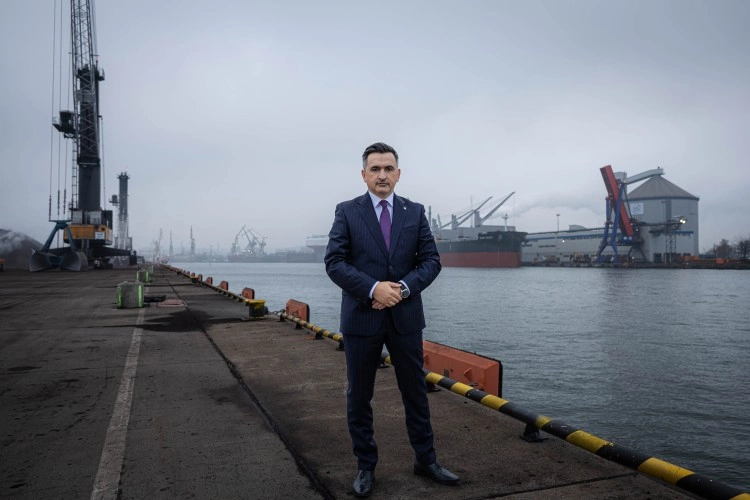


Port Gdański Eksploatacja, the largest cargo handling operator in Gdańsk, delivered what it describes as a solid performance. Its President, Andrzej Kuźmicz, has expressed satisfaction with the team’s efforts, while acknowledging that 2026 will bring fresh challenges.
A total of 4.2 million tonnes of cargo was handled by the Port Gdański Eksploatacja terminal in 2025. The past 12 months, however, were not confined solely to vessel operations. Alongside activity on the quays, considerable work was undertaken behind the scenes, with further investments under preparation.
“I believe Port Gdański Eksploatacja closed 2025 on a very positive note,” said Mr Kuźmicz. Although the company fell short of its budgeted target of approximately 4.65 million tonnes, he regards the outcome as satisfactory, particularly given the strong price competition from other terminals, notably private operators. “Quite simply, the volume of cargo available on the market was insufficient to achieve the full planned throughput,” he explained.
He emphasised that 2025 was not solely about cargo handling. Changes were introduced within the operational and commercial teams, alongside progress on a series of both minor and major capital projects.
“We achieved what was realistically possible in 2025, and the result is very good,” he reiterated. Final financial confirmation is still pending, but net results are expected to align with assumptions made in 2024, despite significantly higher port infrastructure access costs.
Coal dominant, grain weaker
Of the 4.2 million tonnes handled, coal and coke accounted for the largest share. Mr Kuźmicz noted that work is under way to reduce the relative dependence on this cargo group over time — not by lowering overall volumes, but by expanding other segments.
Biomass, primarily imports for the energy sector, and wood pellets also made a significant contribution. “These two commodity groups strongly support our budget, and we are working to increase their share into the low double digits,” he said, targeting an additional half a million tonnes next year.
Coal and coke represented 57% of total throughput, amounting to 2.384 million tonnes in 2025 — above 2024 levels, when bulk coal imports slowed (1.95 million tonnes, or 51%), but well below the 2023 peak of 3.752 million tonnes, when the category accounted for 63% of overall volumes.
Grain throughput, by contrast, declined. “We do not currently have the appropriate technology,” Mr Kuźmicz acknowledged. The planned Gdańsk Agro Terminal investment is intended to secure a strong position in grain and feed handling, with competitive discharge rates and cost efficiency.
Grain and feed volumes fell to 250,000 tonnes in 2025, compared with peaks of 700,000 tonnes in earlier years. The 2026 plan foresees a recovery towards 400,000 tonnes, although the president noted that previous record volumes coincided with exceptional national export levels exceeding several million tonnes annually.
General cargo, project cargo and strategic consignments
Beyond coal and coke, general cargo performed solidly, accounting for 21% of total throughput at 886,000 tonnes. The terminal also handled 217,000 tonnes of ores and 466,000 tonnes of other bulk cargoes, including aggregates, PKS biomass and pellets.
As a multifunctional strategic operator, the terminal recorded automotive shipments, IMO Class 1 cargoes and military consignments within its general cargo portfolio.
Throughput is forecast to increase in 2026 to approximately 4.6 million tonnes, with coal and coke expected to represent around half of total volumes. Efforts are under way to strengthen other cargo categories, particularly steel products. A major slab handling contract is anticipated, although final volumes remain to be confirmed. In a more optimistic scenario, steel throughput could exceed budgeted assumptions.
Slabs already stood out in 2025, representing more than half of general cargo volumes at close to 500,000 tonnes.
Competition for such cargoes remains intense, with terminals in Szczecin, Świnoujście and Gdynia also active in the segment. Nevertheless, Mr Kuźmicz expressed confidence that the company’s integrated logistics offering — including onward rail delivery from Gdańsk — would attract additional volumes.
Other bulk cargo is forecast to reach 900,000 tonnes in 2026, nearly double the 2025 figure.
Project cargo remains a key growth area. The terminal is expanding its capabilities to serve specialist, technology and offshore sectors. In 2025 it handled more than 5,000 tonnes of project cargo, including transformers exceeding 200 tonnes lifted by floating crane, as well as 160-tonne units handled in tandem by LHM 550 mobile harbour cranes. Bridge sections up to 42.5 metres in length were also discharged, weighing up to 102 tonnes.
Following refurbishment works at the Ore Quay, a dedicated area for dust-free project cargo operations is planned.
Operational enhancements also include the introduction of weekend rail services at no additional cost to customers, aimed at increasing throughput and reducing dwell times.
Busiest quay and vessel calls
The Dworzec Drzewny Quay recorded the highest throughput at over 1.8 million tonnes. Significant volumes were also handled at the Coal, Ore and Szczecińskie quays. In total, 587 vessels called at the terminal in 2025, 23 more than the previous year.
Operational milestones included direct bulk discharge from containers into ship holds using rotating spreaders, pumping oil from tank containers to vessels, bitumen transfers, and surpassing 100,000 tonnes of bagged coal.
While 2026 throughput is projected at 4.6 million tonnes, the longer-term ambition — following completion of investment projects including the Gdańsk Agro Terminal — is to exceed 7 million tonnes annually.
After the “anomalous” peak of nearly 6 million tonnes in 2023 and subsequent decline in 2024, 2025 is regarded as a year of stabilisation and a platform for further cargo diversification.
Equipment renewal and quay modernisation
To support higher volumes, the terminal has embarked on a phased fleet renewal programme covering forklifts, container handlers, loaders, excavators, RTGs and tractor units. Much of the existing equipment dates back two or three decades. Full modernisation is expected within three to four years.
Newer machinery will improve fuel efficiency, reduce maintenance costs and increase handling rates, particularly as deeper quays accommodate larger vessels.
Quay refurbishment works led by the Port of Gdańsk Authority at the Wiślane, Ore and Coal quays have operational implications but are expected to enhance long-term capacity. Plans include the gradual replacement of 1990s-era quay cranes, with new installations aligned to phased quay completions.
Recent acquisitions include loaders, tractor units, trailers, forklifts and excavators, alongside infrastructure upgrades such as storage yard modernisation and drainage improvements.
Gdańsk Agro Terminal and digitalisation
The flagship Gdańsk Agro Terminal (GAT) project, announced in 2024, progressed through planning stages in 2025. A 30,000-tonne flat warehouse is under construction, with completion targeted by mid-year, weather permitting. The second phase will include silos and automated handling systems at Wiślane Quay, positioning the terminal as a leading Baltic agro hub.
The company is also preparing to implement an integrated ERP-class IT system across operations in 2026–27. The objective is full digital workflow integration from gate entry to final documentation, improving operational efficiency and information flow
Company profile
Port Gdański Eksploatacja is a universal cargo handling terminal operating within the Port of Gdańsk and a subsidiary of the Port of Gdańsk Authority. It operates across five quays in the Inner Port and handles bulk, general cargo, specialist containers and project cargo, offering packaging, storage, logistics, customs and rail services.
 DOWNLOAD PDF