

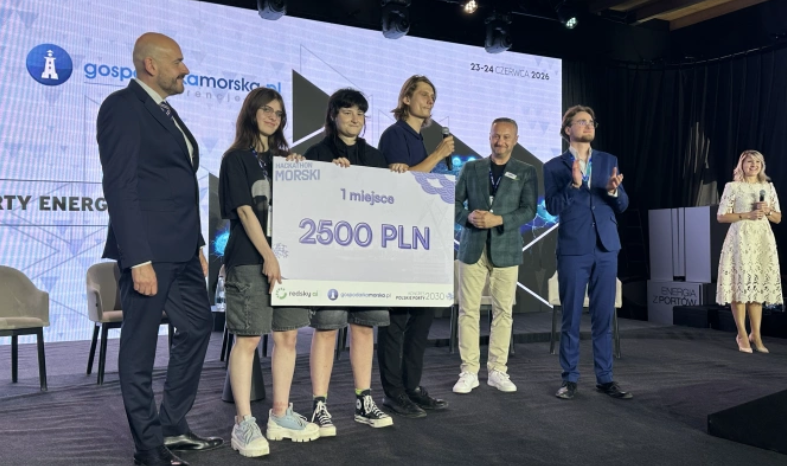


Real Challenges of the Maritime Industry, 24 Hours of Intensive Work, Modern Technologies and Artificial Intelligence – This Was the Hackathon Organized During the Polish Ports 2030+ Congress.
Real challenges from the maritime industry, 24 hours of intensive work, modern technologies, and artificial intelligence – this was the hackathon organized during the Polish Ports 2030+ Congress. The event was delivered by GospodarkaMorska.pl in cooperation with Red Sky, a technology studio with more than 20 years of experience in building innovative solutions and the creator of the global success RemoteMyApp, later acquired by Intel.
The hackathon took place over the two days of the Congress and brought together 32 students from across Poland, divided into 10 teams. Participants worked around the clock on challenges prepared by Congress partners representing the port, logistics, and maritime sectors. Their goal was to develop practical tools leveraging modern technologies, including artificial intelligence, to improve business processes.
“This year, we decided to place a special emphasis on technology. We are living through a period of tremendous transformation, and AI-based solutions are increasingly becoming part of both business and everyday life. We wanted to create a space where young IT specialists could tackle real industry challenges and propose concrete solutions,” emphasized Mateusz Kowalewski, organizer of the Polish Ports 2030+ Congress and publisher of GospodarkaMorska.pl.
Practical Solutions
As Kowalewski noted, the hackathon became a platform for cooperation between academia and representatives of businesses, ports, maritime terminals, and logistics companies. The result was a range of projects addressing genuine industry needs.
The solution developed by students from AGH University of Krakow for Maritime Agency Gdynia received the highest recognition from the jury. The project was rated most highly for its innovation, practical applicability, and implementation potential. The application integrates data exchange among all parties involved in the logistics process – the agency, cargo owners, and transport companies – with the entire process optimized using AI-powered tools.
“The hackathon demonstrated something that is often missing at conferences – the transition from discussion to action. In just 24 hours, participants tackled real challenges facing the maritime, port, and logistics industries. There was no unnecessary theory. Instead, there were concrete problems, creative ideas from young people, collaboration among specialists from different fields, and the use of modern technologies to build practical solutions,” said Michał Śmigielski, President of Maritime Agency Gdynia, in a social media post.
“Events such as the Maritime Hackathon show that the maritime industry and innovation are not two separate worlds. Our goal was to bring the unique energy and agility for which Red Sky is known in the technology market to the Congress,” said Damian Suchocki, organizer of the Hackathon. “As an organization, we have been building innovations for more than 20 years, which allowed us to combine our experience with the incredible energy and fresh perspective of the students. The participants carried out an enormous amount of technological work, while our team of mentors ensured that these ideas were immediately directed toward viable market applications. What makes us happiest is that the participants’ work does not end with attractive portfolio presentations but has real potential for business implementation,” added Suchocki.
More Than Just AI
According to Suchocki, the greatest value of the event was the opportunity to observe young people with diverse skill sets working together to create solutions with genuine business value in a very short time.
“This is where the true potential of innovation becomes most visible – not in presentations, but in action,” added Michał Śmigielski.
“These implementations significantly accelerate further technological development. We are not only talking about artificial intelligence. We are also talking about digitalization, automation, process robotization, and numerous aspects related to the energy transition, as well as the digitization of various solutions in ports and shipyards,” added Mateusz Kowalewski.
The organizers announced that technology development, process digitalization, artificial intelligence, and cooperation between businesses and universities will remain key priorities in future editions of the Polish Ports 2030+ Congress.
The Polish Ports 2030 Congress, together with the inaugural Maritime Hackathon, has now officially become part of history. The results were as follows:
🥇 1st Place: Team from AGH University of Krakow / AGH Skylink, led by Aleksander Kopyto
🥈 2nd Place: Team from Gdańsk University of Technology, led by Grzegorz Lange
🥉 3rd Place: Team from Maritime University of Szczecin, led by Aleksy Chojnowski
 DOWNLOAD PDF