

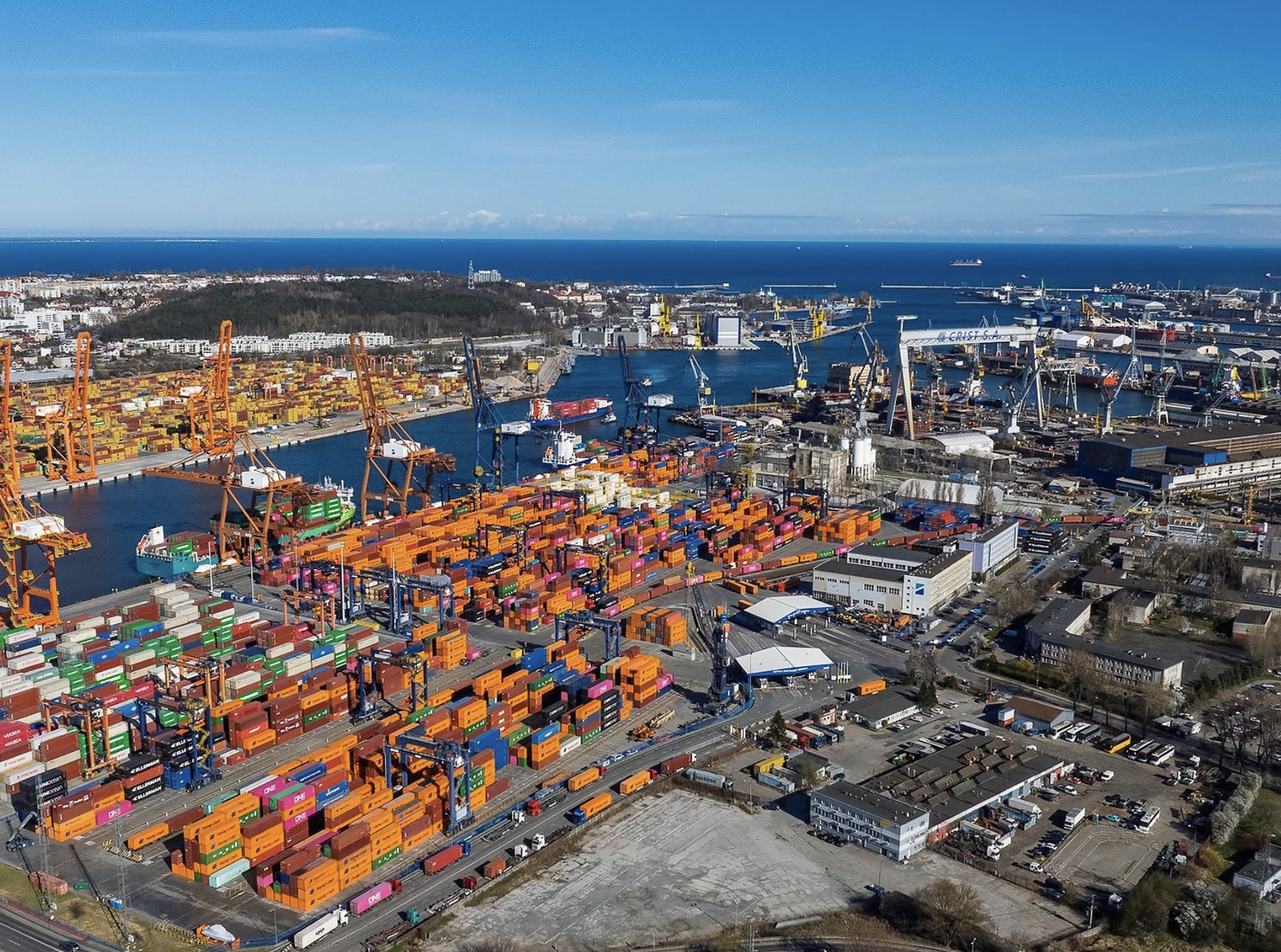


The Port of Gdynia has completed one of the largest modernisation projects in its history. With deeper waters, a wider port entrance and reconstructed quays, it is now able to handle the largest container ships operating in the Baltic Sea. The project involved twelve years of work and investment totalling more than PLN 1.28 billion. It formed part of a comprehensive overhaul of the port’s hydrotechnical infrastructure. The results of the project were reviewed on 8 October at a conference held at the headquarters of the Port of Gdynia Authority S.A.
The official completion of the project provided an opportunity to assess its significance for the future of the Port of Gdynia. Participants in the conference included Marcin Skwierawski, Deputy Marshal of the Pomeranian Voivodeship; Aleksandra Kosiorek, Mayor of Gdynia; Tomasz Augustyniak, Deputy Mayor of Gdynia; Katarzyna Zielińska-Heitkötter, Deputy Director of the Transport Strategy Department at the Ministry of Infrastructure; and Anna Stelmaszyk-Świerczyńska, Director of the Maritime Office in Gdynia. Representatives of institutions involved in the project, contractors and employees of the Port of Gdynia Authority S.A. also attended the meeting.
Over the past twelve years, the Port of Gdynia has undergone one of the largest modernisations of its hydrotechnical infrastructure. The work has resulted in the deepening of inner port waters to 15.9 metres, the widening of the inner entrance from 100 to 140 metres, and the construction of Turning Basin No. 2, with a diameter of 480 metres. The quays have also been reconstructed, including the nearly 800-metre-long Helskie Quay, whose modernisation was completed in June 2026. These investments now enable the Port of Gdynia to receive and handle container ships up to 400 metres long. The first such vessel, the container ship MSC Venice, called at the Gdynia port on 24 July 2026. Measuring 399 metres in length and with a capacity of 18,755 TEU, it was the largest vessel handled at the Gdynia port to date.
“The most difficult part of a project spanning such a long period is coordinating the preparation and securing of funding. When funding is obtained, certain schedules are established, but various problems emerge during construction. Some construction works proceed relatively smoothly, while unexpected difficulties arise in other tasks, for example in obtaining permits. We had an initial schedule in place, and we could not simply change it at will. Admittedly, the funding agreement was amended three times during the project. This is difficult for us, but also for the EU authorities, because each amendment entails around six months of additional work involving revised analyses and calculations, rescheduling and reallocating funds” – said Mariusz Karbowski, Head of the Projects Department at the Port of Gdynia Authority.
“The completion of this project confirms that we have chosen the right direction for the development of the Port of Gdynia. We are aiming to match the best in the maritime industry. Thanks to this investment, we can now accommodate the largest ships operating in the Baltic Sea, as demonstrated by the MSC Venice’s call in July. But our ambitions extend much further. We want to continue strengthening Gdynia’s position among the Baltic’s leading ports. Behind this success lie years of work and cooperation between numerous institutions, designers and contractors, and, above all, the tremendous commitment of the Port of Gdynia’s employees, who deserve special thanks” – said Piotr Gorzeński, President of the Management Board of the Port of Gdynia Authority S.A.
As ship sizes increased and global maritime transport changed, demands on port infrastructure also grew. Successive stages of the investment gradually removed restrictions on the size of vessels able to call at Gdynia. More than PLN 1.28 billion was allocated to the project between 2014 and 2026, including PLN 273 million in EU funding under the Infrastructure and Environment 2014–2020 programme. Completion of the project marks the end of an important phase in the development of the Port of Gdynia. The modernised infrastructure increases the port’s cargo-handling capacity, strengthens its competitiveness and creates the conditions for the development of direct ocean-going services.
“Twelve years of implementation does not mean twelve years of construction work. It includes the preparatory phase, concept development, preparation of design documentation, and obtaining the necessary approvals and permits. Paradoxically, this is where we spend most of our time. We know that these documents are extremely important and must be secured to ensure compliance with environmental requirements, regulations and standards, all of which takes a great deal of time. The actual implementation phase takes the least time, and that is what pleases us most. I am an engineer myself and supervised some of these projects, which was a real pleasure. Of course, there were challenges — I would not call them problems. There were situations that needed to be resolved, and thanks to the work of the entire team and cooperation with our neighbours, we managed to complete everything within budget, on schedule and to the required standard" – said Tomasz Wawrzyński, Director of the Asset Management Centre at the Port of Gdynia Authority.
Photo: Port of Gdynia Authority
 DOWNLOAD PDF