

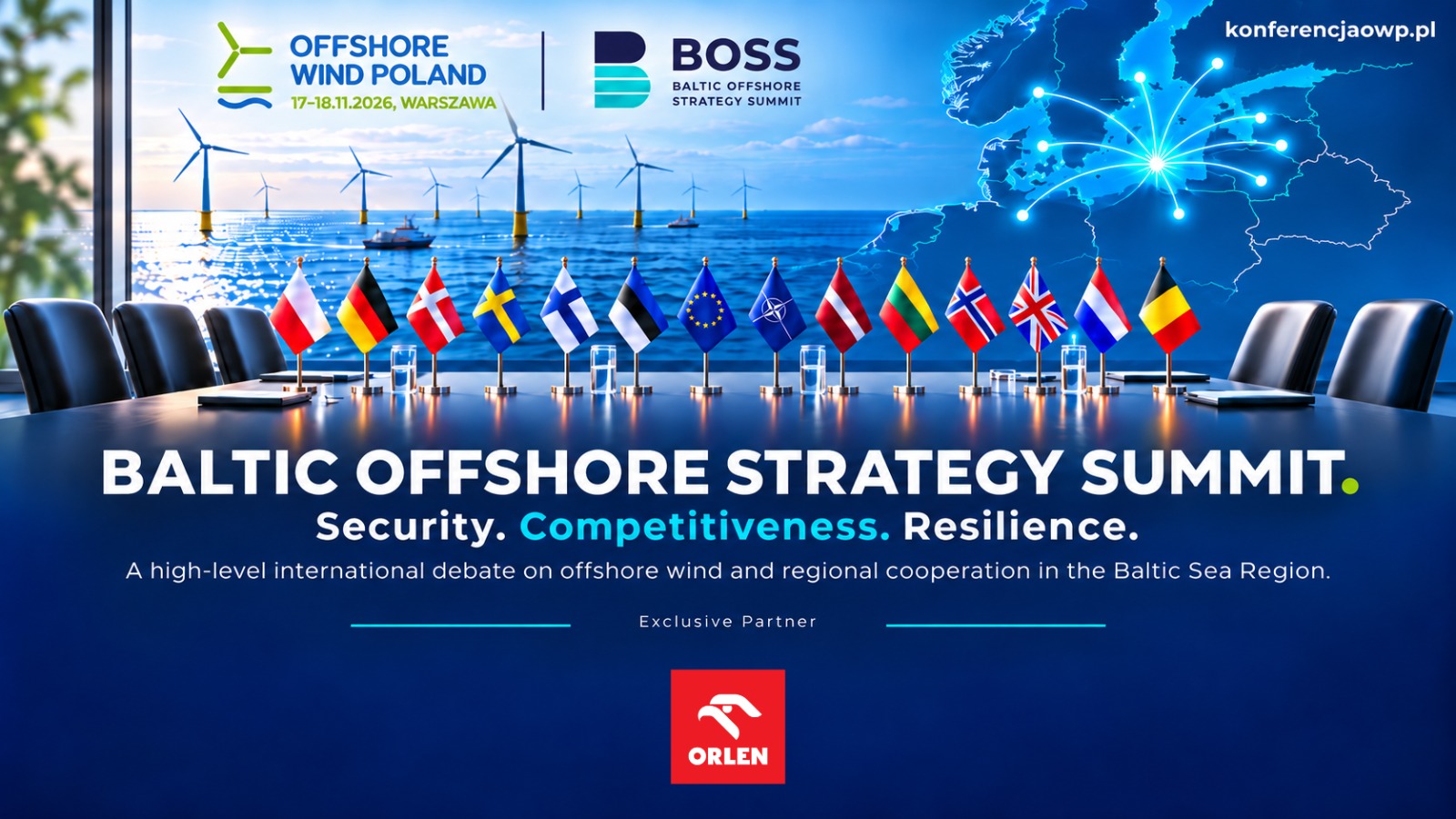


Ambassadors from the Baltic Sea region, government representatives, NATO and the European Commission, as well as offshore industry leaders, will meet in Warsaw on 17–18 November for the Baltic Offshore Strategy Summit (BOSS), held as part of Offshore Wind Poland 2026. The discussions in Warsaw will take forward the priorities identified by the business community on 3 September during the Baltic Energy Conference organised by ORLEN and translate them into a joint work plan aimed at closing the gap of around 12 GW between the Baltic region’s ambitions and its delivery prospects.
Poland, which is now bringing its first offshore wind farm into operation and already has around 5 GW of projects with final investment decisions, is becoming the host of talks on the future of offshore wind across the entire region. ORLEN is the exclusive partner of BOSS. In September this year, the company launched a cross-border dialogue initiative called the Baltic Energy Initiative, bringing together 13 partners from nine countries in the region. The summit is organised by the Polish Wind Energy Association (PSEW) and the Wind Industry Hub Foundation as part of Offshore Wind Poland 2026.
The countries of the Baltic Sea region have been building the political framework for offshore wind for years. Under the 2022 Marienborg Declaration, eight EU countries pledged to achieve at least 19.6 GW of offshore wind capacity by 2030, while the 2024 Vilnius Declaration set out plans to strengthen the region’s energy independence and develop renewable energy sources. However, ambitions are running ahead of delivery: around 2.8 GW is currently operational in the Baltic Sea, with a further 4.7 GW under construction. This leaves a shortfall of around 12 GW against the 2030 target, while development continues to rely on eight separate national project pipelines.
At the same time, North Sea countries signed an investment pact in Hamburg in January 2026, designed to mobilise nearly €1 trillion for 300 GW of capacity by 2050. The Baltic needs its own joint action plan – a programme running alongside, rather than competing with, the North Sea initiative. On the business side, the Baltic Energy Initiative, established by the ORLEN Group, is intended to provide such a platform.
“The Baltic has everything it needs to become, alongside the North Sea, the second pillar of Europe’s offshore wind industry: shallow and calm waters, favourable wind conditions and a growing industrial base. What it lacks is a common delivery plan. Today, eight countries are developing eight separate project pipelines, while investors and suppliers do not know where and when the next gigawatts will be built. Poland is implementing one of the largest offshore wind programmes in the region, and ORLEN’s involvement gives these discussions strong business backing. We are showing that we can turn plans into operational wind farms. Now we want the entire Baltic region to accelerate together with us,” said Janusz Gajowiecki, President of the Polish Wind Energy Association.
BOSS is the next stage in efforts to integrate offshore wind activities across the Baltic region under the Baltic Energy Initiative agreement, signed on 3 September 2026 by ORLEN and 13 partners from Poland, Sweden, Finland, Denmark, Lithuania, Germany, Estonia, Latvia and Norway. It is the first industry-led initiative of its kind, complementing the region’s intergovernmental cooperation framework. During an offshore wind roundtable held under ORLEN’s auspices at the Baltic Energy Conference, business representatives identified three key priorities: a realistic and continuous regional project pipeline; complementary industrial clusters and common standards; and coordinated Baltic-wide security and resilience arrangements.
The Warsaw summit is not intended to reopen these discussions. Instead, BOSS is expected to turn them into concrete outcomes. ORLEN, the summit’s exclusive partner, sees BOSS as a direct continuation of the work launched in September.
“Offshore investors in the Baltic need predictability above all: clear auction schedules, timely grid connections and access to installation ports. Only a continuous, realistic project pipeline across the entire region will enable suppliers to invest in new factories and reduce costs. Security is also essential, including the protection of offshore infrastructure such as wind farms and cables on the seabed of the Baltic Sea. If we address these issues together, the countries of the region will build their own competitive supply chain instead of competing for the same vessels, ports and components,” said Sławomir Staszak, ORLEN Vice-President of the Management Board for Energy.
Three priorities identified on 3 September, three roundtables
The summit will open on 17 November with a closed Ambassadors’ Session attended by ambassadors from, among others, Norway, Denmark, Finland, Estonia, Latvia and the Netherlands, representatives of Poland’s Ministry of Foreign Affairs and Senate, and the heads of offshore companies. Its aim is to establish a shared understanding among the administrations of the countries in the region of the priorities identified by the business community.
Three roundtables will take place on 18 November. Each will address one of the priorities identified by the Baltic Energy Initiative and is intended to produce a concrete outcome to guide further work on trans-Baltic integration:
Political: continuing the priority of establishing a realistic and continuous project pipeline. Discussions on cooperation between regional countries to strengthen energy security and the possibility of a Baltic Offshore Wind Pact are expected to result in agreement on the scope of a comparative review of projects across the region.
Security and defence: advancing the priority of coordinated Baltic-wide security and resilience arrangements. Discussions on the protection of critical infrastructure in the Baltic Sea, involving representatives of NATO, Poland’s Government Centre for Security (RCB) and NASK, among others, are intended to identify common recommendations on infrastructure protection, cybersecurity and civil-military coordination.
Industrial: addressing the priority of complementary industrial clusters and common standards.
Discussions on the competitiveness of the European supply chain and the industrial specialisations of countries in the region are expected to define the scope of a mapping exercise covering industrial capabilities and supply-chain gaps.
During Offshore Wind Poland 2026, industry organisations from the region will sign a Memorandum of Understanding on cooperation on the Baltic Offshore Wind Industrial Strategy. The agreement, which follows directly from the priorities identified at the September roundtable, will be open to additional companies. The process will be coordinated by PSEW, with decisions taken by consensus.
Offshore Wind Poland 2026 will take place in Warsaw on 17–18 November. The event is organised by the Polish Wind Energy Association. Further information: https://konferencjaowp.pl/
 DOWNLOAD PDF
