

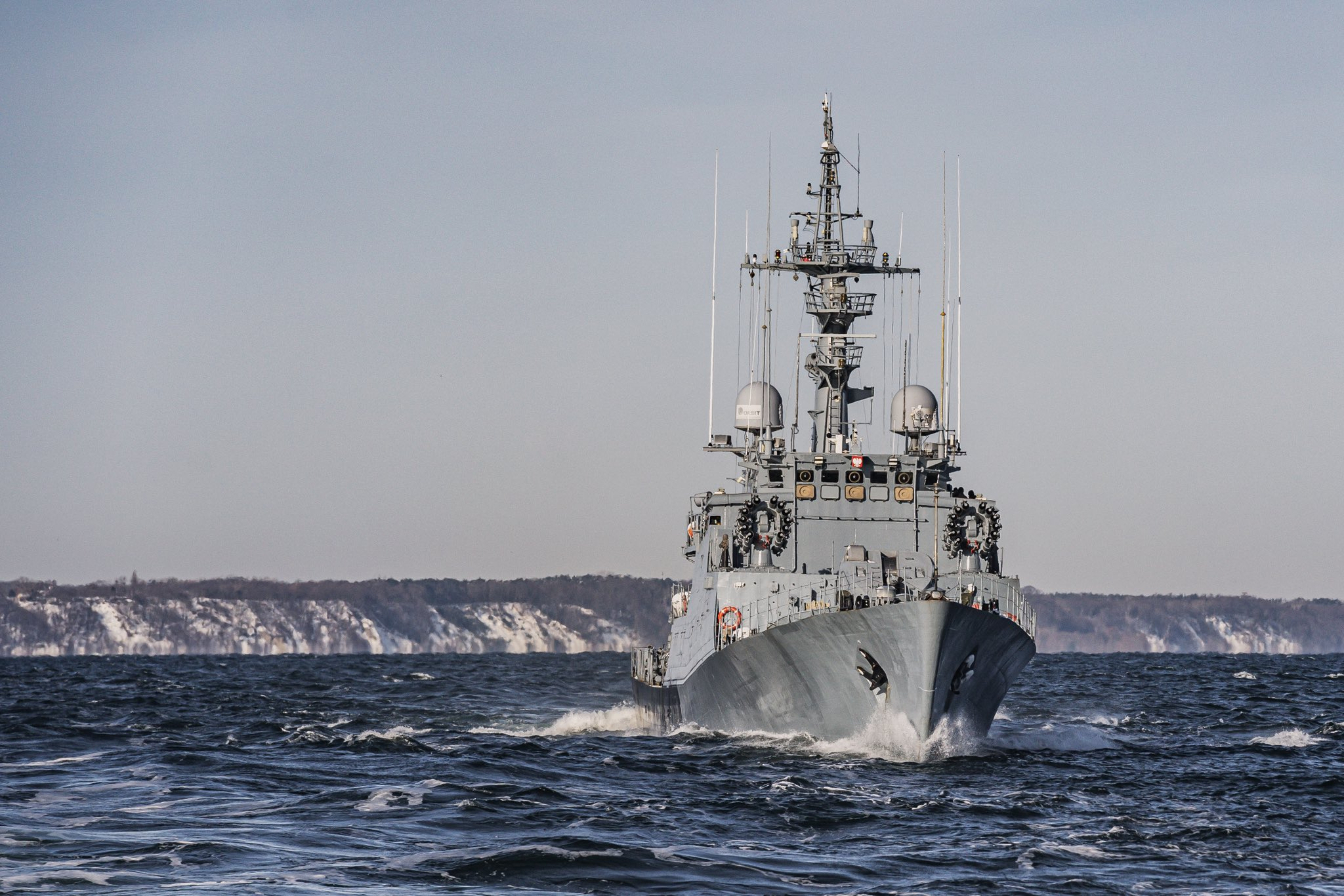


During yesterday’s joint sitting of the Sejm’s Committee on Maritime Economy and Inland Navigation and the National Defence Committee, Members of Parliament were briefed on the progress of the Polish Navy’s key modernisation programmes: Miecznik, Orka and Delfin. Much of the discussion centred on domestic industrial participation, technology transfer and the so-called interim submarine capability, but ultimately focused on the future armament configuration of the Orka-class submarines.
The joint committee session, scheduled to begin at 11:30, commenced nearly an hour later. Although representatives of the Ministry of Infrastructure and the Ministry of National Defence had been expected, neither attended. Present, however, were Rear Admiral Włodzimierz Kułagin, Head of the Armaments Directorate of the Naval Inspectorate within the General Command of the Armed Forces; Jan Grabowski, Vice-President of the Polish Armaments Group (PGZ); and Commander Artur Chudziński of the Armament Agency.
Rear Admiral Kułagin delivered a concise briefing on the Orka, Miecznik and Delfin programmes. With regard to Orka — the acquisition of three next-generation submarines capable of prolonged submerged operations and covert strike missions — he reiterated the publicly known decision to select the Swedish offer from Saab Kockums. He confirmed that the Swedish partner will provide Poland with an interim “bridging” submarine to be operated pending delivery of the first newly built unit. Negotiations with the Swedish side are ongoing within the Armament Agency and are expected to conclude by June 2026.
The new submarines, based on the A26 design, are to be constructed with the participation of the Polish supply chain. A key objective is to establish domestic maintenance and support capabilities within Polish shipyards. To accommodate the future fleet, quay infrastructure at the Naval Port in Gdynia has already been upgraded.
Rear Admiral Kułagin further stated that the interim “gap filler” submarine — a used A17-class boat — will be transferred to Poland by the end of 2027, following crew training. The vessel is described as fully operational and combat-ready. Talks with Sweden are currently under way regarding the commencement of training cycles. The Navy anticipates training one full crew, “possibly a second reserve crew”. Once the first new A26 submarine is delivered, that crew will transition to the new platform, and the A17 will return to Sweden.
The Miecznik programme is considerably more advanced. Rear Admiral Kułagin outlined not only the current status of works but also infrastructure investments at PGZ Stocznia Wojenna necessary for frigate construction. He confirmed that the launch of ORP Wicher, the first vessel in the class, is scheduled for 12 August this year. Construction of the third frigate, ORP Huragan, is due to commence in July.
According to Kułagin, one of the most efficiently executed naval projects is Delfin — the construction of two signals intelligence vessels awarded to Saab Kockums and being built at Remontowa Shipbuilding in Gdańsk. Both hulls — the future ORP Jerzy Różycki and ORP Henryk Zygalski — have already been launched, with the first currently undergoing outfitting.
Jan Grabowski of PGZ added that Miecznik represents the largest modernisation undertaking in the history of PGZ Stocznia Wojenna and serves as a significant industrial driver for subcontractors, academia and the city of Gdynia. The programme has entailed substantial shipyard investments and comprehensive technology transfer, encompassing not only ship construction but also design processes, contracting and production management. Since the programme’s inception, employment at the yard has doubled. As of 26 January 2026, domestic industrial participation in Miecznik stood at 40 per cent, although the methodology for calculating this figure was not specified.
Members of Parliament — primarily from the National Defence Committee — sought further details on individual projects. The most contentious issue, raised by Andrzej Szewiński, concerned the potential arming of the Orka submarines with cruise missiles. Rear Admiral Kułagin stated that such weapons are not currently envisaged as part of the baseline armament package, though their future integration has not been ruled out, as the platform design provides space for them.
MP Michał Jach criticised this approach as a waste of taxpayers’ money, arguing that cruise missiles constitute a key deterrent capability that should be integral to Poland’s submarine force. He pointed to a 2017 presidentially endorsed strategic document stating that submarines without cruise missile capability would be of limited utility in Poland’s strategic circumstances. Rear Admiral Kułagin and Commander Chudziński responded that cruise missiles had not been included in the initial requirements formulated on the basis of General Staff guidance. They also noted that Poland participates as an observer in the development of the NSM Sub Launch system by Kongsberg Defence & Aerospace, which could potentially be considered during negotiations. Further details on the negotiations are expected in mid-March, when the Swedish side is due to respond to the formal negotiation questionnaire.
Beyond broadly framed assurances regarding technology transfer and repeated statements that the announced Miecznik frigate milestones remain on schedule, the relatively small group of MPs and invited participants also received information on the prospective embarked helicopter for the frigates. In response to a question from MP Andrzej Śliwka, Commander Chudziński stated that the matter is being handled by the Air Technology Inspectorate, with capability requirements currently under definition. The final document is expected by mid-year.
Witold Zembaczyński also raised the Ratownik programme, which envisages the construction of a vessel intended to support submarine operations. Rear Admiral Kułagin acknowledged that Ratownik is a critical capability, though not limited solely to submarine support. The vessel is intended to provide assistance to a range of platforms operating in its vicinity or from its deck. It will also deliver a deep-diving support capability, currently available within the Navy only to a limited extent, with divers forming part of its complement. Kułagin added that the programme has attracted notable international interest, and that Sweden has expressed preliminary interest in acquiring one such unit in connection with the Orka contract.
 DOWNLOAD PDF