

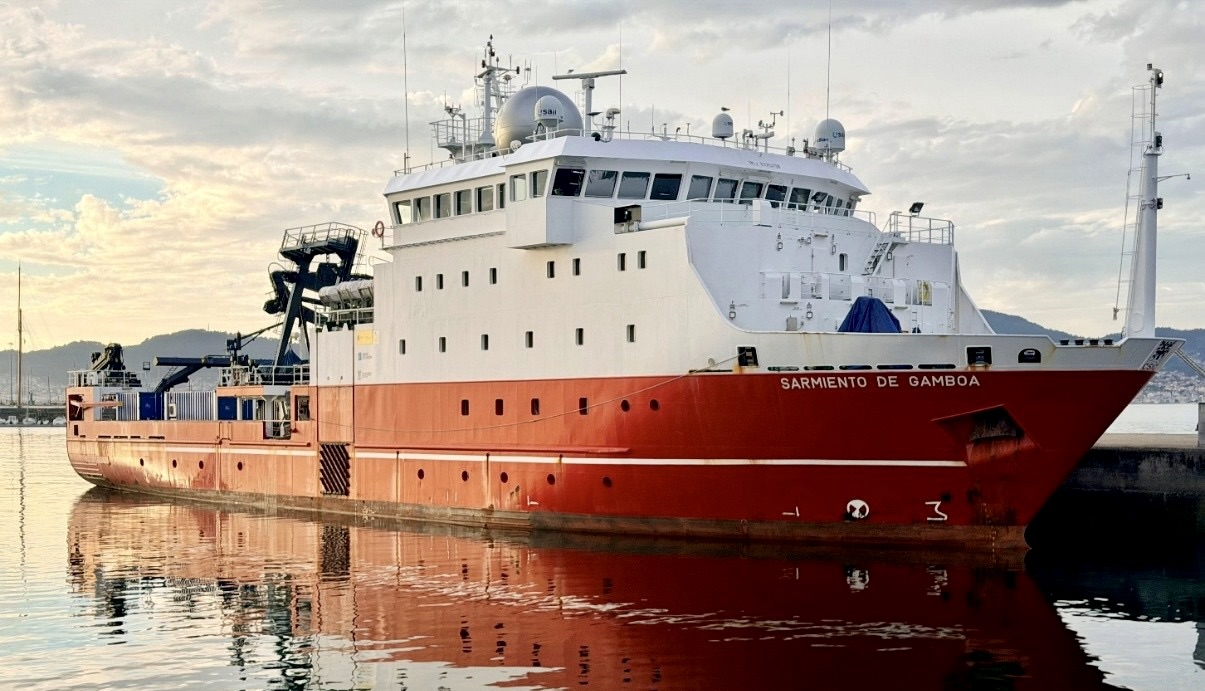


An international expedition, Atlantis-2, involving researchers from the Polish Geological Institute – National Research Institute (PIG-PIB), has begun research activities in the Atlantic. The scientists are focusing on the exploration and identification of mineral deposits rich in metals. Following a seven-day transit from the port of Vigo in north-western Spain, the oceanographic campaign reached the research area aboard the Spanish multipurpose research vessel Sarmiento de Gamboa and began its work.
“The research expedition entitled ‘Exploration of Deep Geobiosystems of the North Atlantic, Mid-Atlantic Ridge – ATLANTIS-2’ (Leg 3 & Leg 4) is being conducted in cooperation between the Polish and Spanish geological surveys within the Polish contract area on the Mid-Atlantic Ridge, awarded under an agreement with the International Seabed Authority (ISA), and is focused on the exploration and identification of massive sulphides. The work provides a foundation for understanding these deep-water ecosystems and is also part of the assessment of marine resources in the context of diversifying sources of critical raw materials in the future,” researchers from the Polish Geological Institute – National Research Institute said.
The expedition involves 31 scientists. In addition to the Polish researchers, the international team includes experts from Instituto Geológico y Minero de España (CSIC-IGME), Unidad de Tecnología Marina (UTM-CSIC), Estrutura de Missão para a Extensão da Plataforma Continental (EMEPC), Instituto Volcanológico de Canarias (INVOLCAN), University of Lisbon (Ulisboa), Instituto Dom Luiz (IDL), University of Göttingen (GAU) and University of São Paulo (USP).
The scientific team is led by specialists in marine geology and deep-sea exploration: Dr Francisco Javier González Sanz (CSIC-IGME) and Dr Michał Tomczak (PIG-PIB). Captain Pablo Andrade (CSIC-UTM) is responsible for safely navigating the vessel through the Atlantic swell.
Research area
The expedition has been divided into two key stages. Leg 3 began on 22 August and will continue until 18 September, while Leg 4 will run until 17 October this year. The expedition route is defined by the ports of Vigo in Spain and Horta in Portugal’s Azores, where the scientific crew will be exchanged.
The PIG-PIB research team comprises Michał Tomczak and Łukasz Smajdor for Leg 3, and Bartosz Kotrys and Weronika Wierny for Leg 4.
“The current expedition directly continues and expands on research initiated and carried out by PIG-PIB in 2022–2023 using onboard equipment and advanced autonomous underwater vehicles (AUVs). The scientists will investigate the unique structures discovered at that time, including Oceanic Core Complexes (OCCs) and active and inactive hydrothermal systems associated with accumulations of polymetallic massive sulphides and unique ecosystems,” the researchers said.
They added that one of the key objectives of the current campaign is to investigate the famous Lost City and Broken Spur hydrothermal systems, located several hundred metres below the surface of the Atlantic Ocean.
“Depending on weather and sea conditions, we will collect unique data and research samples from around 15 research stations in total and produce detailed photographic and video documentation of locations whose unique physicochemical conditions are regarded as natural analogues of environments in which the first life on Earth may have originated.”
Technology on board
During the expedition, the scientists will use a broad range of modern research tools and methods. Sound waves will be used to create three-dimensional maps of the seabed, “scan” the water column and sediments, and measure ocean currents.
A CTD rosette, a set of sensors lowered on a cable, will enable samples to be collected from the water column and hydrothermal areas. The device will also be used to measure, among other things, concentrations of methane, pH and CO2, as well as to trace signs of life.
“Plankton and sediment samples, together with analysis of eDNA dispersed in the water, will make it possible to detect organisms invisible to the naked eye. Sampling devices and the underwater robot will in turn recover fragments of sediments and rocks, including material originating from even deeper layers of the Earth’s crust,” the researchers explain.
The collected data and research samples will undergo processing and initial analysis in the vessel’s onboard laboratories.
A key role in direct observation of the seabed and sample collection will be played by Luso, a remotely operated underwater vehicle (ROV) operated by Portugal’s EMEPC. The vehicle, which operates like an underwater drone connected by a cable, is capable of descending to a depth of 6,000 metres.
“Thanks to its 4K cameras, we will be able to view the seabed almost in real time, while two mechanical arms and a special vacuum sampler will allow us to carefully collect samples of rocks and organisms during a single dive. The robot also carries a mini-laboratory equipped with sensors measuring temperature, oxygen, turbidity, methane and CO2, meaning that Luso effectively serves as a geologist, biologist and chemist during a single dive,” the experts conclude.
LIVE broadcast from the Atlantic seabed
During the expedition, a LIVE broadcast is being transmitted directly from the seabed of the Atlantic Ocean. Thanks to the 4K cameras mounted on the Luso ROV, everyone interested will be able to observe unique ecosystems, extraordinary geological formations and the research work being carried out directly in real time, together with the scientists.
You can follow the expedition's live broadcasts here.
Photo: PIG-PIB/Facebook
 DOWNLOAD PDF