

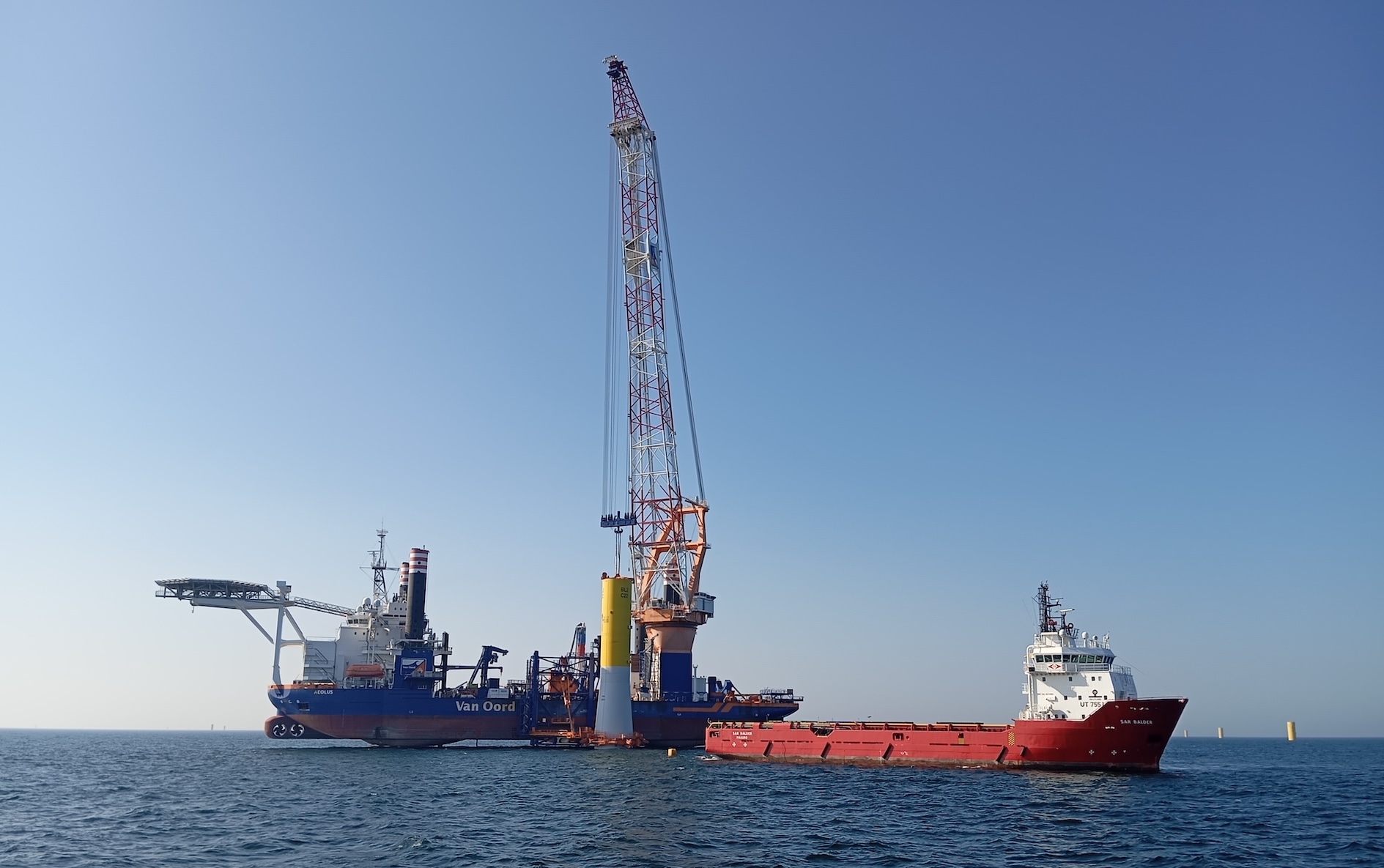


Work on the offshore construction site where the Baltica 2 offshore wind farm is being built is continuing unabated. The foundation installation campaign has recently been officially completed, with a total of 111 monopiles installed in the Baltic Sea. Gospodarka Morska was able to observe the installation of monopile No. 100 at close quarters.
At the end of August, PGE and Ørsted announced that, in line with the schedule, the installation of 111 foundations for wind turbine towers and offshore substations at the Baltica 2 offshore wind farm – the largest wind farm currently being built in Poland – had been completed. Gospodarka Morska had the opportunity to observe the entire process at close quarters from the water. We watched the installation of the 100th monopile, as well as the installation of the so-called secondary steel, the equipment that must be installed inside the foundation.
The installation of foundations for wind turbine towers is one of the most complex and critical stages in the construction of any offshore wind farm. At Baltica 2, being developed by Polska Grupa Energetyczna and Ørsted, as with the vast majority of similar projects currently under construction around the world, the foundations take the form of monopiles – huge steel tubes, often widening towards the base. They are driven several dozen metres into the seabed. Given the depth of the water in which they are installed and the need to drive them deep into the seabed, the monopiles at Baltica 2 are up to 100 metres long. Their diameter ranges from 7.5 to 10.5 metres, while an individual monopile can weigh as much as 1,900 tonnes. Moreover, each foundation may be slightly different, depending on the specific characteristics of the exact location where it is to be installed at sea.
Monopile installation is a complex process. These huge structures, made up of several modules, are transported to the offshore construction site by tugboats. The monopiles are sealed at both ends with special steel caps, then placed in the water, where they remain afloat thanks to their own buoyancy, and towed beneath the installation vessel. During a voyage organised by Ørsted and PGE aboard the CTV Manor Vulcan, we were able to observe the entire process at close quarters. The 139-metre-long jack-up installation vessel Aeolus was already positioned at the site where the 100th monopile was to be installed. The four long legs of the vessel, operated by Van Oord, had been lowered and were lifting the hull slightly above the water, keeping the vessel stable in the designated position throughout the operation. Once the monopile had been delivered alongside the installation vessel, its large crane lifted the foundation into a vertical position. It then slowly lowered it into the water before finally lowering a special tool onto it, which drove the monopile into the seabed so that it was embedded several dozen metres into the ground. The entire procedure proceeded surprisingly quickly, considering the scale of the operation and the dimensions of the foundation.

Another vessel assisted Aeolus at the installation site, responsible for protecting the area with the use of a so-called bubble curtain. Its purpose is to limit the propagation of noise through the water during monopile driving. This is necessary to avoid disturbing marine fauna in the surrounding area. The curtain itself is simply a wall of air bubbles released from a special hose laid around the seabed area where the operation is taking place. The bubble curtain acts as an acoustic insulator and damper – the energy of the sound wave travelling through the water is rapidly reduced, while the wave itself is largely reflected back towards its source. What travels further is dispersed: rather than one powerful sound wave, there are countless smaller waves with significantly less energy, spreading in all directions. Similar systems are used, among other places, in rivers and other bodies of water, where they can not only reduce noise but also capture pollutants and waste. They also look impressive, which is why bubble curtains can also be found in aquariums.
It is worth adding that Aeolus was not the only vessel involved in the installation of the foundations at Baltica 2. A substantial part of the work was also carried out by one of the world's largest crane vessels, the impressive Svanen, which has been based in Gdynia for some time for the duration of its operations in the Polish Baltic Sea. Like Aeolus, it is operated by Van Oord.
Monopile installation is, of course, only one stage in the construction of a wind turbine. The next stage involves installing additional steel structures on and inside the foundation. At Baltica 2, this work is being carried out, among others, by the specialist vessel Lone. The 160-metre heavy-lift cargo vessel transports a set of equipment from the installation port that must be installed inside the foundation. These include anode cages and so-called boat landings – structures used for mooring vessels alongside wind turbine towers. Both types of structures for the Baltica 2 project were manufactured by Gdańsk-based Grupa Przemysłowa Baltic, which is currently undergoing rebranding and is about to return to its historic name, Stocznia Gdańska. More than 400 additional steel structures for the wind farm's foundations also include external platforms and suspended internal platforms. The latter were manufactured by Smulders. They were produced in Żary and transported to the installation port from Świnoujście, where their final assembly was carried out in a makeshift hall built from containers. The external platforms for Baltica 2, meanwhile, arrived by sea all the way from Setúbal in Portugal. All these components, arriving from different locations, were first gathered at the installation port in Rønne on Bornholm. From there, they are loaded onto vessels responsible for transporting and installing them, such as Lone.

From the deck of Manor Vulcan, we watched as Lone lowered a special tool over a monopile protruding several metres above the waterline. The device, which enclosed the top of the monopile, climbed up the upper section of the foundation like a spider. Once all the work had been completed, the machine was lowered back onto Lone.
As Mieszko Stępień, a project manager working on the Baltica 2, explains, the foundations extend approximately 12 metres above the sea surface. A concrete flange is installed on top of them, positioned around 20 metres above the water. Special internal platforms are installed inside the monopiles, with cables used to export the electricity generated by the turbine also routed through them. Only then will the wind turbine tower be installed on the flange, followed by the nacelle and blades at its top – the wind turbine itself.
PGE and Ørsted plan to complete the installation of additional steel structures on the foundations by the end of this year. Preparations are already under way for the next stages of the project: the installation of offshore substations and export cables, which is also due to take place this year, as well as inter-array cables connecting the individual components of the wind farm and the turbines themselves, which we will see being installed in 2027. In fact, the first fully completed turbines are due to be commissioned in the first half of next year, meaning that the first joules of electricity generated by the Baltica 2 offshore wind farm will then flow into the grid. Full commercial operation of the wind farm is planned by the end of 2027.
Baltica 2, which is being built approximately 40 km off the coast at the level of Ustka, is not only an offshore construction site – the project also includes onshore infrastructure. From the perspective of transmitting electricity to the national grid, the most important element is the grid connection infrastructure. It is being developed in Osieki Lęborskie, in the Choczewo municipality. This comprises not only underground cable lines, but also an onshore transformer substation. The latter will receive electricity transmitted ashore from the offshore substations and then feed it into the grid.
At the interface between sea and land, in the port of Ustka, an operations and maintenance base is also being built by PGE Baltica, which will be responsible for servicing Baltica 2 during its operational phase. On the western bank of the Słupia River, on a site covering more than 2.3 hectares, an administration building and a warehouse, a manoeuvring yard and, above all, a quay for vessels working on Baltica 2 and transporting technicians to the wind farm are being constructed. All of this infrastructure in Ustka is due to be completed by the end of 2026. At the same time, during construction, Baltica 2 is using a small base in Łeba, where the CTV base serving the project has been established.

Photos: GospodarkaMorska.pl
 DOWNLOAD PDF