

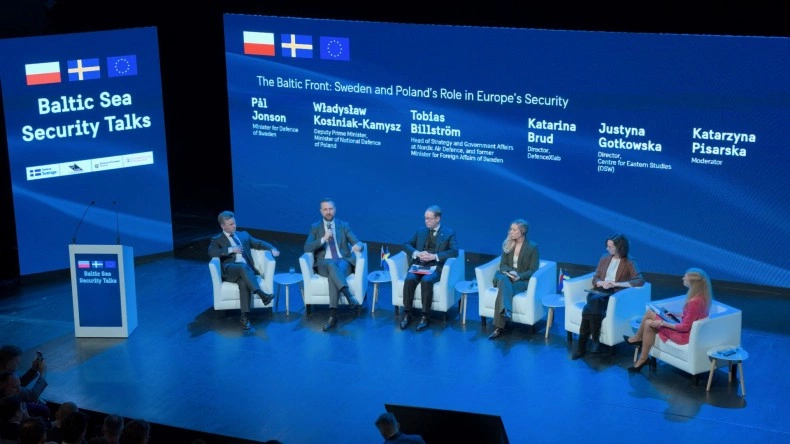


A conference devoted to the security of the Baltic Sea region and Polish-Swedish defense cooperation was held at the Wybrzeże Theatre in Gdańsk on March 12th. The event brought together representatives of the defence ministries, senior military personnel, and executives from maritime, defence and technology companies from both countries. Also in attendance was King of Sweden Carl XVI Gustaf. The conference was organised by the Kazimierz Pułaski Foundation.
The conference, entitled “Baltic Sea Security Talks: Strengthening the Polish-Swedish Strategic Partnership”, gathered representatives from government, security institutions and industry in Poland and Sweden. The programme included high-level addresses and panel discussions focusing on the role of Poland and Sweden within Europe’s security architecture, as well as the development of bilateral defence cooperation.
Discussions also addressed the consolidation of the Polish-Swedish partnership in defense and security, closely linked to the strategic geography of the Baltic Sea, and the need to further deepen cooperation. Panel debates examined the evolving global and European security environment, with particular emphasis on the shared security interests of Sweden and Poland in the Baltic Sea region, as well as the prospects for the Swedish and Polish defence industries.
Prior to the event, the defence ministers of Poland and Sweden — Władysław Kosiniak‑Kamysz and Pål Jonson — visited the Naval Port Gdynia, where a press conference was also held. The choice of venue was symbolic: shortly beforehand, the Swedish submarine HMS Uppland had entered Gdynia and berthed alongside the Polish Navy submarine ORP Orzeł.
The gesture was intended to underline that both governments are expected to sign, later this year, an agreement for the delivery of new A26 Blekinge‑class submarines to the Polish Navy under the Orka submarine programme. The future submarines are expected to be based at the Naval Port in Gdynia, serving within the Submarine Squadron of the 3rd Ship Flotilla.
The Kazimierz Pułaski Foundation emphasised that the Baltic Sea Security Talks align with one of its key priorities for 2026: the development of the Nordic-Baltic-Black Sea format as an operational axis for regional cooperation. In this context, the conference is intended to serve as one of several platforms for dialogue supporting the coordination of regional policies and initiatives aimed at strengthening the strategic resilience of Central and Northern Europe, with particular focus on the Baltic Sea basin.

“Our shared Polish-Swedish strategy is full commitment to the Transatlantic Alliance, ensuring the continued presence of the United States in Europe and in Poland, and expanding that presence wherever possible. This is absolutely clear and necessary. There is no NATO without the United States. Anyone imagining NATO without the US is mistaken. Likewise, the United States cannot maintain its position as a global military power without its role in NATO and its leadership within the Alliance. Today we are the most dynamic part of Europe in terms of defence, and we should remain a beacon for the whole continent, setting the direction for military modernisation and security building. Poland and Sweden are today setting the tone in Europe and NATO for how to build partnerships, strengthen resilience, understand threats and respond to them" –Władysław Kosiniak‑Kamysz said during the conference.
On the same day, Polska Grupa Zbrojeniowa signed a Memorandum of Cooperation with the Swedish defence group Saab, marking a step towards developing industrial partnership in connection with the planned modernisation of the Polish Navy and the acquisition of submarines under the Orka programme.
The initiative reflects the shared objective of the signatories — PGZ S.A., PGZ Stocznia Wojenna, Stocznia Remontowa Nauta, Centrum Techniki Morskiej, and Saab — to develop modern and sustainable competencies in the maintenance and lifecycle support of the A26-class submarines offered by the Swedish side. These capabilities are also intended to provide the foundation for Poland’s future sovereign maintenance capacity.
Following the agreement with PGZ, Saab also concluded a similar cooperation arrangement with WB Group, a private Polish defence technology group supplying advanced systems to both domestic and international markets.
“The signing of these new agreements with PGZ Group and WB Group represents an important milestone in strengthening cooperation between the Polish and Swedish defence industries. By sharing expertise and jointly developing innovation, we can ensure the advancement of cutting-edge solutions and capabilities that will contribute to security and stability in Europe and the Baltic Sea region” — said Micael Johansson, President and Chief Executive Officer of Saab.
The key objective of the partnership is to create the conditions for building and developing specialised technical, organisational and industrial infrastructure that will ultimately form the basis of Poland’s domestic service and maintenance capabilities for the next generation of submarines. By harnessing the synergy of expertise from both companies, the initiative also offers an opportunity to strengthen the industrial base across the Baltic Sea region.
The integration of knowledge, experience and technological resources will enable the development of enduring capabilities, forming the foundation for sustainable growth and long-term benefits for both sides.
 DOWNLOAD PDF