

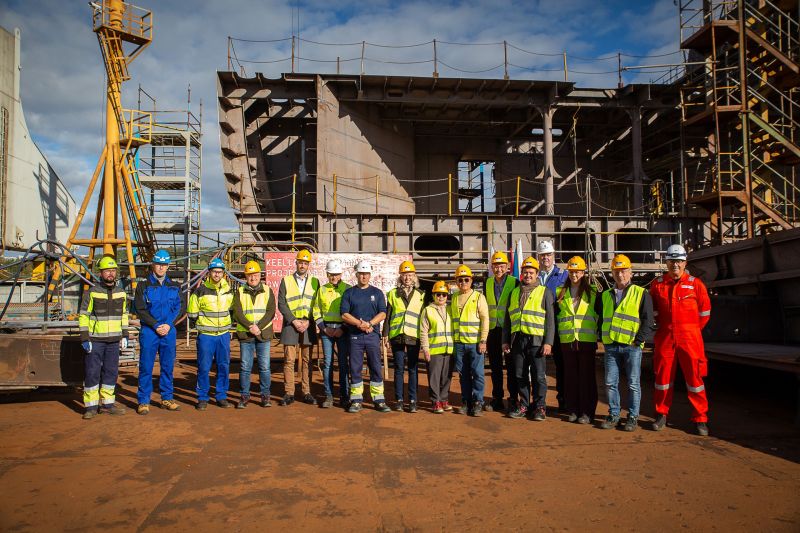


CRIST S.A. shipyard in Gdynia has completed another stage in the construction of one of two cable-laying vessels ordered by OMS Group. Norwegian shipbuilder Ulstein, the main contractor, announced that a keel-laying ceremony for the vessel designated NB328 had taken place at the Gdynia yard.
The construction follows an order announced in January this year. Swedish company OMS Group plans to acquire two new cable-laying vessels for offshore industry contracts. The vessels are scheduled to be built and delivered to the customer by 2028.
Norwegian shipbuilder Ulstein is the main contractor for the project. Under a long-standing partnership, the hulls will be built, launched and partially outfitted at CRIST S.A. in Gdynia. The cable-laying vessels will then be taken to Norway for further outfitting and sea trials before being handed over to the customer.
“The keel laying marks the point at which a vessel begins to take shape, becoming something more than just drawings and steel. It is an important milestone, and we are pleased with the progress made on the construction during our visit to Gdynia" – said Datuk Lim Soon Foo, President of OMS Group.
The planned cable-laying vessels are based on the ULSTEIN SX252 design, developed by Ulstein Design & Solutions. Each vessel will be 130 metres long and 22 metres wide. Accommodation will be provided for 75 people, including crew members and personnel carrying out subsea operations. Onboard cable carousels will enable the vessels to carry up to 6,500 tonnes of cable.
The vessels will also feature a large, open deck designed to accommodate remotely operated vehicles (ROVs) and containers, as well as a 50-tonne A-frame equipped with a towing winch. They will be fitted with a dynamic positioning system, enabling them to maintain a stable position during operations requiring them to remain in one place. This will also enhance safety and operational capability, including in more challenging sea conditions.
Once delivered, both cable-laying vessels will be used to support the installation and maintenance of subsea fibre-optic networks. The project is intended to provide the necessary installation capabilities while complying with stringent requirements for sustainability in the maritime industry and reducing CO₂ emissions.
The contractor emphasises that the vessels will be equipped with state-of-the-art engineering solutions and designed for high operational efficiency. This will enable them to carry out contracts involving the installation of subsea fibre-optic infrastructure effectively while minimising their environmental impact.

Photos: Ulstein Verft
 DOWNLOAD PDF