

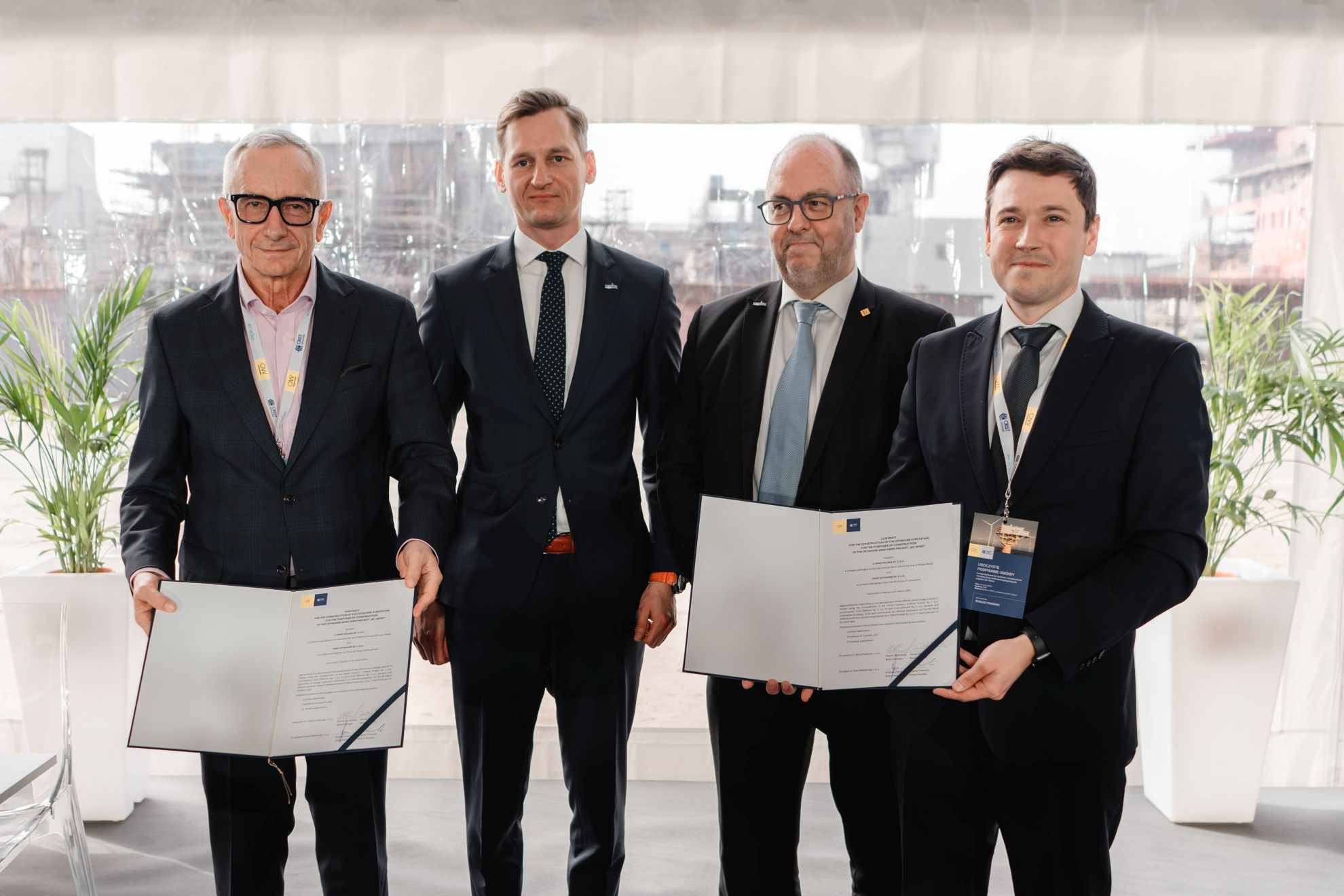


Ocean Winds, developing the BC-Wind offshore wind farm in Polish waters, has signed a contract with Gdynia-based CRIST Offshore for the design, construction, and commissioning of an offshore electrical substation. With this agreement, CRIST Offshore assumes the role of a Tier 1 supplier for the offshore market, occupying the highest level in the supply chain.
The official signing of the contract for the design, construction, and commissioning of the offshore electrical substation for the BC-Wind farm developed by Ocean Winds took place during a ceremony at the CRIST shipyard on the last day of March. The event brought together a large group of stakeholders involved in the development of Polish offshore wind energy, as well as local and central authorities. This is not surprising—everyone emphasized that the agreement represents a significant milestone for the entire industry. It is not merely another contract required for the BC-Wind launch but opens entirely new doors for the Polish shipbuilding market, demonstrating that Polish companies can act as Tier 1 suppliers, signing contracts directly with developers rather than solely participating in the supply chain.
“This is a breakthrough event because, for the first time in the history of the Polish offshore wind industry, a Polish contractor will be responsible for nearly the full scope of work related to the delivery, turnkey handover, and commissioning of an offshore substation for the BC-Wind farm,” emphasizes Jakub Budzyński from the Polish Offshore Wind Energy Chamber.
The offshore electrical substation ordered by Ocean Winds is the heart of the wind farm. Mounted on a monopile, the structure will collect energy generated by the wind turbines, transform it to 275 kV, and transmit it to shore via the export cable. During the conference, attendees were given a brief presentation on the still-under-design substation, which CRIST Offshore will construct. The substation will be equipped with a power transformer converting energy from 66 kV to 275 kV, an emergency power source, fire protection and ventilation systems, and a range of safety systems. It will be unmanned, meaning it will not have permanent staff on site—technicians will visit for maintenance and any necessary repairs. The full structure will measure approximately 30 x 20 x 20 meters, roughly the size of a multi-story building, and will include five decks: a lower technical deck, cable deck, main deck, first deck, and roof deck. The roof will provide a helipad for emergency or sea-inaccessible personnel transfers. The substation’s estimated mass is about 2,000 tons.

“CRIST Offshore participated in a fully open tender process but had already demonstrated its capability to deliver infrastructure, including significant offshore project infrastructure. The Polish industry has also proven itself in other offshore wind projects in Europe, including for Ocean Winds, which allowed us to advance them to the next stage. We went through the full early-stage project evaluation, competence verification, review of previous projects, and assessment of their ability to safely and timely deliver, before making our selection,” explains Dan Finch, Country Manager for Ocean Winds in Poland. He emphasizes that Ocean Winds values local content, but it must also be economically viable. “Simply choosing local suppliers if they are too costly does not work in the long term—we’ve tried that in other countries. This is also an opportunity for CRIST because if they are economically competitive with us, they can also be competitive on other international projects, both with Ocean Winds and other developers.”
Choosing a completely new Tier 1 supplier carries risks for the client, but Dan Finch remains confident. “Banks financing the project need assurance that the selected company will meet all requirements—adhere to the schedule, meet technical specifications, etc. There is an element of risk, but CRIST has 35 years of experience. We must trust that they will deliver as promised, and that’s what we evaluate during the tender stage. If the project succeeds, it will be an excellent showcase for the rest of Europe and the world. That’s the biggest reward—not just this project, but also future opportunities.”
Andrzej Czech, a board member of CRIST Offshore, explains that construction will begin once the so-called Notice to Proceed is issued—confirmation that the developer has signed all necessary agreements with key suppliers and secured project financing. This milestone is expected in Q4 2025 or early 2026. In the meantime, CRIST Offshore will focus on preparing all required design work. Czech adds that the full potential supply chain for CRIST Offshore is already practically in place.
“To submit the proposal we worked on for two years, it was not enough to simply say we know, can, and are capable. We had to provide concrete technical proposals, so we are very familiar with the supply chain,” says Czech. He expects subcontractor contracts to be signed in the coming weeks and months. “The only company we have partnered with from the very beginning is Hitachi. We signed an Early Works Agreement (EWE) due to the long lead times for transformers,” he explains.
“This contract confirms that the Polish supply chain can compete with more experienced players in this market. Cooperation has gone flawlessly so far. Now we enter the phase of actual contract execution, but we are very positive and confident that the agreement will be delivered as expected,” says Kacper Kostrzewa, BC-Wind Project Director, for whom the substation has been ordered. “The substation will be completed in 2027. Actual construction of the BC-Wind farm begins in 2026, with first power generation planned for 2028,” he adds.
The CRIST shipyard and its subsidiary, CRIST Offshore, have long pursued direct orders from developers, positioning themselves as first-tier suppliers for offshore wind farms. The contract with Ocean Winds may open doors for the Gdynia-based company to other projects, not only in Polish waters. Ewa Kruchelska, Vice Chair of the CRIST shipyard Supervisory Board, openly states that the company aims to become a major player in offshore substation construction.
“This is the most important event for the Polish supply chain in the context of offshore wind farm construction. We are becoming a first-tier contractor for developers, which allows us to look very strategically into the future. We are pleased that a developer has finally trusted a Polish company,” comments Kruchelska. For the shipyard, the next stage—offshore wind vessels—is also crucial. She adds, “This remains our next goal. We want to build a fleet for the second phase of offshore wind in Poland. We have the expertise in Poland—we can build vessels for both construction and service of wind farms.”
BC-Wind is an offshore wind project located approximately 23 km north of the coast, near the municipalities of Krokowa and Choczewo in the Pomeranian Voivodeship. The project is planned to reach a capacity of 390 MW, covering a total area of 90.94 km², sufficient to supply electricity to around 488,000 households annually.

 DOWNLOAD PDF