

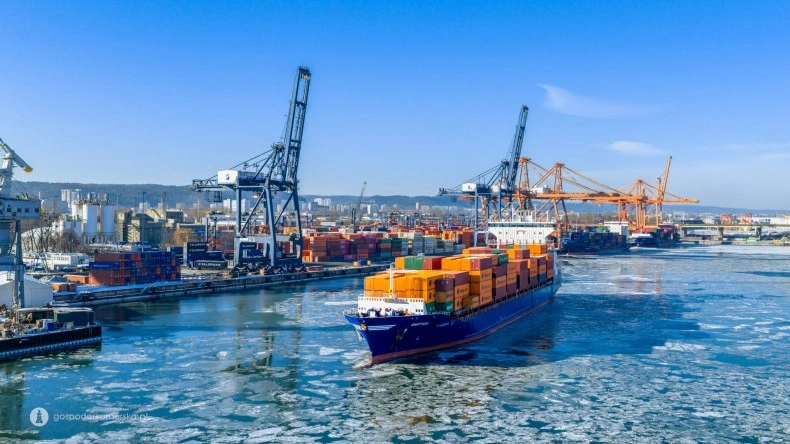


At 5 Energetyków Street in Gdynia, there is a prevailing sense of optimism. Located ther, the Gdynia Container Terminal (GCT), recorded a very strong year, marked by a substantial increase in cargo handling volumes. For GCT, 2025 was not only a record year in operational terms, but also a significant milestone in its decarbonisation process, the first tangible effects of which are already visible.
During the 365 days of 2025, Gdynia Container Terminal handled a total throughput of 465,000 TEU, corresponding to exactly 258,936 containers, discharged and loaded from 569 vessels served. This represents a very strong performance and an all-time throughput record for the terminal.
More containers, fewer vessels
“This has indeed been a record year for us in terms of throughput. We are pleased that our share in the Port of Gdynia’s container turnover reached nearly 45%, and our share in the port’s overall cargo turnover also increased significantly,” emphasises Jan Jarmakowski, Managing Director of GCT.
The 465,000 TEU handled represents a 19% year-on-year increase compared to 395,000 TEU in the previous year. Owing to this substantial growth, the Port of Gdynia exceeded the threshold of 1 million TEU in total annual throughput for the first time, reaching precisely 1.038 million TEU. Without GCT’s additional 70,000 TEU year-on-year increase, this result would not have been achieved. Such dynamics likely make GCT the fastest-growing terminal in Gdynia.
A significant increase in TEU throughput necessarily translated into a higher number of containers handled — up by 36,651 units. Notably, however, this was achieved despite a decrease of 60 in the number of vessel calls. From the terminal’s operational perspective, this is a positive development. It indicates a higher average exchange per call, with each vessel discharging and/or loading a greater number of containers in Gdynia.
Consequently, the number of crane moves per call increased, which constitutes an operational advantage. The entire port call procedure — berthing, mooring, cargo operations, unmooring and departure — is considerably more cost-effective when it involves, for example, 2,000 crane moves rather than 200.
“At a container terminal, the unit value and scale of a vessel call are always highly positive factors”, says Jarmakowski. “The greater the number of moves and the higher the unit value of a call, the more efficiently we can plan our operations”.
The marked increase in volumes despite fewer vessel calls is largely market-driven. The Polish economy continues to expand, and Poland’s trade exchange with both regional and long-haul partners is growing. Shipping lines are responding accordingly, while GCT continues to strengthen its relationships with its carrier base.
“We have consolidated our cooperation with our key shipping line partners, with whom we maintain regular contact. This includes the Gemini service, operated by Maersk, with our long-standing partner Hapag-Lloyd as the main user of the Gdynia call. Services of another major customer, the Japanese carrier Ocean Network Express (ONE), also developed very well. Short-sea calls by the UK-based Ellerman City Liners gained in importance”, lists Jarmakowski. He adds that smaller partners are also significant, including the Israeli state-owned carrier ZIM, which has cooperated with GCT since the beginning of its operations, and the South Korean line HMM.
In 2025, the terminal also handled several calls by ro-ro vessels operated by Finnlines. For several consecutive weeks, GCT provided services to these units, focusing not on rolling cargo but on containers carried on board. Handling ro-ro vessels required different operational planning compared to conventional container ships, primarily due to their greater air draft. Ultimately, the vessels were handled using the terminal’s smallest quay crane, with an outreach of 15 container rows, without the need to deploy the largest units.
Outlook for 2026
As for 2026, the Managing Director adopts a cautious approach. GCT expects moderate organic growth, supported by relatively favourable conditions in Polish foreign trade. Forecasts indicate a few percentage points increase in national trade turnover, which should translate into slightly higher container volumes. However, the terminal does not anticipate exceeding 500,000 TEU in 2026. Potential global or domestic economic disruptions could conversely result in slight declines.
In 2025, Hutchison Ports Gdynia also expanded its container depot located on Logistyczna Street in Gdynia. The facility comprises 4.25 hectares dedicated to container storage and related operations, including stuffing, stripping, servicing and repair. Procedures applied at the depot are aligned with those of GCT’s temporary storage warehouse.
Electrification under way
In 2025, the terminal achieved a partial but notable success in reducing emissions. CO₂ emissions per handled TEU were reduced by approximately 3%. Although below the initially assumed target — due to extended tender procedures in zero-emission projects — the terminal remains on track.
Several key electrification contracts have already been signed. In the coming months, 24 electric terminal tractors are expected to be delivered. Additionally, in 2026 GCT will commission two new electric reachstackers and two electric empty container handlers — likely the first such machines to be operated commercially in Poland. The programme also includes high-capacity charging infrastructure and dedicated fleet and energy management software.
A technical design for the electrification of seven diesel-powered yard cranes has already been completed by Polish engineers. Following modernisation, these cranes will operate exclusively on electric power, in line with other electrically powered cranes at the terminal.
Electrification efforts are complemented by the procurement of electricity with guarantees of origin, with plans to move towards direct Renewable Energy Power Purchase Agreements (PPA). Similar solutions are already being implemented at other Hutchison terminals, including in Felixstowe and Barcelona.
Another major project under consideration is the implementation of Onshore Power Supply (OPS) systems for vessels. In line with the EU Alternative Fuels Infrastructure Regulation (AFIR), adopted under the “Fit for 55” package, TEN-T core network ports must provide OPS by 2030. In GCT’s case, vessels exceeding 5,000 GT will need to be supplied with shore power during at least 90% of annual berth calls, while ships staying at berth for more than two hours will be required to connect. Implementation will require significant infrastructure upgrades, including additional grid capacity and extensive cabling works. Discussions are ongoing with the Polish grid operator Energa regarding increased connection capacity.
Digitalisation and ownership context
The 2026 investment plan also includes modernisation of the eXpress IT system, which has been in operation for over 12 years. Once considered pioneering for integrating shipping lines, freight forwarders and customs administration, it is now due for a comprehensive upgrade. In parallel, significant cybersecurity investments were made in 2025, including the deployment of solutions provided by Palo Alto Networks.
Throughout 2025, the broader CK Hutchison group was the subject of discussions concerning a potential sale of its port business to a consortium including BlackRock and Mediterranean Shipping Company (MSC). According to the terminal’s management, these developments and related media reports had no impact on GCT’s day-to-day operations, which remain focused on serving its established customer portfolio.
 DOWNLOAD PDF