

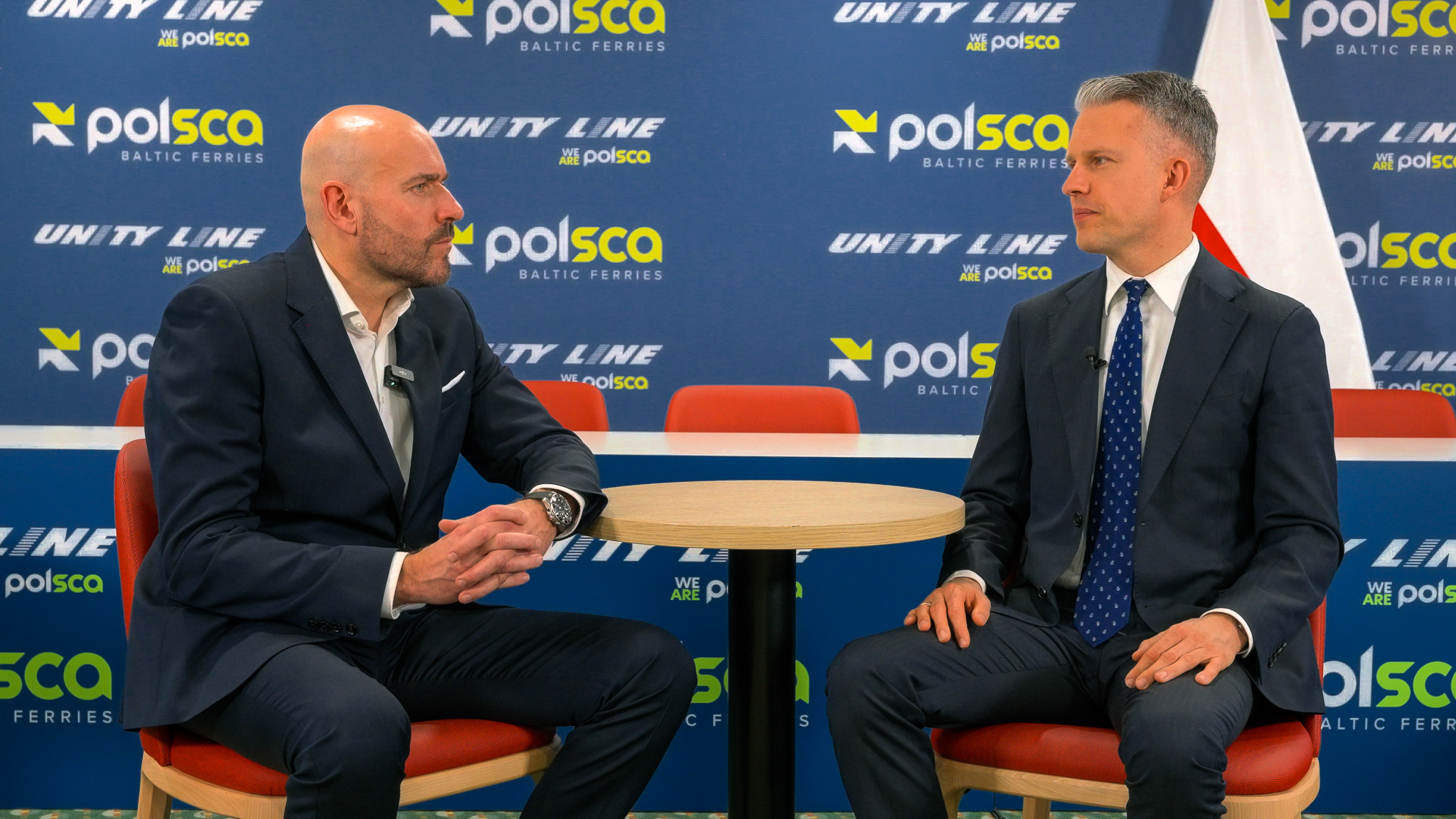


Mateusz Kowalewski, publisher of GospodarkaMorska.pl, ZielonaGospodarka.pl, MarinePoland.com and president of the Maritime Economy Employers’ Forum, speaks to Arkadiusz Marchewka, Deputy Minister of Infrastructure, about the future of Polish shipping, the return of the Polish flag and strategic investment in the country’s ports.
MK: Minister, this is the second time this year that we have had the special opportunity to meet on board a ferry. In January, it was Jantar; today, it is Bursztyn, both of which have arrived here in Szczecin. This autumn occasion is also special, as Bursztyn has arrived here for the first time. It is a ferry sailing under the Polish flag. How do you assess the impact of these events on the Polish maritime economy and, of course, on Western Pomerania?
AM: These are events of key importance not only for Polish shipping but also for the entire maritime economy. That is because everything that matters most is here: shipbuilding, Polish shipyard workers, shipowners and the Polish flag.
After a break of more than 20 years, we are bringing the white-and-red flag back to a merchant vessel. In 2004, the Polish flag was taken down from the last vessel owned by Polish Steamship Company (PŻM). Since then, our shipowners have sailed under the flags of other countries – foreign flags.
Why? The answer was simple: because it was simply cheaper and more profitable. Over the past several months, we have worked very intensively to remove all the obstacles preventing the return of the Polish flag and to establish something that had not been in place for more than 20 years.
First, low taxes for shipowners, in the form of a tonnage tax instead of corporate income tax (CIT). Second, an exemption for seafarers from the requirement to pay personal income tax (PIT), as is currently the case under the flags of Cyprus, Malta and Portugal. Third, lower labour costs, meaning preferential social security contributions for seafarers. This is intended to ensure that seafarers have social protection while preventing shipowners from being placed at a competitive disadvantage.
Both the christening and entry into service of the Jantar ferry, and the events surrounding the christening and launch of Bursztyn’s scheduled services, have had a very positive impact on the image of the Polish maritime economy. At the same time, however, these successes have recently been overshadowed by the difficult situation at Polish Baltic Shipping Company (PŻB). How do you assess the situation, and how does the Ministry view PŻB’s current problems, their causes and the company’s future in the entirely new environment now taking shape?
The situation at Polish Baltic Shipping Company is difficult, and there is no doubt about that. However, the roots of these difficulties go back to around 2018, when decisions were taken that, to put it plainly, had a negative impact on the company’s financial liquidity and overall financial health.
First came the signing of very expensive loan agreements, followed by the chartering of vessels that the company did not own but which required enormous financial outlays. The third factor, to put it plainly, was allowing foreign competitors into the market.
Our first objective is to put the situation in order and pay the outstanding wages owed to seafarers. That has already been done.
Today, we know clearly that competition in the Baltic is extremely aggressive. The only key project that can enable us to regain what has been lost over recent years is integration.
That is why Project Polska was created: to integrate Polish shipowners at the operational level. The next step should be to establish a strong brand within a corporate group. Polish Steamship Company – specifically, its subsidiary Żegluga Polska – will therefore become the strategic investor in Polish Baltic Shipping Company. The aim is to build a strong entity capable of competing in the Baltic, which is what matters to us.
When those who today talk so much about their concern for Polish Baltic shipping took power in 2015, Polish shipowners accounted for 80 per cent of the market on the western flank. In other words, 80 per cent of the lorries transported across the Baltic were carried on vessels operated by Polish shipowners.
By the time those people left office in 2023, that share had fallen to just over 50 per cent. This clearly shows that bad decisions, or the failure to make decisions, had a very negative impact on what is happening at Polish Baltic Shipping Company today.
Our objective, therefore, is to put the situation in order and build a strong ferry group – a powerful entity capable of competing with the aggressive operations of foreign companies. We are doing this to regain what has been lost over recent years.
Can we say today that the concept of Polish shipping lines under the POLSCA brand will be the answer to PŻB’s problems?
It is essential if we are to manage the fleets of Polish shipowners intelligently.
If we have a total of 12 vessels at our disposal today, we need to deploy them across different routes in such a way that they attract as much cargo and as many carriers as possible, rather than competing with one another in an irrational way.
We cannot have Polish shipowners’ vessels departing just an hour apart, with only 30–40 per cent of their capacity filled.
Thanks to the integration, it was possible to launch a new route between Gdańsk and Karlshamn in Sweden. A new service was created using vessels from the pool operated by Polish shipowners. In other words, we made better use of available cargo capacity and created additional opportunities to transport goods, lorries and passengers.
I am convinced that the integration process, which began several months ago, will bring even greater benefits next year. The downward trend I mentioned earlier has already been halted. We are now seeing growth, with Polish shipowners accounting for more than 60 per cent of the market on the western flank alone.
For us, the most important thing is to seek effective cooperation between Polish shipowners, maximise benefits and minimise costs, rather than compete with one another. That is why this initiative was launched.
It has already been officially announced that the next ferry, the third in the series, will be built at Gdańsk Shiprepair Yard. It is supposed to be called Amber...
Not necessarily Amber.
I have also heard an interesting suggestion: Elektron, which in Greek also means amber. After all, the ferry will also have a propulsion system partly based on batteries, so there is an electrical element to it. Elektron is an interesting name.
Of course, the minister will not make that decision, as it is up to the shipowner. But suggestions of this kind are also being discussed within the shipping industry. I think it is an interesting proposal.
It is certainly a more energetic name than Amber, which is also very widely used.
But I can confirm that construction of the third vessel has begun.
Let me remind you that when we took responsibility for this project, it did not even have secured financing. To put it plainly, it was drowning in debt, and the shipyard had not been paid for many months. So what we had to do first and foremost was give the project a sound economic basis and invest PLN 1.3 billion. That enabled the Jantar ferry to be completed and Bursztyn to be built. Construction of the third vessel began immediately after Bursztyn was handed over for service.
This is a programme that, to put it plainly, has been delivered and saved because we have experts on board who know what they are doing.
Every year, we talk about the budget allocated to the Polish maritime economy, and the figures keep rising. What will this look like next year, in the context of the 2026 budget? What are the key plans for next year’s budget?
It is true that spending on the maritime economy is at a record level, exceeding PLN 3.7 billion. That is 23 per cent more than last year and 236 per cent more than in 2023.
These funds are being used to carry out a range of projects that strengthen the Polish maritime economy. These include approach channels to our ports along the entire coast, from Szczecin and Świnoujście to Gdynia and Gdańsk.
We are also carrying out road infrastructure projects, including the construction of the Red Road. We are implementing a project to build vessels for our maritime universities, as well as Przylądek Pomerania – the largest and most ambitious investment in the history of the Szczecin-Świnoujście Seaports Authority and, indeed, the entire western coast.
Last week, a tender was announced to select a contractor to create new land: an area of 186 hectares on which a deepwater terminal will be built, with quays offering a depth of 17 metres, as well as a breakwater integrated with the new land.
A great deal of effective work is therefore being carried out in the maritime economy. I believe the figures also demonstrate this. Cargo throughput at our ports after the first three quarters clearly shows that we are heading for another record in container handling – an absolute record in Poland’s history. Overall, Polish ports have also handled more cargo than in the same period last year.
I think maritime affairs have become a strategic priority for our country, and more and more projects in the maritime economy are gathering momentum. I am very pleased about that.
Can we say today that the Baltic is driving Poland forward?
Yes. Today, the sea is not only our window on the world but also an essential part of our security in the broadest sense.
We are not only investing in ports in projects that are crucial for international trade and for strengthening the role of our ports in global logistics chains. At the same time, we are building a pillar of security – both military and energy security.
These projects include the FSRU terminal in the Gulf of Gdańsk, the expansion of Naftoport, liquid fuel berths in Gdynia, the commissioning of the T5 terminal for offshore wind farms, and the construction of infrastructure required for Poland’s first nuclear power plant. I believe that issues related to security in the broadest sense are increasingly centred on the Baltic.
How do you see the prospects for further decisions concerning these strategic infrastructure areas? I am thinking specifically of the Red Road. You have already mentioned it, but could you give us a timetable or explain what stage the project has reached? The second issue is the increasingly frequent discussion of an alternative access route to Port Island and the outer port in Gdańsk. This is an area of immense strategic value to the country, given the volume of cargo handled there and the impact of those operations on Poland’s energy and economic security.
How do you view this need, and can we expect any decisions on the matter in the near future?
We regard these investments as strategic because getting goods to a port is not the real challenge – the challenge is distributing them efficiently throughout the country. After all, our ports serve not only Poland but also our southern neighbours.
That is why, several weeks ago, the government adopted a law to streamline infrastructure investment. It covers 20 of the most important projects for economic development and security.
Under this legislation, we have proposed solutions that, to put it plainly, accelerate procedures, shorten the time required for administrative proceedings and give these investments priority when applications are being considered.
The Red Road is among the projects covered by the legislation, as is a new railway line to Port Island in Gdańsk.
This clearly shows that our government regards these projects as priorities, and the first decisions in this area will be taken soon. The Port of Gdańsk Authority is working very intensively with PKP PLK, the national railway infrastructure manager, to begin the preparatory process for this investment. This includes route planning – in other words, determining the precise alignment of the line.
As for the development of the Red Road, the funding has been secured and consultations are under way.
The bill has been passed by the Sejm, which clearly demonstrates that we are committed to these projects. We simply need to speed things up, and that is precisely why we are introducing these solutions.
The political temperature in the media is rising, and an election year lies ahead. How do you assess the role of the maritime economy and developments in the sector in the context of the current government, as well as its potential for another term in office?
When I took responsibility for maritime affairs, I said that this would be a term in which we would have to do a great deal of work to clear up the mess left by our predecessors.
I say that with full responsibility, because none of the projects they left behind had secured financing, had been properly prepared or, quite simply, amounted to anything more than electioneering.
If we look at the construction of ferries, the construction of a dry dock for the Gryfia shipyard, the rebuilding of the shipbuilding industry in Szczecin or the construction of a container terminal in Świnoujście, all of these projects were simply myths. They were stories designed to impress the public, without any concrete action to back them up.
All these issues have now been put right. We have given the projects the appropriate momentum and taken concrete, measurable steps that have allowed us, among other things, to celebrate the handover of the Bursztyn ferry.
Looking at what has been achieved during this term, I believe that, above all, we have reached a point where all the problems left to us by our predecessors have been turned into successes.
At the same time, maritime affairs have been given the status of a priority for the national interest. I believe this has provided a very important impetus, because more and more Poles are beginning to see maritime affairs as something exceptional and important.
Forgive me, this may sound a little strange, but perhaps until now some people have associated maritime affairs simply with a beach and a fish-and-chip restaurant. Yet this is a substantial part of the economy for which we are responsible, and one into which we are investing record amounts. I am convinced that these investments will be even greater in the future.
Thank you for the interview.
 DOWNLOAD PDF
