

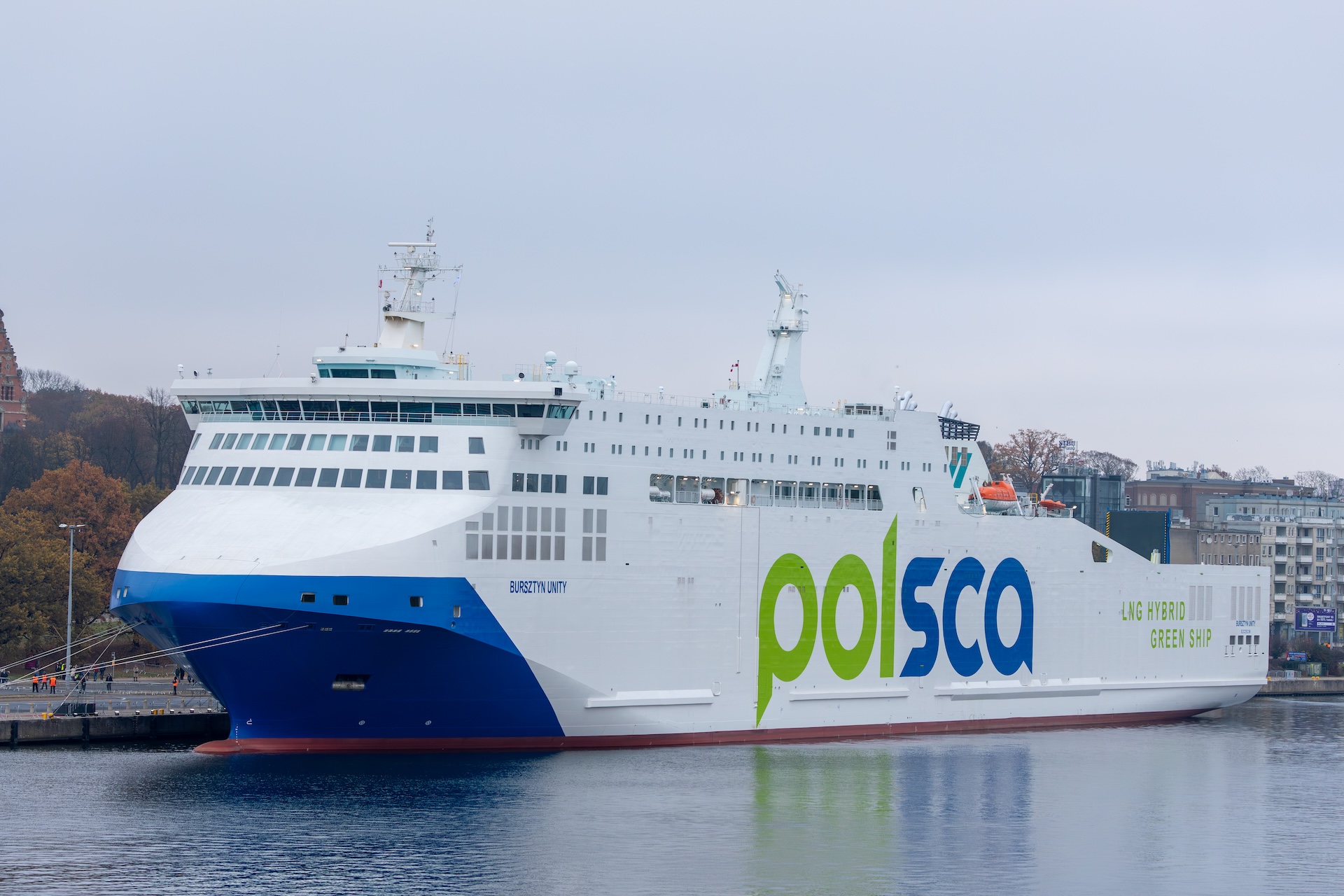


At 13:00 on 18 November, Poland’s newest ferry, Bursztyn Unity, will depart on its first passenger voyage, sailing from the Swedish port of Ystad to Świnoujście. Christened on 11 November, Poland’s National Independence Day, the vessel is the first owned by Polska Żegluga Morska (PŻM) in 22 years to fly the Polish flag. The new ferry symbolises Poland’s growing ambitions as a maritime nation.
From today, Bursztyn Unity will operate the route between Świnoujście and Ystad, while its sister ship, Jantar Unity, will serve the Świnoujście–Trelleborg route. Both vessels operate under the POLSCA Baltic Ferries brand, a joint venture involving Polish operators Unity Line, Polferries and EuroAfrica. The first passenger voyage will depart from Sweden, as the ferry previously made only a technical voyage, with crew on board.
The ferry was built at Gdańsk Remontowa Shipbuilding Yard, the same yard where Jantar Unity was constructed and a third vessel in the series is being built. Bursztyn is 195.6 metres long and 32.2 metres wide. Its crew numbers 50. The propulsion system comprises four liquefied natural gas (LNG)-fuelled engines, a hybrid battery system and azimuth thrusters. The vessel has 4,100 lane metres of cargo capacity. It can carry up to 400 passengers and 270 standard lorries. More than 15,000 pieces of equipment have been installed on board, along with almost 900 kilometres of cabling, while 364 kilometres of welds have been made in the hull alone.
The combined weight of the hull, hybrid engines (running on diesel oil and LNG) and equipment is 16,690.71 tonnes. The propeller diameter of the azimuth thrusters is 2.85 metres. Economical use of the propulsion system allows the vessel to consume approximately 17.5 tonnes of LNG per day. More than 3.5 million man-hours were worked during construction. Around 10,000 people were involved in the project, including shipyard employees and staff from partner companies. The construction of Bursztyn Unity, its predecessor Jantar and its successor Amber is expected to cost a total of approximately PLN 1.3 billion.
The bridge is equipped with an integrated NACOS navigation and control system. It combines information from various devices, providing the captain and officers with a consistent picture of the navigational situation. The ferry is also fitted with Anti-Heeling and Anti-Rolling systems. These are designed to reduce the vessel’s heel and rolling motion, which is important both during cargo operations and while under way.
Bursztyn Unity can accommodate up to 400 passengers. They have access to 188 standard twin cabins, four cabins adapted for passengers with disabilities and eight cabins of a higher standard. For those who do not plan to travel in a cabin, 75 airline-style seats are available. Additional places to rest are provided in the passenger areas, where armchairs, sofas and chairs have also been arranged.
Photo: C. Spigarski
 DOWNLOAD PDF
