

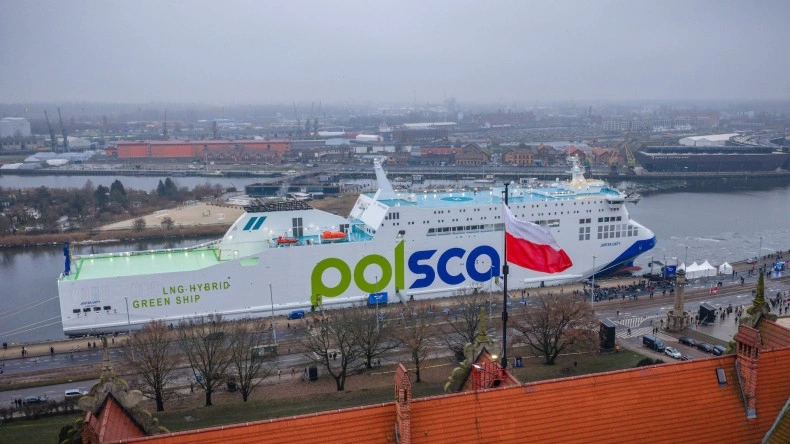


On Tuesday, 20 January, the new Polish ferry Jantar Unity will embark her first passengers and sail on her inaugural sailing within the regular service from Świnoujście to Trelleborg. She has already been formally named – the naming ceremony took place alongside Wały Chrobrego in Szczecin. The vessel’s Godmother, delivered for the new ferry operator Polsca Baltic Ferries, is Mirosława Błaszyk-Zjawińska, Managing Director of Polish Steamship Company. Her introduction into service is intended as the first step towards restoring a greater share of Baltic ferry traffic to Polish shipowners.
The new ferry Jantar Unity berthed on Friday at Wały Chrobrego in Szczecin for the official naming ceremony. In December she was handed over by her builder, Remontowa Shipbuilding S.A. of Gdańsk, to her operator, Unity Line. As disclosed by Piotr Krzystek, Mayor of Szczecin, she is the largest vessel in the city’s post-war history ever to berth at this quay.
She is the first ro-pax vessel completed under the programme to construct new ferries in Polish shipyards for Polish operators. The vessel is intended to significantly strengthen the position of domestic companies on the Baltic market. Before Jantar Unity proceeds to the Baltic to enhance the competitiveness of Polish ferry operators vis-à-vis foreign competition, she lay alongside at Wały Chrobrego in Szczecin. The venue for the naming ceremony was chosen deliberately. As emphasised by Dariusz Doskocz, Chief Executive Officer of Polish Steamship Company, it was important for the shipowner that as many residents as possible of the city in which the company is headquartered should have the opportunity to see the vessel.
“For the entire PŻM Group, and in particular for all seafarers associated with our ships and fleet, this is a special occasion. Two weeks ago we marked the 75th anniversary of the establishment of PŻM. The new ferry, which we are able to present to our home city, is of great significance to us both emotionally and operationally,” said Doskocz.
Polsca Set To Strengthen Its Position On The Baltic
The entry into service of a new ferry is always a milestone for an operator. However, for Unity Line and the State Treasury, Jantar Unity carries considerably greater weight. Above all, she is substantially larger and more modern than the remaining vessels in the owner’s fleet and, consequently, more cost-efficient in operation.
“Unity Line is increasing capacity, gaining freight space one and a half times greater than that of the previous vessel deployed on this route, namely Gryf. Our customers will feel the difference immediately; we are able to offer significantly more lane metres,” Paweł Pluto-Prądzyński, President of Polskie Promy and at the same time Managing Director of Unity Line, told Gospodarka Morska. He added that the Baltic ro-ro market is highly specific, with seasonality not limited to the time of year but also evident within the week itself. “There are typical ‘ro-ro days’ and ‘non ro-ro days’. On those ‘ro-ro days’, when sailings operate at or near full freight capacity, supply was insufficient, whereas on ‘non ro-ro days’ there was surplus capacity. With this vessel in service, we can provide our customers, on peak-demand days, with a modern, comfortable and environmentally efficient unit which enables us, as shipowner, to operate more effectively, while offering even greater comfort to our passengers and freight clients than before.”
There is, however, a broader strategic dimension. As stated by Arkadiusz Marchewka, Deputy Minister of Infrastructure responsible, inter alia, for maritime affairs, Poland must rebuild its share of the Baltic ferry market.
“In 2015, the share of Polish shipowners in the ferry market on the western Baltic corridor between Świnoujście and Sweden stood at over 80 per cent. When I took office at the Ministry and reviewed the figures, that share had fallen to just 58 per cent – a decline of 20 percentage points over eight years,” Marchewka explained.
The Deputy Minister also outlined the reasons for this state of affairs, the principal one being the absence of timely decisions to renew the fleets of State Treasury–supervised operators: Unity Line and Polferries. Meanwhile, competitors did not stand still – in recent years both TT-Line and Stena Line have introduced new tonnage onto the Baltic. Although Polferries also responded with a new vessel built in Italy, this proved insufficient to restore the competitive standing of Polish operators.
“Our foremost task today is to regain that market share. To achieve this, substantial capital investment is required; accordingly, we have committed PLN 1.3 billion to this project and to the construction of two further vessels,” Arkadiusz Marchewka added.
The Secretary of State stressed, however, that securing a larger share of north–south Baltic ferry traffic will require more than fleet renewal alone. He referred, inter alia, to the completion of the S3 expressway linking the coast with southern Poland, as well as to the decision of the Czech government—following a visit by a Polish delegation to Prague—to construct the continuation of that corridor on its territory. This will effectively establish a transport corridor running through West Pomerania from Scandinavia as far as the Balkans.
Another issue to be addressed is the internal competition between Polish State-owned ferry operators.
“We currently have two ferry operators owned by the State Treasury – Unity Line and Polferries. Put bluntly, these two companies have been competing against each other. If a Unity Line ferry departed for Sweden with 40 per cent load factor, and an hour later a Polferries vessel sailed with a similar 40 per cent utilisation, effectively operating in parallel, then from the perspective of the owner – the State Treasury – operating costs were significantly higher than those incurred by a carrier operating modern tonnage capable of lifting a greater number of freight units per sailing,” Arkadiusz Marchewka stated.
The proposed solution is closer cooperation between Polish operators under a joint brand, Polsca Baltic Ferries.
The shipbuilding contract covers three ro-pax vessels, with an option for a fourth. All are to be constructed at Remontowa Shipbuilding S.A. in Gdańsk, part of the Remontowa Holding Group, with the formal contracting entity being Polskie Promy, a special-purpose vehicle established by the State Treasury. The vessels are subsequently to be chartered to the operators: Polish Steamship Company (operator of Unity Line) and Polska Żegluga Bałtycka (operator of Polferries).
Under the original plan, the second vessel under construction—already launched in Gdańsk—was to be allocated to Polferries. It is now understood, however, that she will be named Bursztyn Unity, indicating that Unity Line will take delivery.
“At the stage of structuring the project finance for these vessels, the lending banks questioned the financial standing of one of the participating operators, which required us to restructure the financing model,” said Paweł Pluto-Prądzyński.
As a result, Unity Line is currently the bareboat charterer and the entity securing financing for all three vessels. Unity Line will charter the ships from the owner, Polskie Promy, on a bareboat basis, providing crew, technical management and insurance cover, and will subsequently sub-charter the vessels on a time charter basis to Polsca Baltic Ferries. This is a new ferry operator established through the consolidation of three Polish entities: Unity Line (Polish Steamship Company), Polferries (Polska Żegluga Bałtycka) and Euroafrica. In due course, all vessels are expected to operate under the Polsca brand, formally announced in 2025 during the International Maritime Congress in Szczecin. Polsca is also intended to provide integrated operational management for the three constituent companies. It remains unclear, however, whether the creation of this overarching structure will result in adjustments to existing route networks, for example the potential withdrawal of Polferries from the Świnoujście–Ystad service, on which Unity Line also operates.

Interestingly, however, Jantar Unity will not sail under the Polish flag—at least for the time being. During the aforementioned International Maritime Congress in Szczecin, Prime Minister Donald Tusk announced the “Polish Sea” programme. One of its core objectives was the restoration of the Polish flag, a proposal welcomed enthusiastically by the maritime sector and, owing to its ideological overtones, also by those not usually engaged in maritime affairs. Yet the new ferry—ceremonially received by politicians, operated by Polish ferry lines and constructed in a Polish shipyard—will not, for now, fly the Polish ensign. This is because improving the competitiveness of the Polish register for shipowners is dependent upon the legislative process. In short, it takes time.
“Shipowners operate within the framework of international competition. It is evident that if other operators enjoy lower business and operating costs, they are able to offer more competitive freight and passage rates,” Arkadiusz Marchewka stated, adding that the Polish flag does not currently provide such cost advantages. He also recalled that the last vessel of Polish Steamship Company to transfer from the Polish flag to a foreign registry did so in 2004. “Such decisions were necessary in order to seek jurisdictions offering lower costs of doing business. Without those options, Polish shipowners would simply not have survived, as they would have been unable to remain competitive,” he added.
The Deputy Minister nevertheless assured that legislative work is underway and that the issue ranks among the present government’s priorities. The first step is to create commercially attractive conditions for shipowners.
“We are preparing a package of measures that will ensure that operating a shipping business in Poland becomes commercially viable again. The first step has already been taken: the Act on the Social Security of Seafarers has been adopted, allowing labour costs to be reduced. Secondly, we have drafted the Act on Support for Shipping Enterprises and on Establishing Conditions for Their Operation under the Polish Flag,” Arkadiusz Marchewka reported.
Among other provisions, the draft legislation proposes tax reductions for shipping companies. Marchewka expressed hope that within the coming weeks—possibly still in February—the bill would be submitted to the Standing Committee of the Council of Ministers. The Ministry is also working to streamline vessel registration procedures, which, in the Deputy Minister’s words, are currently “rather burdensome and difficult to navigate.”
Dariusz Doskocz, Chief Executive Officer of Polish Steamship Company, added that the process of vessels leaving the Polish register has in fact been ongoing since the early 1990s.
“This is not a process that can be reversed within a week or two, nor by means of administrative decisions alone. It involves an entire framework of statutes and regulations, and the alignment of practice and domestic law with international requirements and convention standards,” he stated.
Doskocz also referred to a widely discussed example within the maritime industry of inconsistencies between national and international regulations, which at one stage made the delivery of medicines to vessels in Polish ports extremely challenging—and for several years virtually impossible. Problems also arose in relation to the calculation of overtime on board, and even whether a seafarer, who must be provided with meals on board, should treat such provision as taxable income.
“And that is merely one thousandth of the matters associated with shipping operations,” Doskocz concluded.
Dariusz Doskocz further stated that, during financing negotiations with the lending banks, they made it clear that “the Polish flag is regarded by them as an exotic register under which they are unwilling to finance operations.” Shipowners were therefore faced with a stark choice: either place the ferry under a foreign flag or forgo the vessel altogether. Ultimately, Jantar Unity sails under the Cyprus flag, a decision that was likewise not coincidental. It is the flag of an EU Member State, operating within a recognised regulatory framework and compliant with applicable international and European requirements.
“I hope that the entire process of reflagging our vessels can commence as soon as possible. I do not wish to commit to any specific date, as this will depend on the pace of the legislative process,” Doskocz concluded.

Challenges Along the Way – Ministry Intervention
The Polish ferry construction programme was announced three years ago. The contract for three vessels, with an option for a fourth, was awarded to Remontowa Shipbuilding S.A. in Gdańsk. One of the programme’s objectives was to strengthen Polish shipyards and companies participating in the supply chain. Accordingly, emphasis was placed on maximising the involvement of domestic subcontractors.
“The ferry was designed by a design office within Remontowa Holding, Marine Design & Consulting, and is a 100 per cent Polish product,” said Adam Ruszkowski, President of the Management Board of Remontowa Holding. He added that all equipment and systems that could be sourced domestically were in fact procured in Poland. Numerous enterprises from the maritime sector and related industries participated in the construction process.
As Ruszkowski noted, approximately 10,000 people were involved in the vessel’s construction. The total length of hull welds laid on the ship amounts to 364 kilometres—equivalent to the distance from Wały Chrobrego in Szczecin to Remontowa Shipbuilding in Gdańsk, accurate to within one kilometre. It is also roughly the distance between the shipyard and Świnoujście, from where the ferry will operate. Around 15,000 items of equipment were installed on board Jantar Unity, together with approximately 900 kilometres of cabling. The project required some three million man-hours to complete. The President emphasised that it represents the largest undertaking in the Group’s history.

The project was not without difficulties. These were disclosed for the first time during the launching ceremony of the second of the ordered ferries, now confirmed to be named Bursztyn Unity. At that time, the Deputy Minister of Infrastructure for Maritime Economy and Inland Navigation, Arkadiusz Marchewka, revealed that the programme had been improperly structured from a financial standpoint and that, despite ongoing works, the shipyard had not been receiving payment. Rescuing the project was the first challenge he faced upon taking office. The sums that had to be secured were substantial. Although the exact contract price for Jantar Unity remains commercially confidential between the contracting authority and the yard, Paweł Pluto-Prądzyński disclosed at a press conference that the cost is in the region of EUR 250 million.
“Two years ago, this project was sinking under debt. It came very close to ending up like the rusting keel block that still lies in the Szczecin yard,” Deputy Minister Marchewka recalled during the press conference preceding the vessel’s naming ceremony. “We rescued the project, settled outstanding liabilities and secured financing,” he added.
Dariusz Doskocz, Chief Executive Officer of Polish Steamship Company, explained during the conference that “the funding model and financial structure under which the project had previously been implemented reached a point where further reliance solely on the shipowner’s resources—being the entity providing security under the guarantees of Żegluga Polska, the core company within the PŻM Group—simply became unsustainable.”
“In short, the money ran out,” Doskocz stated candidly. “Without the direct intervention of Deputy Minister Marchewka—indeed, on his very first day in office we met with him to present our position and underline the necessity of addressing the project—we would most likely have become entangled in protracted legal proceedings. The ferry would not have been completed, and the consequences of that failure would have had long-term implications for the future of the ferry shipping sector in Poland.”
During the period when funding for the yard’s works was effectively suspended, Remontowa Shipbuilding continued construction activities. This fact was emphasised repeatedly during the launching ceremony of the second vessel under construction.

Interestingly, payment difficulties had already arisen at the time of Jantar Unity’s launching in October 2023, attended by representatives of the previous government, including the then Deputy Minister of Infrastructure for Maritime Economy and Inland Navigation, Marek Gróbarczyk. At that stage, however, the issue was not publicly addressed. Today, it is openly acknowledged that the construction process itself was both challenging and stressful, primarily due to instability in the payment flow.
“Had Deputy Minister Marchewka not taken up this matter virtually in his first days in office, and had the Ministry of Infrastructure not developed a new business model and secured financing, Remontowa Shipbuilding in Gdańsk would most likely not be operating today,” stated Adam Ruszkowski, President of Remontowa Holding, in unequivocal terms.
All parties involved emphasised that the yard’s stance and conduct were pivotal to saving the project. Accordingly, during the press conference preceding Jantar Unity’s naming ceremony, strong words of appreciation were directed towards the shipyard workforce.
“Mr President, I am aware that two years ago, as a private enterprise, you had serious doubts as to whether the State and State-owned companies were capable of being predictable and rational partners. I thank you for restoring that trust,” said Deputy Minister Arkadiusz Marchewka.
“I must underline the very good cooperation with the shipyard. In difficult times—when commercial interests can at times diverge—there was complete alignment on certain key matters: namely, the highest standards of quality and professionalism,” added Dariusz Doskocz of Polish Steamship Company.
Ultimately, a financing model was structured that enabled completion of the first vessel and continuation of construction of the second. All indications suggest that Bursztyn Unity will be delivered to the operator in the second half of this year. A third ferry remains in the pipeline; however, her construction schedule has been deferred precisely due to the earlier payment-related issues.
“These were demanding negotiations with the shipyard, lasting nearly eighteen months, as there had been considerable delays in payments resulting from the absence of an operator able to provide security for vessels of such value. We intend, no later than February, to settle all outstanding liabilities towards the yard, execute an addendum to the contract and proceed with the subsequent stages of construction, including keel laying and further contractual milestones. As this phase of the investment will recommence following its suspension, while the second unit will be delivered this year, the third must be expected in two to three years’ time. Our current planning assumption is delivery at the end of 2028 or the beginning of 2029,” explained Paweł Pluto-Prądzyński.

The option for a fourth vessel remains on the table. However, that prospect is more distant and no formal decisions have yet been taken, although Paweł Pluto-Prądzyński emphasised that “as Polish shipowners, we will require more than just three new units.”
“The project is sufficiently attractive, well-conceived and scalable that we intend to use it as a platform for further vessel construction,” he assured.
Moreover, on previous occasions relating to the ferry newbuild programme, representatives of Remontowa Holding did not conceal the fact that the project could assist in opening new opportunities on international markets and in securing clients interested in constructing ro-pax vessels in Poland. Nevertheless, Adam Ruszkowski, President of Remontowa Holding, remains measured in his outlook.
“Business values discretion. A great deal is happening in the market. Remontowa Shipbuilding is currently executing a series of smaller ferry newbuildings—seven units for CMAL. Just yesterday, a further project was signed with Torghatten. The entire Remontowa Group is well regarded and recognised globally,” Ruszkowski stated.
With regard to additional ferries for Polish operators, the President is for the time being focused on the existing orderbook, while leaving the door open for future developments. “We have the second and probably the third vessel to complete. Further ferries for Polish shipowners constitute a necessary investment, as over the next decade Polsca will require approximately ten new units. Provided we operate on a commercial basis and reach agreement on pricing, all options remain open for consideration,” Ruszkowski observed. He added, however, that “the name Gdańsk Shiprepair Yard did not arise by chance,” underlining that the yard intends primarily to develop its core business, namely ship repairs, retrofits and complex conversions.
Jantar Unity – The Most Advanced Ferry on the Baltic
Representatives of all companies involved in the project state unequivocally that Jantar Unity is currently the most technologically advanced ferry operating on the Baltic. Competition is intense, as the new vessels introduced on Baltic routes by TT-Line and Stena Line are only two to three years old and likewise represent state-of-the-art tonnage.
The classification society for the new Polish ferry is DNV, while the Polish Register of Shipping was also involved at the design, construction and certification stages.
Jantar Unity has an overall length of 195.6 metres and a beam of 32.2 metres. The vessel can accommodate 400 passengers and offers approximately 4,100 lane metres of freight capacity.
“A length below 200 metres provides operational advantages, as windage area and manoeuvring challenges are not as significant as with ferries measuring 220–230 metres,” explained Captain Adam Kowalski, one of the two masters who will command Jantar Unity. “The vessel’s economic efficiency has been achieved through increased beam. Thirty-two metres is considerable for a ferry.”
Captain Kowalski added that the vessel differs technically from other units in the owner’s fleet. Two 7.5 MW azimuth thrusters are installed aft, supported by two 2.5 MW bow thrusters. This propulsion configuration is designed to facilitate safe harbour manoeuvring and complies with the most stringent IMO Tier III emission standards. The vessel is fuelled by LNG (liquefied natural gas), with a bunkering agreement in Świnoujście already concluded with Orlen.
“An interesting point: the ferry is not fitted with a conventional rudder—none at all. Steering is effected entirely through the rotation of the azimuth thrusters, with full computerised control,” Captain Kowalski noted. He added that such propulsion arrangements are typically associated with ice-class vessels. “The ferry entered Szczecin through relatively thick ice cover as though in her natural environment. Ferries equipped with azimuth propulsion perform exceptionally well in ice conditions,” he concluded.
Jantar Unity is, of course, fitted with a Safe Return to Port system, as required under current SOLAS regulations. This means that all critical onboard systems are fully redundant, ensuring continued operational capability in the event of a casualty at sea. In such circumstances, the ferry remains functional and is able to proceed safely to the nearest port of refuge under her own power.
Passenger comfort was also a key consideration at the design stage. Owing to the hybrid propulsion arrangement utilising LNG, the vessel operates with significantly reduced noise levels. Paweł Pluto-Prądzyński further noted that the absence of a conventional shaft line—typically associated with vibration during manoeuvring—contributes to enhanced onboard comfort.
“I was able to experience this personally when departing Świnoujście. I could not tell at which exact moment we let go from the berth, as the operation takes place in such quiet and composure that it is virtually imperceptible,” Pluto-Prądzyński remarked.
In addition to enhanced comfort and low noise levels, drivers and passengers have access to interiors finished to a standard “comparable to that of a four-star hotel.” On board there are restaurants, bars, a children’s play area and a retail outlet. Loading and discharge operations can be conducted via a total of four ramps—upper and lower stern ramps as well as bow ramps. This configuration is intended to expedite turnaround times, which is advantageous both for hauliers and for the operator.
On Friday, Jantar Unity underwent her first Port State Control inspection. No deficiencies were recorded.
“We are fully prepared and hold all necessary certification to welcome our first passengers on Tuesday for the inaugural commercial sailing to Sweden,” Pluto-Prądzyński emphasised. He also assured that ticket prices for sailings operated by Jantar Unity will not exceed those applicable to other vessels in the company’s fleet.
At present, the ferry is scheduled to operate on the Trelleborg service; however, Polish Steamship Company is also considering the possibility of deploying her on the Ystad route. The final deployment will depend on market conditions, prevailing demand and operational requirements.
 DOWNLOAD PDF