

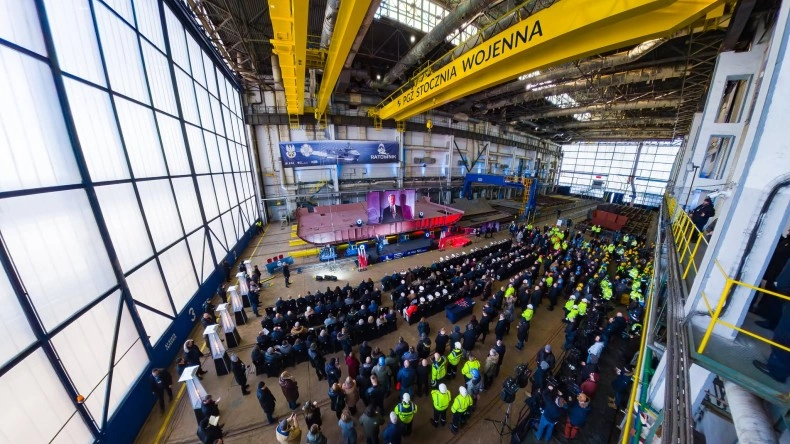


Representatives of central and local government, the shipbuilding industry, senior Armed Forces command, and other invited guests gathered at PGZ Stocznia Wojenna in Gdynia to witness the keel-laying ceremony for a new rescue vessel for the Polish Navy. Construction of "Ratownik", under way since November last year, has now reached a further key milestone.
The new vessel will join the Support Ship Division of the 3rd Ship Flotilla and will be based at the Naval Port of Gdynia. She will replace two ageing Piast-class rescue vessels commissioned in 1973–1974. The executive contract for delivery of the ship was signed in December 2024. The programme schedule provides for handover in the fourth quarter of 2029, with launching planned for 2027.
Significant for Defence and Industry
Today’s keel-laying ceremony was attended by representatives of the government, including the Ministry of National Defence and local authorities, members of the senior command of the Polish Armed Forces, and representatives of the maritime and technology sectors. Shipyard personnel directly engaged in the programme were also present, alongside foreign guests, including partners involved in naval shipbuilding projects for the Polish Navy.
Among those in attendance were Deputy Minister of National Defence Stanisław Wziątek; Secretary of State at the Ministry of State Assets Konrad Gołota; Vice-President of Polska Grupa Zbrojeniowa Jan Grabowski; Inspector of the Navy Vice Admiral Jarosław Ziemiański; Commander of the 3rd Ship Flotilla Rear Admiral Andrzej Ogrodnik; Head of Maritime Technology at the Armament Agency Captain Piotr Skóra; and President of the Management Board of PGZ Stocznia Wojenna Marcin Ryngwelski.
“This vessel is being constructed in a Polish shipyard and is the product of Polish technical expertise. It stands as proof that the national defence industry possesses the capability to deliver for the Navy. Ratownik is a specialised support unit, essential to safeguarding the operational activity of Polish naval vessels. Her modern rescue equipment and capabilities will form a critical component of the system ensuring the security of our naval assets and will materially enhance the fleet’s operational capacity. The Baltic Sea has become an arena marked by numerous incidents and threats to maritime infrastructure. New energy investments, including pipelines and offshore wind farms, require protection and the capacity to respond to emerging challenges,” said Stanisław Wziątek.
“There can be no strong navy without a dynamic, modern and sovereign shipbuilding industry. That is what we shall continue to invest in and develop, because alongside the construction of military security, the defence industry must also be strengthened, and shipyards form a pillar of our industrial and technological cohesion. We aspire to be a leader and a model for others. We have said before that this is the era of the rescuer; it will be a period envied by many navies worldwide. Moments such as this demonstrate that long-awaited, breakthrough developments for the Navy are finally taking place,” added Konrad Gołota.
“This vessel is 100 per cent a product of Polish technical thought and is being built under the supervision of the Polish classification society, Polski Rejestr Statków. As a shipyard, we have very limited time to complete construction. The vessel must be launched next year and delivered before the first submarine under the ‘Orka’ programme enters service in Poland. Our yard forms part of this year’s centenary celebrations of Gdynia, a city inextricably linked with shipbuilding and the Navy,” said Marcin Ryngwelski.

A Vessel for the Challenges of the 21st Century
Under the design assumptions, the future unit will measure 95 metres in length overall, with a beam of 18.8 metres and a draught of 5 metres. Maximum displacement is projected at 6,000 tonnes. The ship’s complement will comprise approximately 110 officers and ratings.
The vessel will be equipped with unmanned surface and underwater vehicles, as well as a flight deck capable of supporting helicopters and unmanned aerial systems. Her outfit will include a hyperbaric complex with decompression chambers, a diving bell, and systems enabling cooperation with the NATO Submarine Rescue System (NSRS). This equipment will permit rescue operations at depths of up to 300 metres and sustained operations at sea for several dozen days without replenishment.
On board will also be advanced navigation and subsea systems, alongside deployable fast workboats and both remotely operated and autonomous underwater vehicles intended for seabed monitoring and inspection.
In addition to supporting submarine crews, including maintaining readiness for submarine rescue operations, Ratownik will be capable of conducting search and rescue (SAR) missions, firefighting at sea — both in response to spills and aboard surface vessels — and supporting subsea works and the monitoring of critical infrastructure such as gas pipelines and subsea transmission cables.
The new vessel is also expected to constitute a significant Polish contribution to Allied activity, participating in multinational operations and exercises and providing safety cover during joint manoeuvres in the Baltic and beyond. This is particularly pertinent given NATO’s increasing activity in the region and the requirement for appropriate submarine rescue capabilities in the event of incidents involving Allied underwater units. Consideration must also be given to the growing traffic calling at Polish ports, driving increased cargo throughput, as well as the rapid development of offshore wind farms.
A Growing Industrial Challenge
Ratownik is currently the third naval vessel under construction at PGZ Stocznia Wojenna. The yard is presently building two multi-role frigates under the ‘Miecznik’ programme — the future ORP Wicher and ORP Burza. The first of these is scheduled for launch in August. At 138 metres in length and approximately 7,000 tonnes displacement, they represent the largest and most complex naval shipbuilding undertaking in the history of the Polish shipbuilding industry. Construction of the third unit, to be named Huragan, is also due to commence this year. All three frigates will join the Combat Ship Division of the 3rd Ship Flotilla and are scheduled for delivery between 2029 and 2031.
The Gdynia shipyard does not intend to conclude its naval ambitions with these projects, as it seeks further domestic and international orders. In parallel, it continues to execute contracts relating to the servicing and modernisation of naval vessels and stands ready to provide comparable support to the maritime forces of NATO partner states.
 DOWNLOAD PDF