

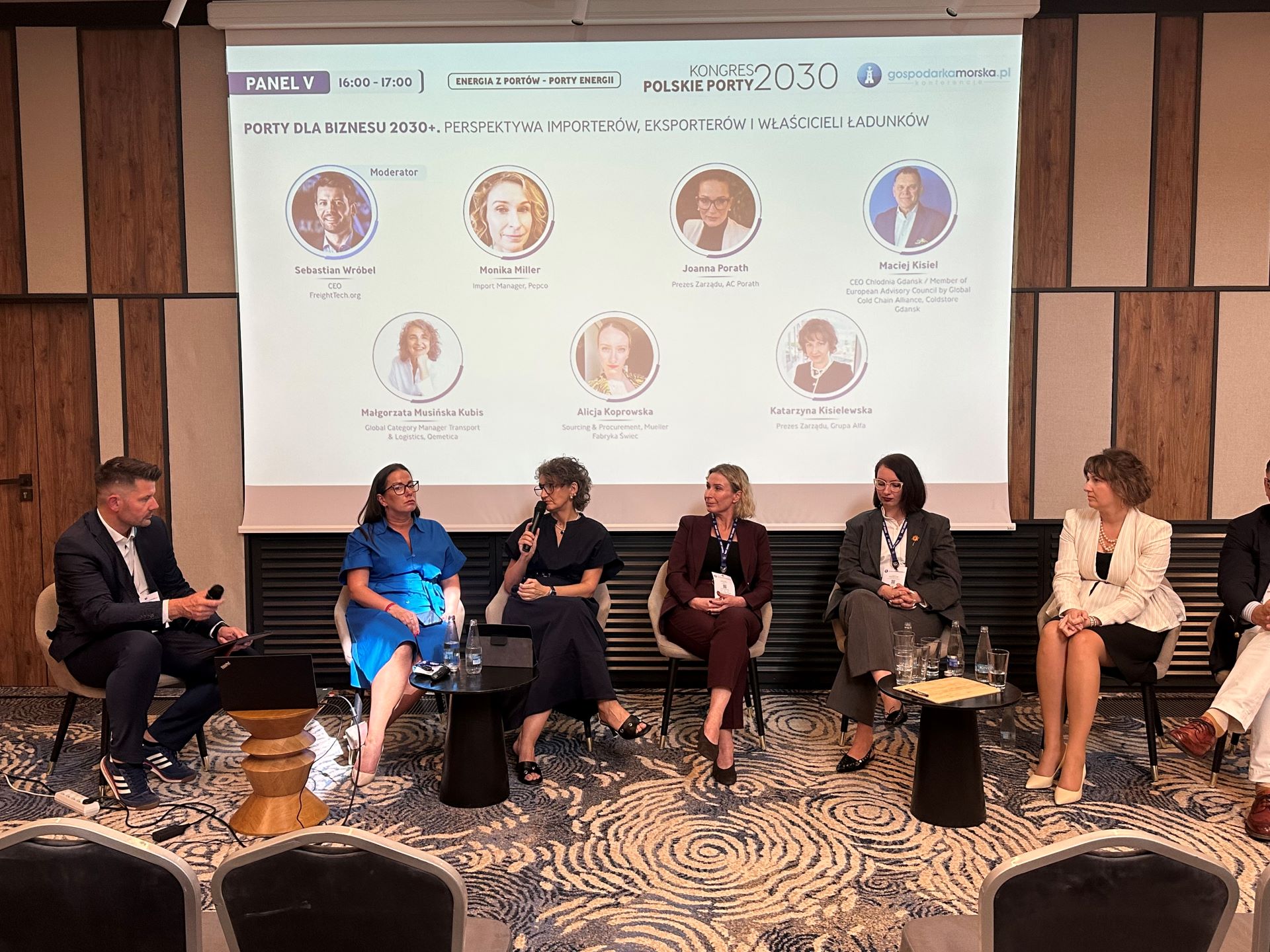


Efficient logistics, including seamless cargo handling and transport operations, remains one of the greatest challenges facing companies across every stage of the supply chain. This is particularly true when operational efficiency is constrained by complex regulations and administrative procedures, which can determine success or failure in the highly competitive international market, regardless of the efforts made by logistics professionals. These issues were at the centre of discussions during the Polish Ports 2030+ Congress in Sopot.
The panel, entitled "Ports for Business 2030+: The Perspective of Importers, Exporters and Cargo Owners", brought together Małgorzata Musińska-Kubis, Global Category Manager Transport & Logistics at Qemetica; Monika Miller, Import Manager at Pepco; Alicja Koprowska, Sourcing & Procurement at Mueller Fabryka Świec; Joanna Porath, President of AC Porath; Katarzyna Kisielewska, President of Alfa Group; and Maciej Kisiel, CEO of Chłodnia Gdańsk and Member of the European Advisory Council at the Global Cold Chain Alliance. The discussion was moderated by Sebastian Wróbel.
Opening the debate, Małgorzata Musińska-Kubis explained that, from the perspective of bulk cargo logistics, rapid delivery is the industry's highest priority, while warehousing represents little more than an additional cost. Direct transfers from ports to trucks or rail wagons, enabling cargo to reach customers without unnecessary storage, are therefore the preferred solution. However, legal obstacles—including customs and tax regulations—as well as the limited capacity of transport operators, continue to hinder such operations.
Monika Miller highlighted the growing importance of Polish ports for importers, driven largely by the expanding network of shipping services. Compared with five or ten years ago, the sector has changed dramatically for the better, with clear progress visible across the market. Nevertheless, she stressed that infrastructure development must be accompanied by regulatory reform:
"The development of ports is relatively predictable, but regulations must evolve alongside it. We base our decisions on risk analysis, yet it remains difficult to anticipate future legal requirements. As a result, procurement planning has to be approached with considerable caution."
Alicja Koprowska then discussed the perspective of manufacturers importing raw materials, including combustible wax blends used in candle production. Such cargo requires strict compliance with transport safety and storage regulations. Since warehousing significantly increases costs, her company focuses on ensuring that cargo is transferred directly from vessels onto trucks whenever possible. The same applies to glass products ordered for specific customer projects. While transport safety is well managed, administrative procedures often create delays. She therefore called for substantial simplification of customs formalities:
"The most expensive shipment is the one that fails to arrive on time. Storing cargo for months is also costly. We know exactly where every product should be delivered, so simpler customs procedures would make a significant difference, particularly when importing the same products on a regular basis."
Katarzyna Kisielewska focused on how customers perceive these challenges compared with logistics providers. Both sides recognise customs clearance as one of the biggest bottlenecks in Polish ports, with processing times sometimes reaching unreasonable levels. She also pointed to a lack of awareness among customers regarding the challenges customs agencies face while simultaneously expecting them to absorb additional costs.
Joanna Porath highlighted the complexity of Polish customs legislation, explaining that domestic regulations often make it impossible to complete formalities within the timeframes expected by customers. This frequently results in misunderstandings, even though customs intermediaries themselves have no influence over the legal framework:
"For us, quality and compliance during customs clearance are paramount. We strive to provide predictable and accurate services while reminding our clients that speed is not always the most important factor. Attempting to accelerate deliveries at all costs can ultimately create far more serious legal or sanctions-related problems."
She further noted that some importers deliberately bypass Polish ports because current fiscal arrangements are neither sufficiently transparent nor commercially attractive. She referred specifically to Article 33a of the Polish VAT Act, under which customs representatives may become jointly liable for unpaid VAT, together with interest, if the importer fails to settle the tax. According to Porath, this discourages foreign importers, including companies from the Czech Republic, from routing cargo through the Port of Gdańsk. Faced with additional financial liability under Polish law, many ultimately choose German ports instead, where fiscal procedures are perceived as simpler and more predictable.
Maciej Kisiel shared a similar assessment from the perspective of the frozen food industry, particularly seafood logistics. He argued that Polish customs procedures remain excessively complex and discourage international businesses, prompting many to redirect shipments from Gdańsk to ports such as Hamburg. As Secretary of the Polish Fish Processors Association, he added that high administrative costs also undermine competitiveness and hinder efforts to optimise logistics operations:
"Logistics thrives on silence. Discussion begins only when something goes wrong. And problems arise because regulations are overly complex, procedures are excessively bureaucratic and there is a shortage of qualified personnel. All of this prolongs the time required to complete customs formalities before cargo can continue its journey. The Port of Pomerania project and the new terminal represent major opportunities. However, unless regulations and procedures are simplified and staffing levels in customs and legal administration increase, we will not fully benefit from these investments."
 DOWNLOAD PDF