

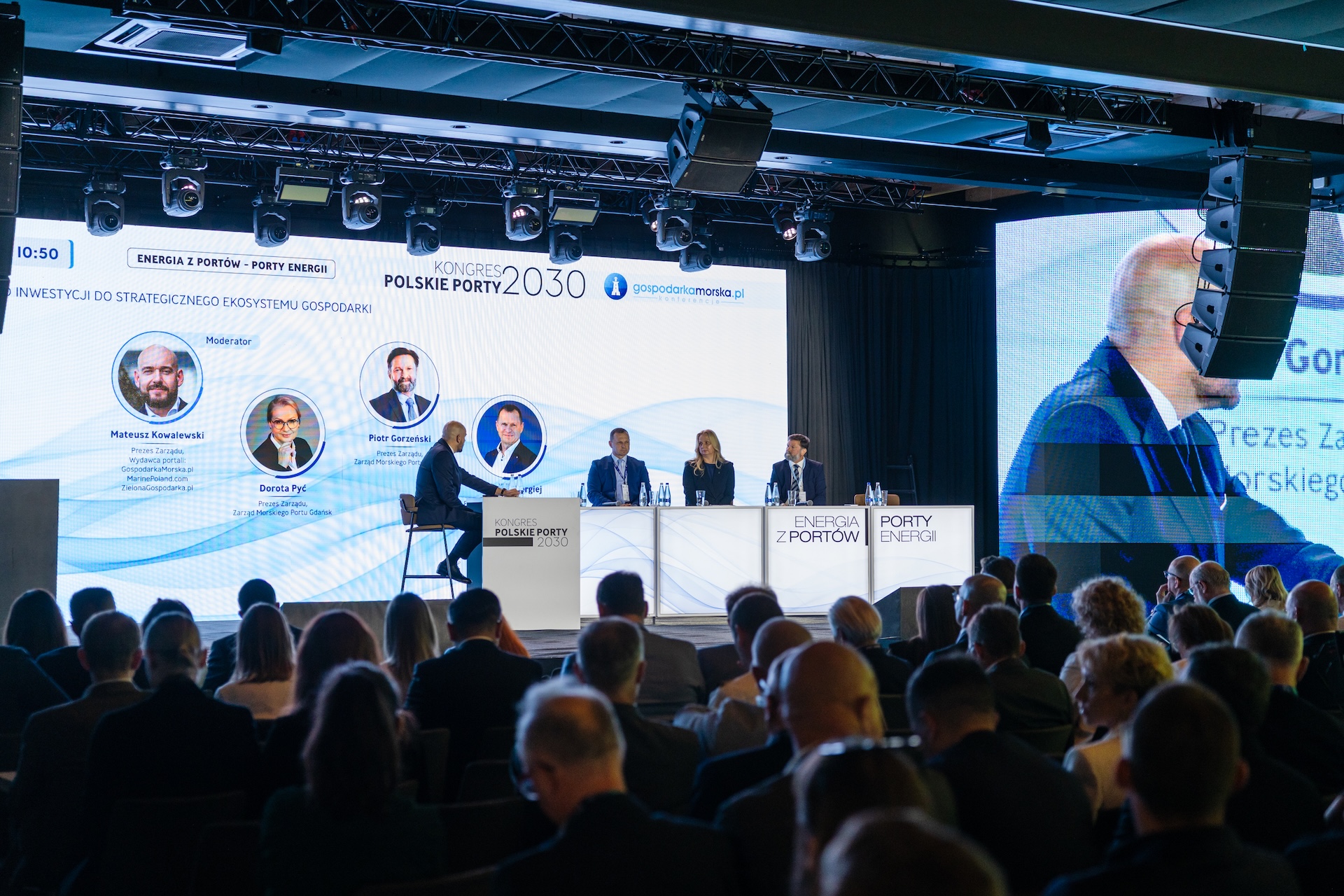


Another year, another set of topics to discuss. This year’s Polish Ports Congress 2030+ was held under the banner “Energy from Ports, Ports of Energy”, but energy was by no means the dominant theme of the discussions. After all, as gateways to the world, ports must not only ensure sufficient capacity, but also provide security and protection.
This year’s spring season of conferences and industry meetings in Poland’s maritime economy came to an end in Sopot with the most important event for the country’s seaports, terminals, cargo handling and maritime transport sector – the Polish Ports Congress 2030+, held in Sopot on 23 and 24 June. This year’s event was held under the banner “Energy from Ports, Ports of Energy”. The slogan could be taken literally, as considerable attention was devoted to offshore energy, which is becoming increasingly important for the maritime sector. But “energy from ports” also means the drive to develop. This has been a defining feature of Polish seaports in recent years, as confirmed in an interview with Gospodarka Morska by Arkadiusz Marchewka, Deputy Minister of Infrastructure, who said that the country’s ports are in excellent condition.
“The facts speak for themselves, as the figures and performance of these ports clearly demonstrate,” Marchewka said. He added that the results recorded during the first months of this year also confirm this trend, despite the disruption caused, among other factors, by the crisis in the Middle East.
Resilience through investment
However, the most important theme to emerge repeatedly during the Polish Ports 2030+ Congress was not cargo throughput, but the resilience of Poland’s seaports. Polish ports understand and pursue resilience in broadly similar ways.
“Today, resilience is built through competitiveness. The more we invest, creating opportunities to handle new cargo groups, the more flexible and, consequently, resilient we become. Of course, the fuel crisis triggered by events in the Middle East clearly demonstrated that the entire world is dependent on these interconnections. At the same time, as Poland, we believe that our ports are genuinely resilient, and the results clearly demonstrate this,” said Arkadiusz Marchewka.
Piotr Gorzeński, CEO of the Port of Gdynia Authority, offers a straightforward definition of resilience. In his view, a resilient port is one capable of continuing to operate even in the face of direct attempts to disrupt its operations, while also being able to adapt to changing trade routes and supply chains.
“In this context, a degree of flexibility and the ability to adapt the port’s operating model will also be necessary in order to remain attractive to shipping lines and operators,” Gorzeński said.
The flexibility referred to by the Port of Gdynia CEO should be understood as the ability to handle a wide range of cargo types. This kind of versatility has recently become a key objective for many terminals. At the same time, however, it is in some respects the opposite of specialisation, which allows a particular cargo group to be handled faster and more efficiently using dedicated equipment and specialised personnel.
Jarosław Siergiej, CEO of the Szczecin and Świnoujście Seaports Authority, argues that such versatility is also an important element of business continuity – a strategy based on identifying the core systems that must remain operational during a crisis in order for a port to maintain at least a basic level of functionality. In such circumstances, it is important for one part of the port to be able to take over the handling of cargo groups normally handled elsewhere.
“This is our response to all kinds of threats. Of course, there are terminals operated by different companies within the port, and they have different profiles. Some are versatile, while others are specialised. This diversity is also necessary in our ports. The most important thing is for the port as a whole to retain this versatile character, which increases its resilience to all kinds of threats,” Siergiej said.
Preparing for threats requires an understanding of what to expect.
“We need to identify risks. We need to assess them, estimate their potential impact and manage them,” said Dorota Pyć, CEO of the Port of Gdańsk Authority.
She added that modern technologies, which are becoming increasingly widespread across ports and terminals, could provide valuable support.
“Today, we need to look for ways to further strengthen competitiveness while, on the one hand, running our business and, on the other, strengthening the port in terms of security, cybersecurity and IT systems. We need to invest today in AI projects that are properly tailored and designed for the Port of Gdańsk, which will take us to the next level. It is important for us to have tools in the form of systems capable of identifying risks for us,” said the CEO of the Port of Gdańsk.
The next generation is coming
Mateusz Kowalewski, organiser of the Polish Ports 2030+ Congress, fully understands the need to bring the port sector closer to artificial intelligence and other digital technologies. This is why the conference was expanded this year with a new element.
“This year, we decided to put a very strong emphasis on technology. We are living through a period of enormous technological transformation. AI-related technologies are becoming part of business processes and our everyday lives. We decided to introduce an innovative format – a hackathon, essentially a challenge for young IT developers,” Kowalewski said.
The challenge was taken up by 30 young programmers, who had 24 hours to develop solutions and applications addressing problems encountered in their daily work by the Congress partners. The winning team came from AGH University of Krakow, led by Aleksander Kopyto. It developed an application designed to integrate and optimise data transmission between all stakeholders involved in the logistics process for the benefit of the Gdynia Maritime Agency.
“We do not want to fall behind; we want to catch up with the best. Initiatives such as this, driven by young people who are full of ideas, creative, looking for new solutions and thinking digitally, can add real value to what we do every day,” Arkadiusz Marchewka commented.
Polish ports are growing
Polish ports have been increasing their cargo throughput for several years. The Polish Ports 2030+ Congress is growing alongside them. This year, its fourth edition attracted more than 900 participants, setting another attendance record in the event’s history.
For the first time, the programme also featured shorter, more dynamic discussions in a format known as the Wave Chat. Over two days, participants took part in panels, interviews and presentations held across two congress halls.
As in previous editions, the event also featured an exhibition area where the event’s partners could showcase their products and services. And, as has become customary, following the first day of the Congress, guests gathered for a gala dinner.
During the evening, the Lighthouses of the Maritime Economy awards were presented, while the event was rounded off with a performance by Kasia Kowalska and her band.
Photo: GospodarkaMorska.pl
 DOWNLOAD PDF