

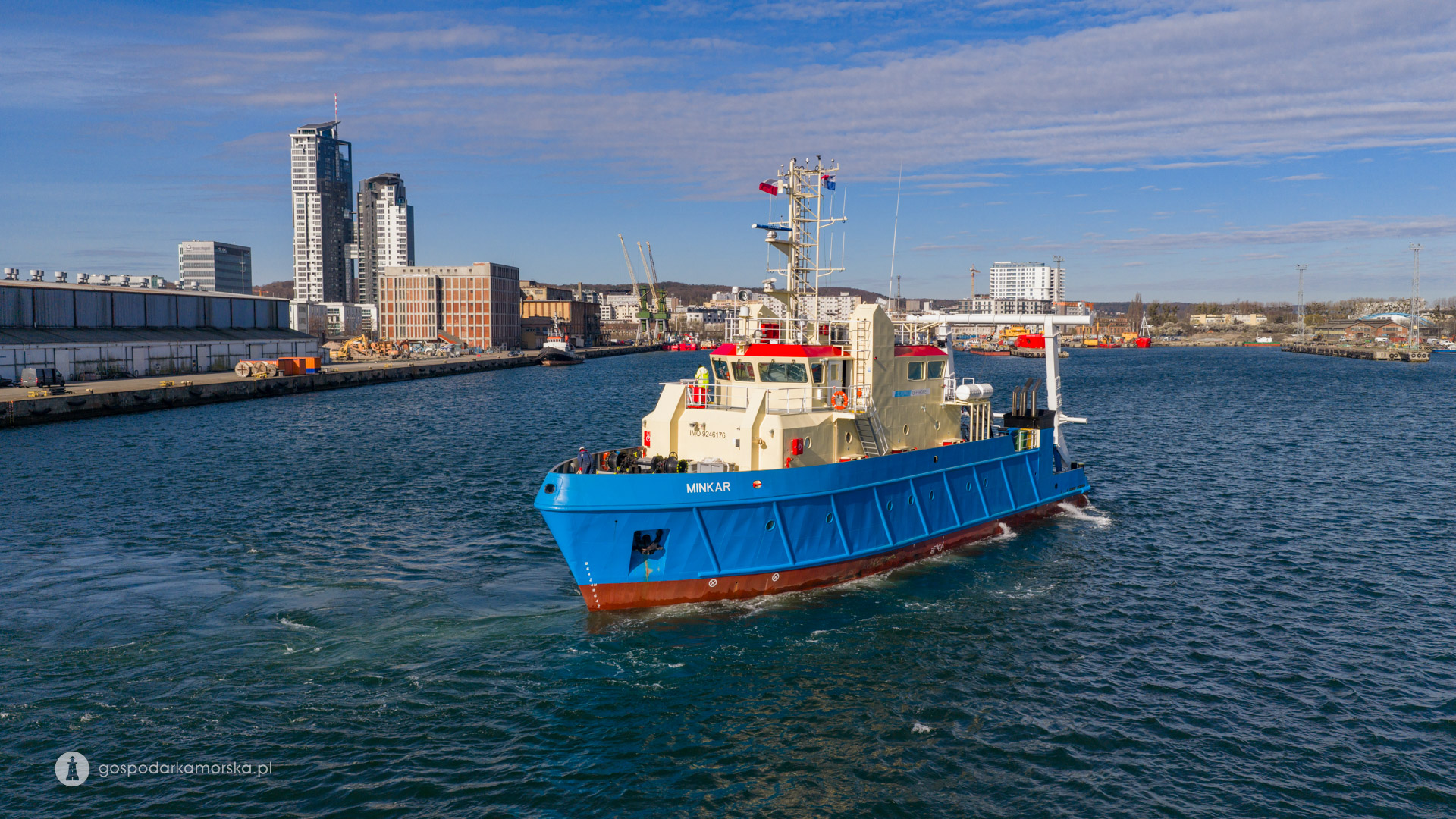


Sea trials are currently under way on the Baltic Sea for the modern specialist vessel MINKAR, built by the Gdynia-based shipyard Elektro-Plus. The unit has been designed to carry out advanced offshore operations, and the current testing phase is intended to confirm its reliability and operational safety.
The trials are focused on verifying the systems responsible for keeping the vessel in a fixed position even in the event of partial failure of onboard components. This is one of the key performance parameters for offshore vessels, where precise positioning directly affects operational safety.
“MINKAR is equipped with a DP-2 (Dynamic Positioning Class 2) system, which allows the vessel to maintain an accurate position and heading without the use of anchors, even in challenging weather conditions. It uses an integrated system of computers, sensors and propulsion units that continuously compensate for wind, waves and sea currents,” explains Arkadiusz Zieliński, Technical Director at Elektro-Plus.
Dynamic Positioning (DP) classes define the level of redundancy and reliability of positioning systems. In DP-1, a single failure may result in loss of position. DP-2, by contrast, requires duplication of critical components, ensuring that a single failure does not compromise the vessel’s stability. This solution is particularly valued by offshore operators, especially in operations involving subsea robotics or offshore wind installations, where safety is paramount.
MINKAR – a multi-purpose offshore vessel
MINKAR is an example of an advanced approach to building work vessels, combining high functionality with modern onboard automation. Thanks to its systems, the ship is capable of performing a wide range of tasks – from maintenance and installation work to offshore operational support.
The vessel was designed by Elektro-Plus, a Gdynia-based company specialising in shipbuilding, outfitting, and the integration of electrical and automation systems. The company has been active since 2003 and delivers projects for both domestic and international clients.
“MINKAR is a multi-purpose vessel designed for survey operations, subsea robotics support, and specialised research and technical offshore work. Its use depends on the charterer’s needs and the nature of the operations being conducted,” says Maciej Zwara, CEO of Elektro-Plus.
He adds that modern vessels are distinguished not only by their technical specifications but also by their level of automation and crew comfort.
“Compared to ships built 20–30 years ago, modern units offer advanced control systems, integrated monitoring and significantly improved living conditions for the crew. This translates into both safety and operational efficiency,” he notes.
Despite its relatively compact size, MINKAR has been designed to operate in demanding maritime conditions. It can be deployed not only in the Baltic Sea, but also in the North Sea, the Mediterranean, or off the coast of Africa – wherever weather conditions allow safe operations and offshore installations are planned or under development.
Strong prospects for offshore growth
The vessel’s owner will be Seaspan Offshore, part of the Glomar Shipmanagement group, one of Europe’s leading offshore service providers. The company specialises in installation support, maintenance operations and offshore infrastructure services.
“In the next five years, the offshore market is expected to grow gradually, driven by geopolitical factors and the increasing importance of energy security,” says Melvin Weij, CEO of Glomar Shipmanagement.
He adds that the expansion of offshore wind projects in the United Kingdom, the Netherlands and the Baltic Sea region will drive demand for specialist offshore vessels. “Price remains a key factor, but reliability and high service quality are equally important. Vessels such a MINKAR help strike a balance between competitiveness and operational standards,” he notes.
Specialists from Gdynia
Elektro-Plus Sp. z o.o. has been operating since 2003. Initially focused on service work, ship construction and repairs without its own shipyard facilities, the company has since developed significantly and now operates its own quay in Gdynia.
“We have been functioning as a fully-fledged shipyard for two years now, and building vessels in-house – as in the case of MINKAR – marks a new stage in the company’s development,” says Maciej Zwara.
Today, the company carries out vessel modernisations, automation system integrations, and retrofit projects adapting older ships to new market requirements.
In the CEO’s view, Polish companies have a real opportunity to play a significant role in the development of the domestic offshore sector. More and more firms from the Pomeranian region are becoming involved in offshore wind and energy infrastructure projects.
The greatest challenge remains access to skilled specialists. Building and operating modern vessels requires high-level competencies, and training staff to work independently with advanced systems takes several years. “We, as businesses, must encourage today’s students to pursue offshore-related education, as this is currently a major driver of regional development for the coming decade,” he adds.
MINKAR in figures
MINKAR is a modern DP-2 class offshore vessel designed for research, maintenance and operational support tasks at sea. The vessel measures 38.08 metres in length, 9.5 metres in beam, with a draught of 3.43 metres and a gross tonnage of 499 GT. It can accommodate up to 22 people on board, with 14 cabins available for crew and client personnel, along with living, operational and survey facilities.
The vessel is equipped with a diesel-electric and conventional propulsion system, two Baudouin main engines rated at 599 kW, two azimuth thrusters and two bow thrusters. The Kongsberg K-POS 21 DP-2 dynamic positioning system enables the vessel to maintain a fixed position even in the event of a single equipment failure.
MINKAR also features hydrographic survey and ROV support capabilities, including a moonpool, an 8-tonne A-frame, research laboratories and advanced navigation systems. This makes it a versatile platform for complex offshore operations in the Baltic Sea and other European waters.
 DOWNLOAD PDF