



Construction of Ocean Winds’ operational base has officially begun in the port hinterland of Władysławowo. The developer of offshore wind farms will manage the emerging BC-Wind wind farm from the site. It is an important step for the offshore company, but probably an even more significant one for the port itself.
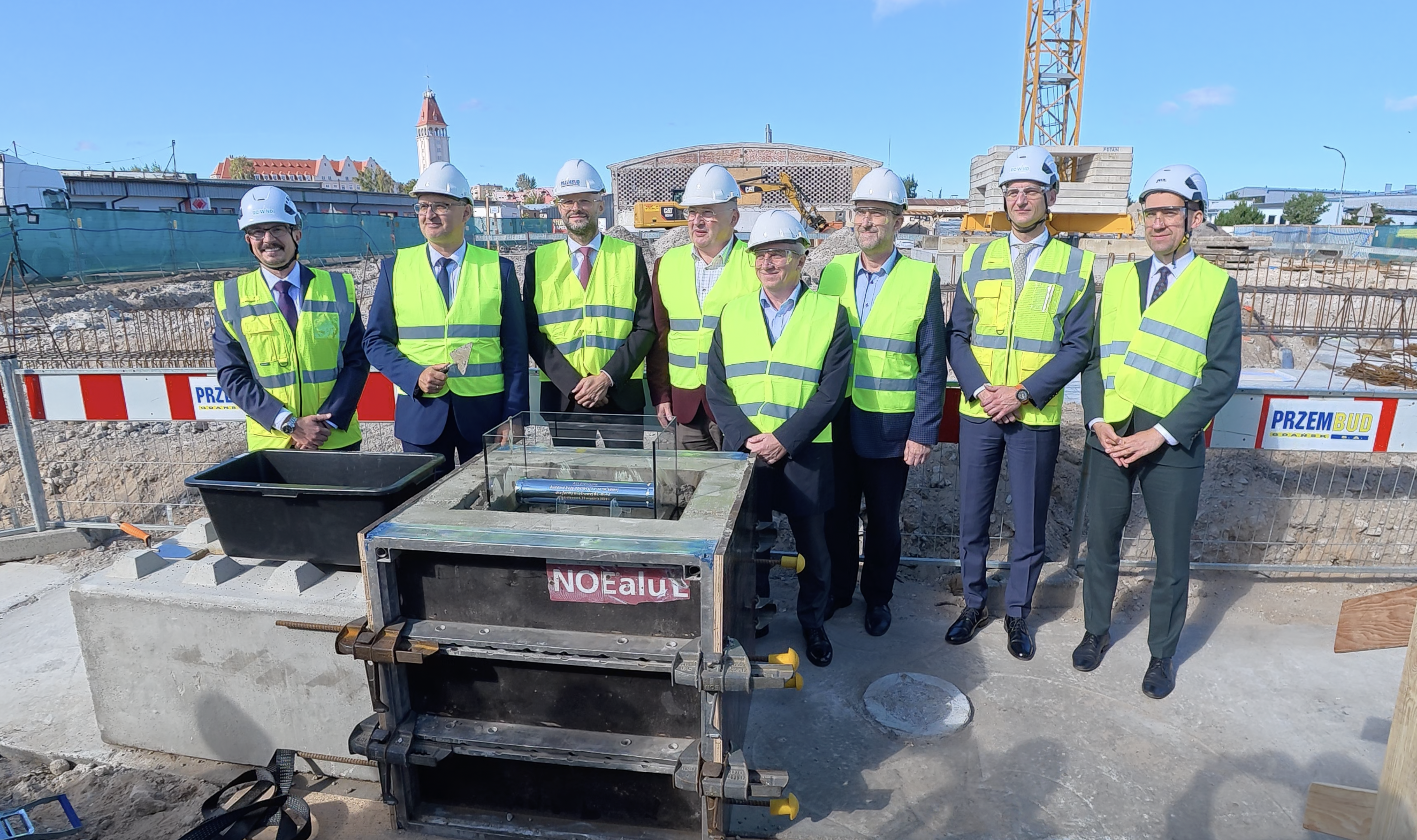
The plot located in Władysławowo, at the junction of Portowa and Władysława IV streets, has already been a construction site for some time, with work being carried out by Gdańsk-based company Przembud. The company is constructing the facilities of an operations and maintenance (O&M) base for Ocean Winds, which is developing the BC-Wind offshore wind farm in the Polish Baltic Sea. Foundations for the future buildings are already being laid, while on Wednesday, 23 September, the foundation stone and a time capsule containing memorabilia from the day were officially laid.
The base is expected to be completed in about a year and will take the form of a two-storey building housing an office section, including a Marine Coordination Center, as well as storage facilities.
Base to be ready within 12 months
“The O&M base will support the long-term operation and maintenance of the BC-Wind offshore wind farm, playing a key role in ensuring the project operates efficiently over the coming decades. It will also support the development of local expertise and create new jobs, thereby strengthening the region’s role in the rapidly developing offshore wind energy sector,” said Dominik Dados, O&M Senior Manager at Ocean Winds, during the inauguration ceremony.
Dados stressed that the project would not have been possible without effective cooperation with numerous partners, adding that the ceremony was also an opportunity to thank them. There is no doubt that the start of construction is also an important moment for the local community and business. Although offshore activity has been present in the port of Władysławowo, operated by Szkuner, for at least a dozen months – transformers for the onshore part of the investment were unloaded here, for example, while some of the vessels involved in seabed surveys were also based here – this is the first permanent physical sign of the sector’s presence in Wielka Wieś.
The base is being built by Gdańsk-based Przembud. The facilities are being constructed on a plot within the boundaries of the seaport which had previously been developed. On 31 July 2025, the investor received permission to demolish some of the existing buildings and construct an office and warehouse facility. During the demolition of the old buildings, Ocean Winds invited the local Volunteer Fire Service and the Tricity-based Special Rescue Group of the Polish Red Cross to conduct training exercises on the site, including searches for and the rescue of people buried under rubble.
During a brief presentation, Dominik Dados showed a visualisation of the base being built, prepared by Haskoning Polska. The modern two-storey building, including a mezzanine, will be clad in Alucobond aluminium panels. One section will be light-coloured and will contain administrative facilities. The ground floor will house facilities for technicians, as well as operational and technical areas for servicing CTV units (Crew Transfer Vessels – vessels used to transport personnel to the wind farm). The first floor will contain offices and the Marine Coordination Center, which will be responsible for supervising all maritime operations within the base and wind farm. The second section of the building, designed in grey, will serve as a warehouse. Overall, the facility will have approximately 1,200 square metres of usable floor space.
“This is where we will manage the entire wind farm and monitor it. This is where our technicians and service personnel, who will carry out daily maintenance during this phase, will have their facilities. And, of course, this is where we will dispatch the CTVs that will transport our service personnel to the wind farm area,” confirms Kacper Kostrzewa, Managing Director of Ocean Winds in Poland.
The journey for technicians from the Władysławowo base to the wind farm, located approximately 20 nautical miles (37 km) offshore, will take around 70 minutes. Completion of the base is scheduled for the fourth quarter of next year.
Ocean Winds expects the construction of the base to attract other companies to the Władysławowo area or the town itself that will cooperate with the developer. Such a development would increase the region’s economic importance. Dados expressed hope that employees at the future base would be recruited from the local community.
“Educational programmes are already being run in the region for this purpose, at the school in Puck and the school in Kłanino. I genuinely hope that I will be working with these people here in Władysławowo,” said Dominik Dados.
Once the base becomes operational, around 30 people will be employed there.
“The Port of Władysławowo, which has always been known for fishing and later for tourism as well, will gain additional areas of activity. It will become more diversified in terms of its sources of revenue, but also economically and in terms of financial stability,” said Władysławowo Mayor Roman Kużel.

Future O&M Ocean Winds in Władysławowo; Source: Ocean Winds / Haskoning Polska
No KPO funding for offshore, but offshore is coming
The decision to select Władysławowo as the operational base for the BC-Wind farm was made years ago. Ocean Winds and Szkuner, the operator of the Władysławowo port, signed a land lease agreement in May 2022. Under the agreement, the port will also make a quay available to the developer, from which the company will conduct its operations using vessels.
“Władysławowo has actually been the best location for this type of facility for us for a long time, for many reasons. First and foremost, its distance from our wind farm – it is effectively the seaport located closest to the BC-Wind farm. At the same time, connectivity was crucial, as was how quickly we would be able to get technicians, service personnel and the entire wind farm operation here. The proximity of the Tricity and the airport is very important,” explains Kacper Kostrzewa. “But above all, it was the port’s excellent infrastructure that made the difference. From the outset, during our analyses, we concluded that Władysławowo was the port where the infrastructure would be the most robust and would give us the best operational opportunities for running the wind farm.”
“I have always emphasised that Władysławowo is the best-located port in Poland. It is the safest port,” says Witold Wawrzonkoski, President of Szkuner, which manages the port as well as the local shipyard, fish-processing plant and fishing fleet. “Cape Rozewie does an important job here, protecting us from the prevailing northern and north-western winds. This makes entering the port very safe. We are also a large port. There is plenty of space here. Władysławowo has more than 2 km of quays where vessels can be stationed,” the president explains.
The quays at the Port of Władysławowo are essentially ready and do not require adaptation. Operations carried out as part of the O&M base will be conducted using light, fast CTVs, which have a draught of up to 2–2.5 metres. There will, of course, occasionally be a need to load relatively heavy equipment onto them, meaning that the quays must have a load-bearing capacity of at least 10 kN per square metre. Meanwhile, as Witold Wawrzonkoski points out, three shipments of transformers for the onshore substation at Choczewo have already been unloaded in Władysławowo. The substation will receive electricity generated by offshore wind farms. Each transformer, including its base, weighed around 450 tonnes.
“This shows that our quays are prepared even for such heavy cargo-handling operations,” stresses Witold Wawrzonkoski.
The port’s capabilities could increase further in the future. Szkuner has been working for two years on a project to modernise and redevelop key quays. Witold Wawrzonkoski hopes that by the end of this year the company will obtain the necessary construction permit and be ready to begin work. Once completed, the quays will be able to accommodate not only small CTVs but also significantly larger SOVs (Service Operation Vessels), offshore vessels used to operate and maintain wind farms. Such vessels are generally larger because they remain at offshore wind farms for many days or even weeks, with technicians and service personnel also living on board. These vessels naturally require greater water depth in port. Following the planned modernisation, Władysławowo will be able to accommodate vessels with a draught of up to 6–6.5 metres.
In recent years, Szkuner and its president Witold Wawrzonkoski have done considerable work to attract the emerging offshore wind energy sector to Władysławowo. The establishment of the Ocean Winds base is the first major success, but it is not the first confirmation of the port’s advantages for the sector. As already mentioned, three complex transformer-handling operations have previously been carried out here for the onshore substation at Choczewo. The transformers arrived in Poland and were then transferred from a cargo ship to a barge in Gdynia before being transported to Władysławowo. There, they were unloaded ashore and subsequently transported by road to the construction site in Choczewo.
The Orlen-owned company Orlen Neptun VIII, which is developing the Baltic East offshore wind farm project, also sees Władysławowo as a potential base. In the “Baltic East Offshore Wind Farm Supply Chain, Materials and Services Plan” submitted in 2025, the company stated that, out of “seven locations analysed, the ports of Łeba and Władysławowo were selected for further, in-depth analysis”. Initial discussions were held with representatives of the two ports “regarding the possibility of signing land reservation agreements for the construction of a service base together with a quay serving CTV units”.
In May 2026, meanwhile, the Regional Directorate for Environmental Protection in Gdańsk received an application from Orlen Neptun for an environmental decision for a project entitled “Redevelopment of the Przyslipowe Quay and Passenger Pier in the Port of Władysławowo for the Baltic East Offshore Wind Farm”. The application is currently being processed. In September, the Regional Directorate for Environmental Protection announced for the second time that it could not be considered within the prescribed timeframe due to the need to obtain opinions from other authorities and supplement the documentation.
Everything indicates, however, that at least two operational bases for offshore wind farms will be operating in Władysławowo. This is a major success for the port, which competed with other local centres, above all Ustka and Łeba, to attract as many offshore investments as possible. Unlike its competitors, however, Władysławowo was not included in Poland’s National Recovery and Resilience Plan (KPO) and did not receive funding for the construction of an offshore terminal.
The Maritime Office in Gdynia received more than PLN 200 million from the KPO for projects involving the construction of such terminals – PLN 220 million for Ustka and PLN 190 million for Łeba. These funds are being used for work on breakwaters, including the reconstruction of existing structures and the construction of new ones, as well as quays, approach channels and a turning basin in Łeba. The Port of Darłowo also received nearly PLN 200 million for projects related to the offshore industry. A project to reconstruct a breakwater implemented by the Maritime Office in Szczecin received nearly PLN 124 million in KPO funding.
Formally, this project is an investment in access to the port, but it was included in KPO component B2.2.3, “Construction of offshore terminal infrastructure”, and the documentation refers to vessels servicing offshore wind farms entering the port. Meanwhile, the Municipality of Darłowo is implementing a project entitled “Modernisation and expansion of hydrotechnical facilities in the Port of Darłowo for the servicing and maintenance of offshore wind installations”, which received PLN 74.04 million from the KPO.
The Port of Władysławowo, meanwhile, received no KPO funding, despite seeking financing for its expansion. As early as March 2022, during a joint meeting of the Senate’s committees on Environment, Budget and Public Finance, the Extraordinary Committee on Climate, and the Infrastructure, National Economy and Innovation Committee, Władysławowo Deputy Mayor Kamil Pach said that documentation had been prepared for the expansion of the port, including with offshore wind development in mind.

Construction site of the O&M Ocean Winds in Władysławowo. Photo: GospodarkaMorska.pl
Offshore matters locally
Local issues featured prominently during Wednesday’s ceremony marking the official start of construction and the laying of the foundation stone. Emil Rojek, Deputy Voivode of Pomerania, stressed that Ocean Winds’ investment in Władysławowo forms part of Poland’s broader energy transition, aimed at making the country’s energy production independent.
“This is a major undertaking which, ultimately, is intended to provide us with around 20% of all electricity produced for the Polish system from wind – from an industry that meets our needs in a far more stable way than solar power generation and more stably than onshore wind energy,” the deputy voivode said. He added that this production would be “in our hands”.
“It is based on our resources, rather than resources dependent on geopolitical turbulence, and on energy which may not be the cheapest, although some people believe it will be very cheap, but above all will be stable, reliable and in our hands. In hands that allow for ongoing supervision, managed, of course, by entities professionally specialised in wind energy management, but directly connected to the Polish system rather than through various ocean-based channels and supply chains.”
Jarosław Kumięga of the Marshal’s Office of the Pomeranian Voivodeship stressed that, from the administration’s perspective, it is important that the energy transition should not be limited solely to adding new megawatts in the Baltic Sea.
“The energy transition must also mean the development of support for businesses, ports, expertise and jobs. In the case of BC-Wind, we can already see concrete examples of this approach. The project will use the Polish ports of Gdańsk and Świnoujście, and Polish companies are participating in its supply chain. Crist Offshore is responsible for the offshore substation, and today another element of this chain is being created here in Władysławowo,” said Kumięga.
Tomasz Herrmann of the Puck County Office, meanwhile, hopes that the construction of the Ocean Winds base and the port’s efforts to attract the offshore sector will help reduce the outflow of residents from the county.
“We would like them to be able to find employment here, to build their professional future precisely in Puck County and, as a result, also their family lives, which is very important to us,” said Herrmann.
BC-Wind
The BC-Wind offshore wind farm is the first project being developed by Ocean Winds in the Baltic Sea. The wind farm, which will be located approximately 23 km from the coast, will consist of around 26 turbines to be supplied by Siemens Gamesa. Its capacity will reach 390 MW. Once operational, it will generate enough electricity to power almost half a million households.
Like all offshore wind farms currently under construction along the Polish coast, BC-Wind will use monopile technology, with the turbines installed on individual piles driven deep into the seabed. The wind turbines will stand in waters with depths ranging from 35 to 60 metres.
As Dominik Dados reported, the directional drilling beneath the dunes has already been completed. The cables connecting the wind farm to the onshore substation at Choczewo will be installed through these drillings. Work on the power substation began last year. Heavy offshore construction work is scheduled to begin in 2027, with the installation of monopile foundations. In 2028, the schedule calls for the installation of the turbines and the start of initial electricity generation. The entire BC-Wind farm is scheduled to enter commercial operation at the beginning of 2029.
Photo: GospodarkaMorska.pl
 DOWNLOAD PDF