

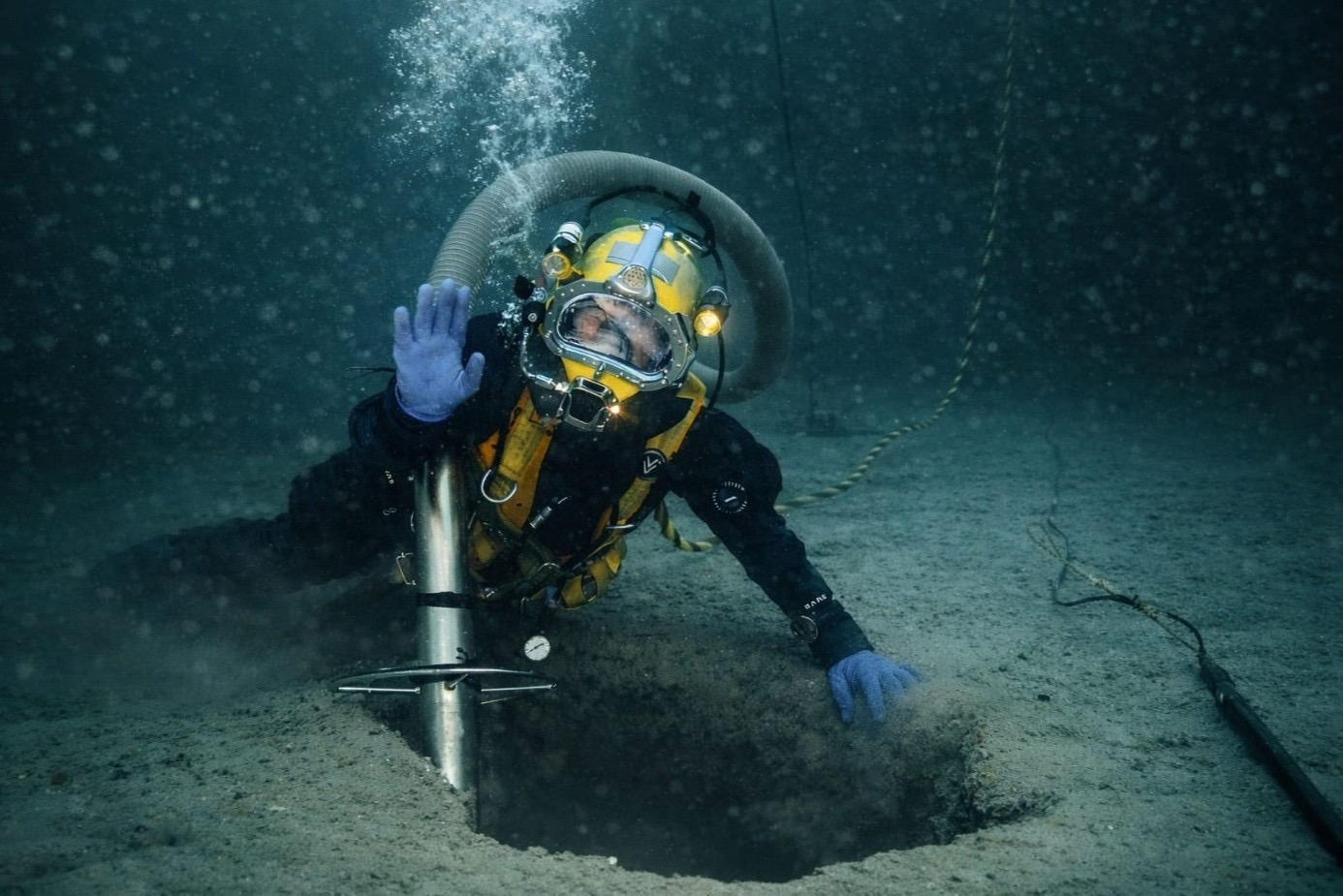


The area where components of the cooling system for the Lubiatowo-Kopalino nuclear power plant will be built is safe – this is the main conclusion of the recently completed survey for potential unexploded ordnance (UXO) conducted in the area designated for the offshore infrastructure of Poland’s first nuclear power plant. The survey covered more than 600 hectares of seabed and resulted in the recovery of around 500 objects. The work also produced a number of discoveries, revealing fragments of history hidden beneath the waters of the Baltic Sea.
– The construction of Poland’s first nuclear power plant requires the responsible and comprehensive preparation of every element of the investment. The completed UXO campaign is an important stage in the work on the plant’s offshore infrastructure. The offshore surveys confirmed that the area we examined is safe, while also allowing valuable evidence of the Baltic’s history to be secured. We are consistently carrying out the successive stages of the project, which is intended to provide Poland with a stable source of energy and become one of the foundations of our power system for decades to come. Every completed stage brings us closer to our most important goal – said Miłosz Motyka, Minister of Energy.
The UXO (Unexploded Ordnance) campaign was one of the key stages in preparing the offshore area for the investment. Its main objective was to detect any unexploded ordnance, remnants of weapons and metal objects on the seabed that could hinder further detailed geological surveys and future construction work related to the first Polish nuclear power plant project.
– Our goal, namely the commissioning and operation of Poland’s first nuclear power plant, lies in the near future, but we want to achieve it while respecting the past. The surveys just completed were a complex undertaking requiring cooperation between specialists from many fields, including archaeology. During the 10 months of surveys, we approached all finds with great care and attention, so as to secure not only the area for further works, but also objects of cultural heritage – added Marek Woszczyk, President of the Management Board of PEJ.
The work produced not only information relevant to the implementation of the investment. The Baltic seabed once again proved to be an area concealing traces of centuries of maritime navigation and trade.
Among the most interesting finds was a wooden barrel probably originating from a Hanseatic merchant vessel, dating from the 15th to 17th centuries, and an Admiralty anchor from the 17th or 18th century. Other discoveries included equipment from historic vessels, such as a manual anchor windlass together with an anchor, probably dating from the turn of the 20th century, as well as a wooden capstan used aboard ships to lift heavy loads and haul in ropes. Archaeologists were also intrigued by a four-cylinder marine engine manufactured by the French company Castelnau, most probably part of the propulsion system or equipment of a vessel from the first half of the 20th century. The artefacts discovered during the work constitute valuable evidence of the region’s history and human activity in the Baltic Sea.
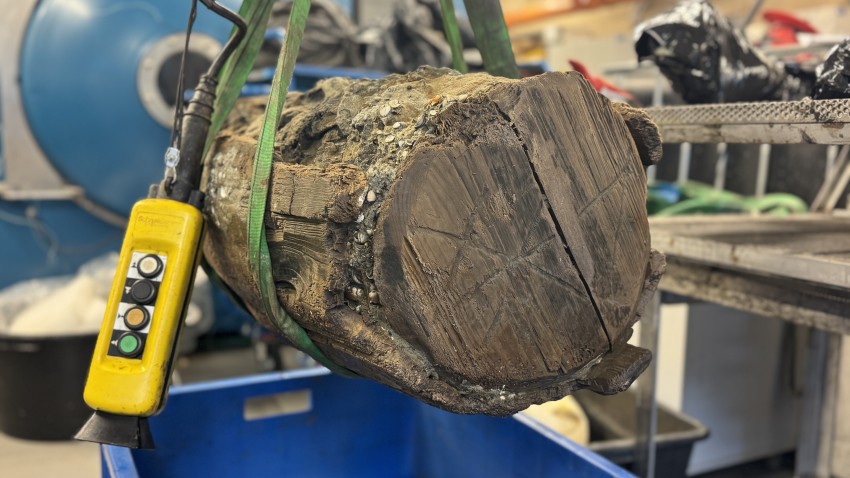
– The archaeological value of the objects discovered lies not only in their age or uniqueness, but above all in the information we can obtain by analysing them and properly interpreting the context in which they were found. A barrel, anchor, capstan or components of deck equipment are evidence of specific practices related to the construction, outfitting and operation of vessels. Their identification, dating and analysis allow us to gain a better understanding of the history of navigation in the Baltic and the trade routes and human activity associated with it. That is why it is so important for objects recovered during investment works to be properly documented, secured and subjected to further research and conservation – said Dr Marcin Westphal, Deputy Director for Substantive Affairs at the National Maritime Museum in Gdańsk.
The historic artefacts discovered during the UXO campaign will be transferred – as has already happened with the wooden barrel from the Hanseatic vessel – to the National Maritime Museum in Gdańsk, where they will undergo further research and conservation.

The work was carried out over a period of 10 months in the area designated for the plant’s offshore infrastructure. It was conducted by a consortium of two companies. Baltic Diving Solutions, based in Wejherowo County, played a key role in the diving operations, carrying out the uncovering, identification and recovery of objects from the seabed. The consortium’s partner, Geo Ingenieurservice Polska, was responsible for geophysical surveys and the analysis of the data collected. The experience of the local contractor, with its in-depth knowledge of conditions in the Baltic, significantly contributed to the efficient progress of the offshore work.
The most important outcome of the campaign was confirmation that there are no remnants of weaponry in the surveyed area that could pose a threat to the project, the safety of workers or the natural environment. This makes it possible to proceed safely to the next stages of the investment.

Carrying out the work required not only advanced equipment and specialist expertise, but also the ability to adapt to changing conditions at sea. During the campaign, the teams faced both winter conditions and ice cover, as well as challenging weather during the summer period. Particularly difficult conditions occurred during the stormy weather in July, when strong winds intensified high waves, forcing research vessels and diving teams to suspend operations.
An additional challenge was the parallel implementation of other offshore activities, including the third stage of geological surveys and marine environmental monitoring. This required close cooperation and careful coordination between all the teams involved.
Photos: Baltic Diving Solutions press release & Paweł Jóźwiak of National Maritime Museum in Gdańsk
 DOWNLOAD PDF