

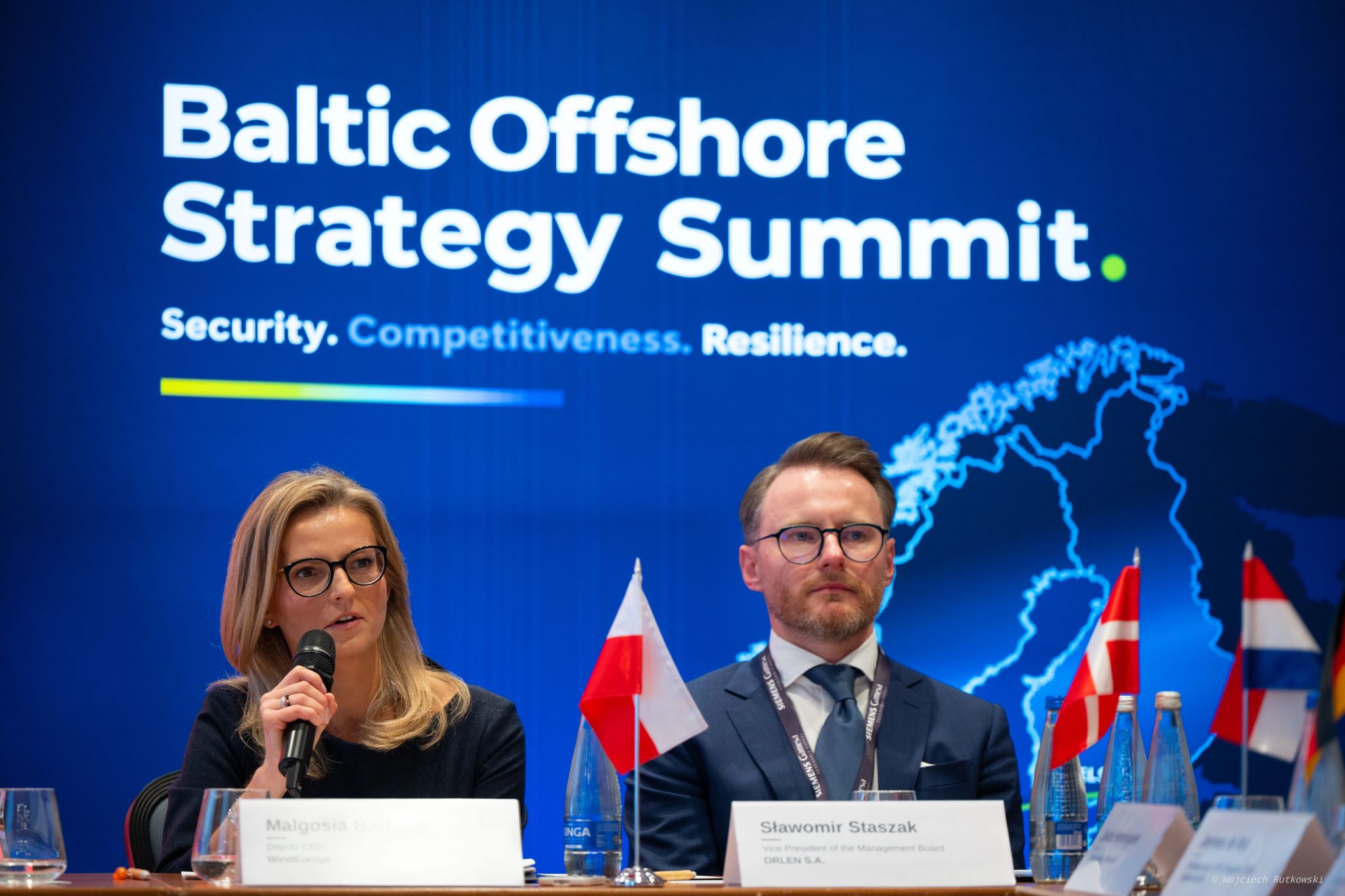


ORLEN is developing an international cooperation initiative in the Baltic Sea region. Following the establishment of the Baltic Energy Initiative in September, the next step is to bring industry organisations together and prepare a joint industrial strategy for offshore wind. “The time has come to turn political declarations into real infrastructure and concrete gigawatts of energy delivered to the grid,” says Sławomir Staszak, ORLEN Vice-President for Energy.
The Offshore Wind Poland 2026 conference in Warsaw also featured a number of international events dedicated to Baltic cooperation. One of these was the Baltic Offshore Strategy Summit, which focused primarily on cooperation between countries and businesses in the Baltic Sea region. The initiative forms part of a broader process of regional integration launched by ORLEN in September this year. At the time, the company presented its Baltic Energy Initiative – a cooperation platform for the region’s largest economic players, also intended to involve public administrations and the governments of individual countries.
“We are meeting at a time when the Baltic Sea region already has solid political foundations, developed by governments in recent years. I am referring, among other things, to the Marienburg Declaration and agreements on the protection of critical infrastructure. The question today is how best to translate this political capital into real infrastructure, its protection and concrete gigawatts of energy delivered to the grid,” said Sławomir Staszak, ORLEN Vice-President.
As Staszak pointed out, the importance of regional cooperation stems not only from the geographical location of the Baltic states but also from their role in the European economy and energy system. According to the Baltic Energy Perspective 2026 report, prepared by ORLEN in cooperation with S&P Global Energy, the countries of the region account for approximately 35 per cent of energy consumption and 37 per cent of carbon dioxide emissions. This means that the success of the energy transition in this part of Europe is of considerable importance to the European Union as a whole.
In the ORLEN representative’s view, the region should build on the experience gained through the integration of gas supply security systems. Following the reduction in supplies of raw materials from the east, energy terminals in Poland, Lithuania and Finland became components of an interconnected regional security system. A similar model of cooperation should now extend to offshore wind, hydrogen and carbon capture and storage (CCS) technologies.
Baltic Power demonstrates Poland’s offshore capabilities
ORLEN argues that regional cooperation should be built on tangible investment experience. One example is the Baltic Power project, being developed jointly with Canada’s Northland Power. As Sławomir Staszak reported, 76 wind turbines have already been installed and the project is approaching the stage at which it will begin supplying electricity to the grid.
“Our company has demonstrated that large-scale offshore investments can be delivered even in difficult geopolitical circumstances, during a pandemic, amid high inflation and high capital costs,” the ORLEN Vice-President emphasised.
At the same time, the scale of investments already undertaken and those planned shows how much remains to be done. According to figures cited by Staszak, even if all currently identified projects are completed by 2030, the combined capacity of offshore wind farms in the region will reach approximately 9.5 GW. That is less than half the 19.6 GW target set out in the Marienburg Declaration.
“We can therefore see a clear shortfall in installed offshore capacity that needs to be addressed. ORLEN and other companies operating in the Baltic Sea region should, and will, work to close this gap,” Staszak announced.
Industry organisations to prepare a joint strategy
A practical aspect of regional cooperation is an agreement signed during Offshore Wind Poland 2026 by industry organisations from the Baltic states. Its aim is to jointly develop a Baltic Offshore Wind Industrial Strategy. The agreement was initiated by the Polish Wind Energy Association (PSEW), with the support of WindEurope.
The document is intended to provide a basis for combining the industrial potential of individual countries and developing a shared vision for the growth of the Baltic offshore wind supply chain. This will include coordinating the development of factories, ports, installation vessels, grid infrastructure and the skills required to deliver future offshore projects.
As Dominika Taranko, Managing Director and Vice-President of Wind Industry Hub, explained during the conference, the Baltic Offshore Strategy Summit is a long-term initiative. Its purpose is to turn political plans and declarations into concrete industrial action. Through this initiative, PSEW aims to bring together industry organisations from individual countries and create a framework for jointly developing a regional industrial policy.
Baltic security requires international cooperation
An integral part of the summit was the aforementioned Baltic Offshore Strategy Summit ambassadors’ debate. Diplomatic representatives from Poland, the Netherlands, Norway, Germany, Finland, Denmark, Estonia, Lithuania, Latvia and Canada took part. They discussed the security of the Baltic Sea and opportunities to strengthen cooperation in the offshore wind sector. The shared conclusion was that energy security needs to be built on cooperation between regional allies and greater economic resilience.
From ORLEN’s perspective, the main task is to create the conditions in which political and business cooperation translates into further investment. As Sławomir Staszak emphasised, the right frameworks and conditions are needed to bring new generating capacity online. Its development will provide a practical test of the effectiveness of Baltic cooperation.
Photo: PSEW
 DOWNLOAD PDF
