

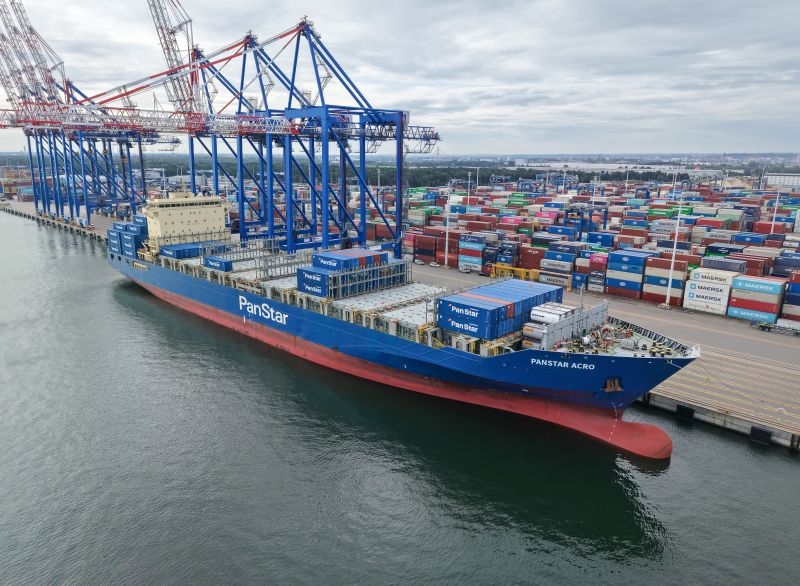


On Friday, 18 September, the container ship PanStar Acro called at Gdańsk during the night, marking the completion of its test voyage from Asia to Europe via the Arctic. The journey took around 20 days, and South Korean PanStar Group is already planning to increase the number of voyages along the Northern Sea Route. The shipowner expects that a seasonal service focused on high-value cargoes and shipments requiring short delivery times could establish a place alongside traditional routes and compete with the emerging services operated by Chinese carriers.
As reported by Japanese newspaper The Japan News, the Northern Sea Route, which runs along Russia's Arctic coast, provides a significantly shorter link between Asia and Europe than the route via the Suez Canal. For years, the route was used primarily to transport Russian energy commodities. However, as climate change reduces the seasonal extent of sea ice and concerns about disruptions along traditional shipping routes grow, interest in the Northern Sea Route is also increasing among container carriers.
As Baltic Hub points out, the call is intended to address one of the key questions facing the maritime and logistics industries today: whether the shorter Arctic route can become an economically viable complement to existing trade routes. Changing ice conditions mean that the route is increasingly being analysed as a supplement to existing links between Asia and Europe. At the same time, its use remains dependent on weather and ice conditions and on a limited shipping season.
PanStar is considering operating up to three Arctic voyages next year, followed by a gradual increase in frequency. According to comments by PanStar Group Chairman Kim Hyun-kyum, the services would primarily operate from July to October. During this period, conditions in Arctic waters are more favourable for navigation, while demand for cargo transport to Europe is also seasonally high.
Chinese competition
One of the main challenges for PanStar will be the expanding plans of Chinese carriers. Chinese companies began testing the Northern Sea Route as early as last year, and operators are gradually moving towards launching commercial services. According to The Japan News, many Chinese container ships are also being built with the ability to navigate in ice conditions in mind.
PanStar does not, however, intend to compete with the largest operators in terms of scale. The company plans to use vessels with a capacity of around 3,000 TEU or less, focusing on cargoes where delivery time is important, as well as higher-value goods. The carrier aims primarily to attract cargo from South Korea and Japan.
In the future, PanStar may also cooperate with Korean and Japanese carriers. The aim would be to increase the frequency of voyages and create a more competitive offering against the emerging services operated by Chinese carriers.
Around 20 days to Europe
The container ship PanStar Acro is 212 metres long and 33 metres wide. It has a capacity of 2,758 TEU. The vessel departed Busan, South Korea, on 22 August. After transiting the Northern Sea Route, it reached Felixstowe in the UK on 12 September. The vessel then sailed to Rotterdam, with Gdańsk the next port of call. It arrived there during the night of 17–18 September, completing the ship's test voyage from Asia to Europe via the Arctic. The entire journey took around 20 days.
According to the shipowner, whose comments were quoted by the Japanese newspaper, the transit time was around one-third shorter than via the Suez Canal when standard port calls are also taken into account.
For PanStar, however, the key consideration is not only the duration of the voyage but also the type of cargo carried. The company intends to target goods for which rapid delivery is important, but where air freight is too expensive. Potential cargoes include temperature-controlled chemicals, equipment for the shipbuilding industry and large wind turbine components. These are goods for which reducing transport time can have significant economic value.
Baltic Hub also notes that the selection of the Port of Gdańsk as one of the ports involved in the project confirms its role as a strategic logistics hub on the map of European trade. For the terminal, the voyage also provides an opportunity to participate in initiatives that could influence the development of global supply chains and new shipping routes in the future.
The voyage was not without difficulties
The test voyage through the Arctic was not without challenges. Heavy ice forced PanStar Acro to alter its route and add around 350 km to the voyage. Extremely low seawater temperatures were an additional challenge, affecting the operation of the vessel's engines. Technical problems and conditions along the route were not the only factors that could affect the future profitability of the service. Operating costs also remain a key issue.
According to PanStar, fuel prices rose by almost 40 per cent in the three months preceding the start of the voyage. The company cited the geopolitical situation and ongoing armed conflicts in Ukraine and the Middle East as among the factors behind the increase. Given the high operating costs, the first test voyage is likely to result in a loss.
Another challenge was the amount of cargo carried. PanStar Acro transported around 700 containers, compared with approximately 1,500 containers on standard voyages. Ensuring an adequate volume of return cargo will also be important for the economics of future services. PanStar is therefore in talks with Korean companies operating in Europe. The focus is primarily on goods that are currently often transported by air because of time pressure. Potential return cargoes include automotive parts and machinery.
PanStar is also analysing the possibility of using smaller and faster vessels in the future. Such a solution could reduce fuel consumption while better matching the characteristics of a planned Arctic service.
Photo: Baltic Hub press release
 DOWNLOAD PDF