

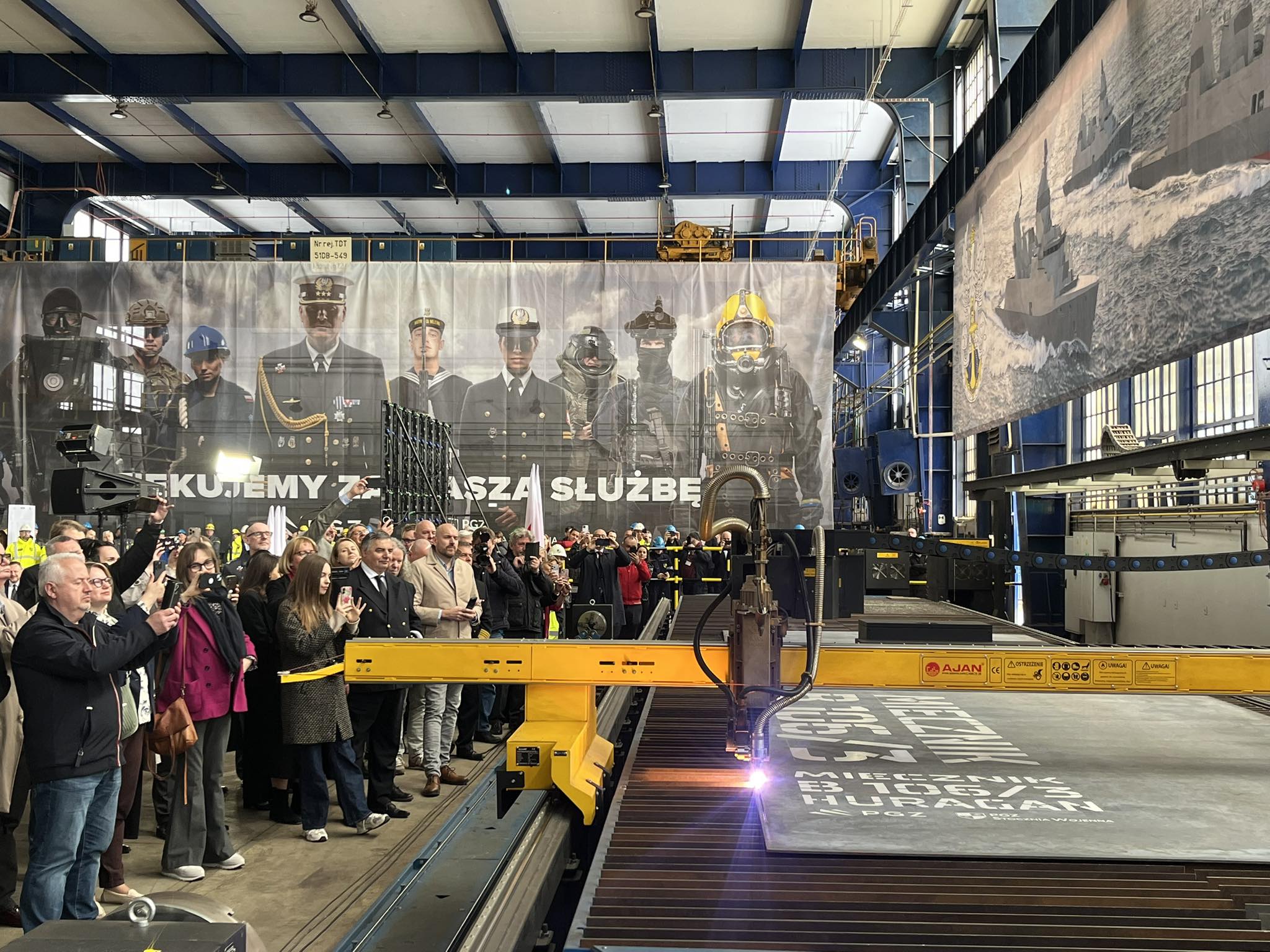


The Gdynia shipyard has, for the third time, hosted a ceremonial steel-cutting for a multi-purpose frigate for the Polish Navy. This means that construction of all planned vessels under the “Miecznik” programme is now under way at the facility.
The ceremony was not only an occasion to mark the start of construction of a new vessel, but also to present wider aspects of the undertaking and to recall how PGZ Stocznia Wojenna has developed. Infrastructure was expanded specifically for projects such as “Miecznik”, symbolised by the towering hull assembly hall, visible from a distance, where the ships are being assembled. It is also the tallest structure of its kind in the country, measuring 154 metres in length, 34 metres in width, and 46 metres in height, including ventilation systems installed on the roof. The main gate weighs 34 tonnes, and the gantry cranes inside are capable of lifting up to 100 tonnes. The building footprint covers nearly 6,000 m².
The contract with the Armament Inspectorate for the construction and delivery of the vessels was signed on 27 July 2021. The project is being delivered by the PGZ-Miecznik consortium, composed of Polska Grupa Zbrojeniowa S.A. and PGZ Stocznia Wojenna sp. z o.o. Strategic international partners include Babcock, Thales UK, and MBDA UK. Subcontractors include the Gdynia-based CRIST S.A., where hull blocks and sections of the future frigates are being manufactured.
All vessels under construction will enter service with the Combat Ship Division of the 3rd Flotilla of Ships, and will be based at the Naval Port in Gdynia. According to the schedule, they are expected to enter service in 2029, 2030, and 2031 respectively. The launch of the first frigate is planned for August this year. The average construction time for each vessel is around five to six years.

Photo: PGZ Stocznia Wojenna
Future core of the fleet
The “Miecznik” class frigates will be 138.7 metres in length, with a maximum displacement of up to 7,000 tonnes. Maximum speed will reach 26 knots, with a cruising speed of 12 knots. Range is expected to be 8,000 nautical miles. Each ship will have a crew of up to 187 personnel. Propulsion will consist of four diesel engines in a CODAD (Combined Diesel and Diesel) configuration, in which some engines operate at lower, economic speeds while others are engaged during higher speeds or increased load.
The vessels will be equipped with an integrated mission system comprising an integrated bridge, communications systems, platform management system, and combat management system. The full combat system, including sensors and effectors, will cover air defence systems, anti-missile capabilities, surface-to-surface strike systems, land-attack capability, and torpedoes for anti-submarine warfare. The planned air defence suite will include Mk41 vertical launch systems (VLS) and CAMM missile family systems.
For engaging surface and land targets, RBS15 missile launchers will be installed. The artillery suite will include a 76 mm OTO Melara Super Rapid Straus medium-calibre gun, two 35 mm OSU-35K guns, remotely operated weapon stations equipped with heavy machine guns, and manually operated machine guns. Torpedo armament will consist of two torpedo launchers. The ships will also be fitted with medium- and long-range multifunction radars, a fire-control radar, imaging reconnaissance systems, hull-mounted and towed sonar, and electronic warfare systems. The frigates will be fully equipped to defend against a wide range of threats.
“Huragan” returns
The name “Huragan” for the third frigate is particularly significant, as no Polish warship has previously carried it, although it has historical associations. Originally, it was intended for a further Grom-class destroyer, to be built alongside “Orkan” at the then Naval Workshops in Gdynia. Work began in August 1939 but was interrupted by the outbreak of the Second World War. The steel intended for the ship’s hull was instead used to construct the armoured train “Smok Kaszubski”, employed by the Polish Armed Forces during the September campaign.
Briefly, in 1940–1941, the French Bourrasque-class destroyer “Ouragan”, built in 1924, served with a Polish crew. In the face of France’s defeat during the German invasion, it was interned in Portsmouth in the United Kingdom. It was loaned to the Polish Navy and operated as OF Ouragan (sometimes incorrectly referred to as ORP Huragan). It was later transferred to the British, and subsequently served in the French Navy until 1949.
The ongoing “Miecznik” programme, launched in 2021, is currently the largest modernisation project of the Polish Navy. Its aim is to build… alongside the future OTP Huragan, construction is also under way on two twin units, the future ORP Wicher and ORP Burza.
 DOWNLOAD PDF