

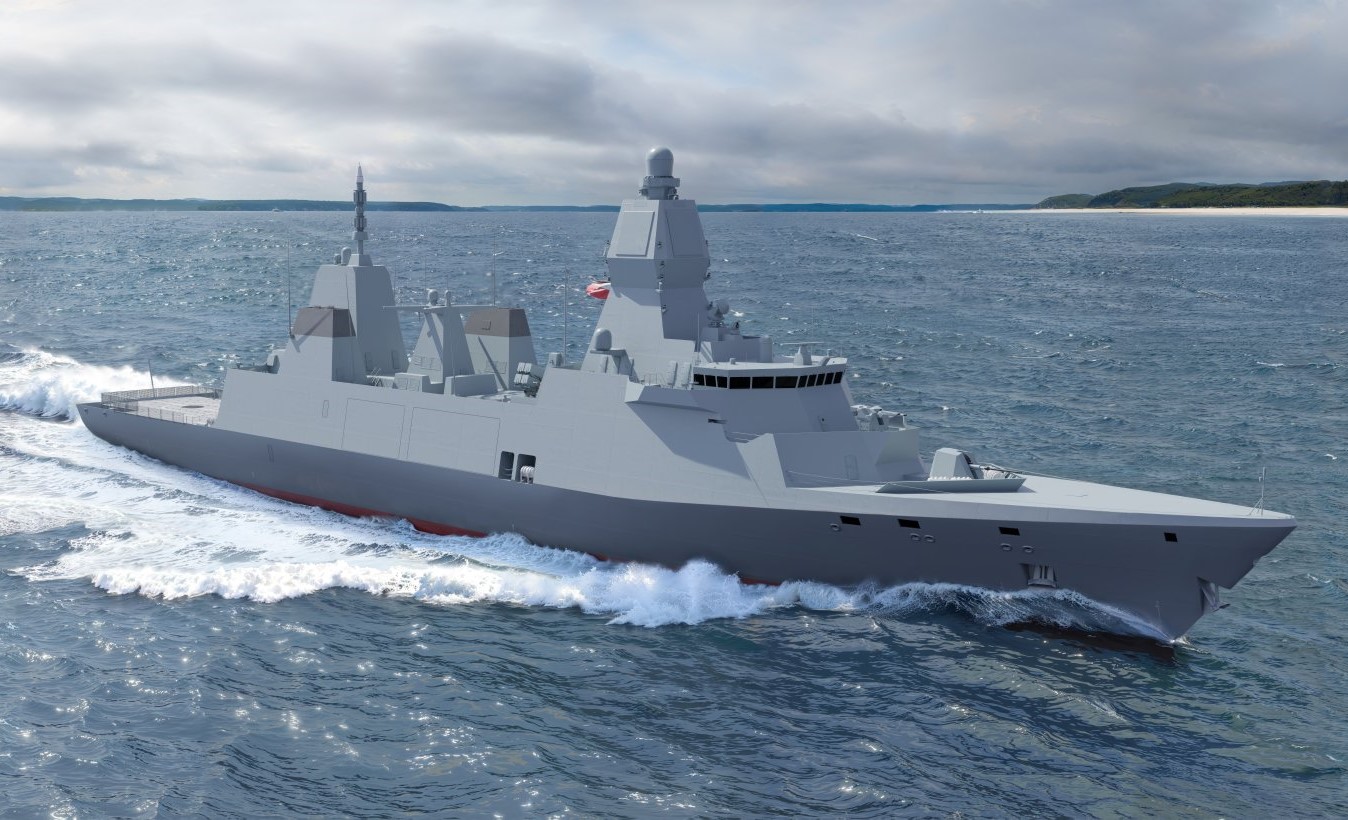


The Gdynia shipyard will host another ceremony on 28 April linked to the construction of multi-role frigates for the Polish Navy. This will mark the third vessel to be built at the yard. In the future, the ships will strengthen Poland’s defence capabilities, while already contributing to the transformation of the domestic shipbuilding industry. The new vessel will be named Huragan.
The “Miecznik” programme, underway since 2021, is currently the largest naval modernisation project of its kind in Poland. Its objective is to build three modern, multi-role frigates that will become the core combat force of the Polish fleet, replacing the ageing Oliver Hazard Perry-class ships. Two vessels—future ORP Wicher and ORP Burza—are currently under construction, with the first scheduled to be launched in August this year.
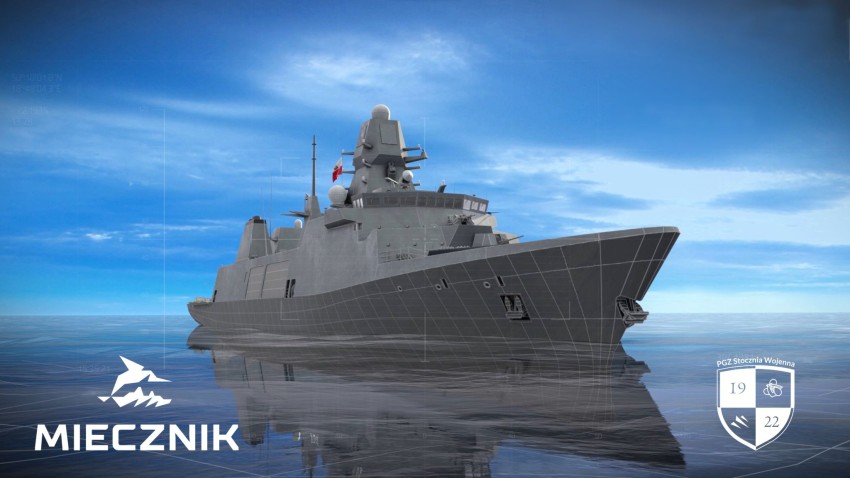
The PGZ-Miecznik consortium responsible for delivery comprises Polska Grupa Zbrojeniowa S.A. (leader) and PGZ Stocznia Wojenna Sp. z o.o., with project partners including CRIST S.A. as well as international companies Babcock, Thales UK and MBDA UK.

GospodarkaMorska.pl
The new frigates are expected to enter service between 2029 and 2031. They will form part of the Combat Ship Division of the 3rd Ship Flotilla and will be based at the Naval Port in Gdynia.
The vessels are based on the Arrowhead 140 platform, developed from the design of the Danish Iver Huitfeldt-class frigates. The platform has also served as the basis for ships built for other countries. In the United Kingdom, these are the Type 31 frigates—two of which, Venturer and Active, have already been launched, with five vessels planned in total. Indonesia is also building its own ships based on this design. Work on two so-called “red-and-white frigates”, as they are officially described, began in 2022 and 2024 respectively, with both expected to enter service by 2029. The first of these, KRI Balaputradewa (322), was launched in December last year. Notably, the Indonesian authorities have decided to order two additional vessels.
The frigates under the “Miecznik” programme will be 138.7 metres long, with a maximum displacement of up to 7,000 tonnes. Their maximum speed is expected to reach 26 knots, with a cruising speed of 12 knots and a range of 8,000 nautical miles. The crew will comprise up to 187 officers and sailors. Propulsion will be provided by four diesel engines in a CODAD (Combined Diesel and Diesel) configuration, in which some engines operate at lower, economical speeds, while additional engines are engaged at higher speeds or under greater load.
The ships will be equipped with an integrated mission system, including an integrated bridge, communications systems, a platform management system and a combat management system—all fully integrated. The complete combat system, sensors and effectors will include air defence systems, anti-missile capabilities, surface-to-surface and surface-to-land strike systems, as well as torpedoes for anti-submarine warfare.
In terms of air defence, the ships will be fitted with Mk41 vertical launch systems (VLS) and missiles from the CAMM family. For engaging surface and land targets, RBS15 missile launchers will be installed. Artillery armament will include a 76 mm OTO Melara Super Rapid Strales gun, two 35 mm OSU-35K naval guns, remotely controlled weapon stations equipped with heavy machine guns, as well as manually operated machine guns. Torpedo armament will include two torpedo launchers.
The vessels will also be equipped with medium- and long-range multifunction radars, fire-control radar, imaging reconnaissance systems, as well as hull-mounted and towed sonars. Electronic warfare systems will also be installed. The ships will possess weaponry enabling them to effectively counter attacks of all types. Weapon ranges are expected to start from 40 km, missiles up to 100 km, while anti-ship missiles will be capable of reaching distances of up to 200 km. The equipment will also include radars capable of detecting aerial targets at distances exceeding 400 km and surface targets at up to 80 km, a fire-control radar with a range of up to 120 km, and sensors for detecting submarines, with the towed sonar theoretically offering detection ranges of up to 60 km (depending on target and sea conditions).
PGZ Stocznia Wojenna
The name Huragan for the third frigate is notable in that no Polish warship has previously borne it, although it has historical roots. Originally, the name was intended for another Grom-class destroyer, which—together with Orkan—was to be built at the then Naval Port Workshops in Gdynia. Construction began in August 1939 but was halted by the outbreak of the Second World War. The steel plates intended for the ship’s hull were later used to build the armoured train Smok Kaszubski, which was deployed by Polish forces during the September Campaign.
For a brief period between 1940 and 1941, a French Bourrasque-class destroyer, Ouragan, built in 1924, served with a Polish crew. Following the fall of France during the German invasion, the vessel was interned in Portsmouth in the United Kingdom. It was loaned to the Polish Navy and operated as OF Ouragan (sometimes incorrectly referred to as ORP Huragan). It was later transferred to the Royal Navy and subsequently returned to French service, where it remained until 1949.
 DOWNLOAD PDF