



Offshore wind energy is rapidly transforming Poland’s port sector. From the launch of the first installation terminal in Świnoujście to the construction of modern service bases in smaller ports, the Baltic Sea is becoming not only a source of clean energy but also a driver of multi-billion-złoty infrastructure investment. The expected impact of these developments will be discussed during the Kongres Polskie Porty (Polish Ports Congress) in Sopot.
One of the leading topics of the Congress, organised by the publisher Gospodarka Morska, will be the impact of energy investments on Poland’s maritime economy. It is already clear that this impact is substantial—not only in terms of infrastructure development, but also in shaping a new structure of the country’s energy mix.
Thanks to projects led by Orlen, PGE Baltica, Ocean Winds and Baltic Hub, Polish ports are gaining new quays, terminals and service facilities that will support offshore wind farms with a combined capacity of several gigawatts.
Since June 2025, the Świnoujście Offshore Terminal—the first facility of its kind in Poland and one of the most advanced in Europe—has been operational, managed by Orlen Neptun. With parameters enabling the handling of the largest jack-up and heavy-lift vessels (12.5-metre fairway depth, nearly 500 metres of quay length and 16 hectares of storage space), the terminal will ultimately be capable of installing more than 80 turbines annually. It is already supporting offshore projects, with preparations under way for a second expansion phase that will double its capacity by 2030, including the construction of new offshore and Ro-Ro quays.
T5 terminal for multiple users
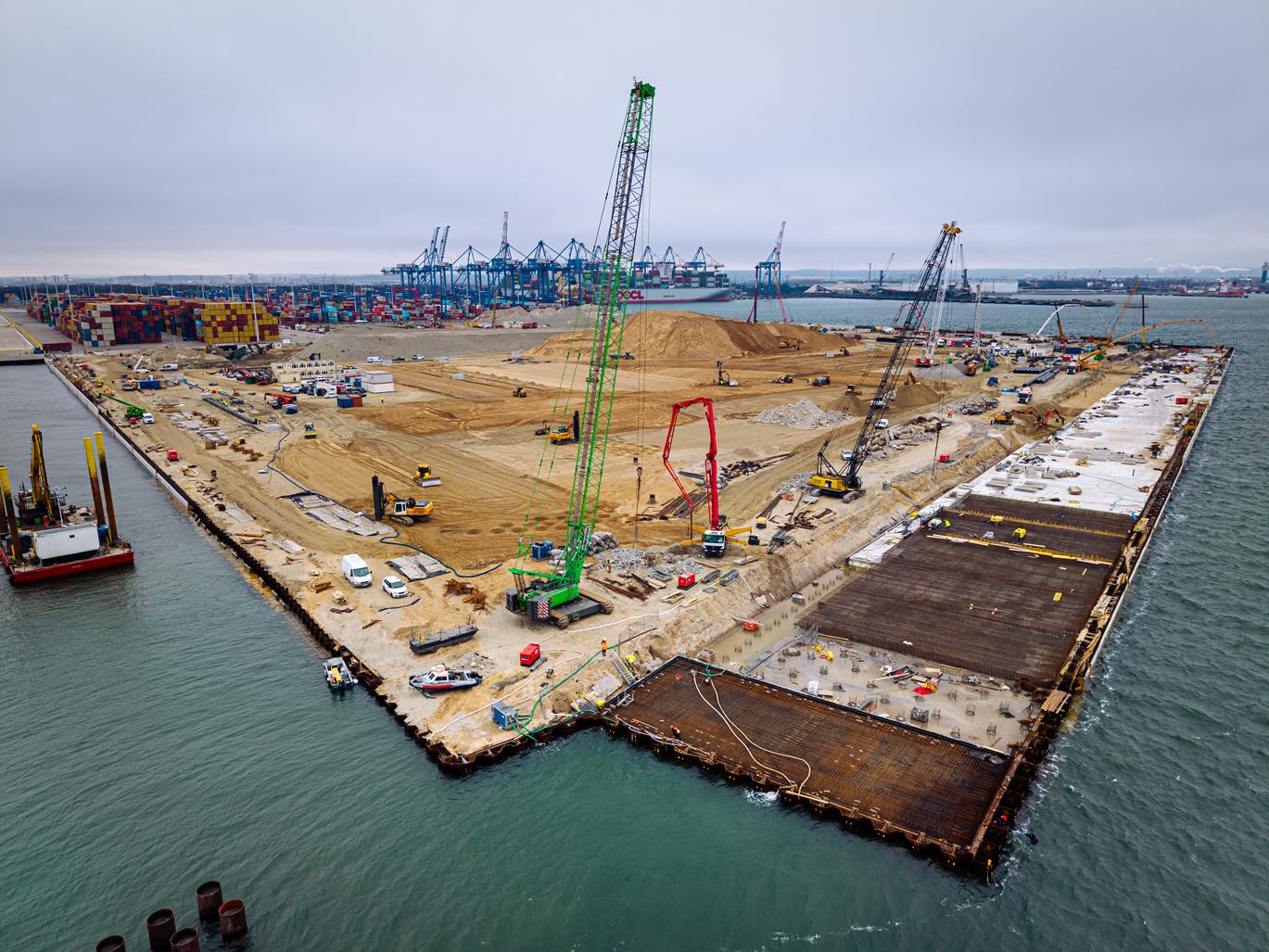
In Gdańsk, the T5 terminal is under construction within Baltic Hub as a dedicated offshore installation base. The investment, valued at nearly PLN 1.18 billion—including over PLN 900 million in EU funding from the National Recovery Plan and PLN 500 million from the Polish Development Fund—will cover more than 21 hectares and enable the simultaneous handling of jack-up and Ro-Ro vessels. Completion is scheduled for the third quarter of 2026.
PGE and Ørsted, through PGE Baltica, are the site’s tenants and primary beneficiaries. The terminal is being developed primarily as an installation base for the Baltica 2 project (1.5 GW), supporting the storage, pre-assembly and installation of turbine components, including 107 Siemens Gamesa 14 MW units. The installation campaign is expected to begin in 2027.
In June 2025, during the Polish Ports Congress 2030, a reservation agreement was signed between Ocean Winds and PGE Baltica, allowing the T5 terminal to also serve as an installation base for the BC-Wind project (approximately 390–500 MW) in 2028. This effectively opens part of the terminal’s capacity to another developer. The facility is set to become a key logistics hub for offshore wind projects in the Baltic Sea.
Major investment in smaller ports
At the same time, smaller ports are evolving into service (O&M) bases for the operational phase of offshore wind farms. In Łeba, Orlen and Northland Power opened Poland’s first O&M base for the Baltic Power project in May 2025. The PLN 62 million investment spans 1.1 hectares, employs around 60 people and will serve as the “onshore heart” of the project, scheduled to come online in 2026.
In Ustka, extensive modernisation of more than 120-year-old breakwaters is under way, with a budget of PLN 102.5 million. These works are preparing the port for a future offshore service terminal valued at over PLN 269 million. In June 2025, PGE Baltica launched construction of an O&M base that will support the Baltica projects from 2027.
In Kołobrzeg, Orlen Neptun has secured land for an O&M base for the Baltic West development. The port’s proximity to the planned wind farm and its infrastructure make it suitable for servicing crew transfer vessels (CTV).
Meanwhile, in Władysławowo, Ocean Winds is constructing a service base for the BC-Wind project alongside quay refurbishment works. The project is progressing on schedule, with completion expected in 2026. The base will support a wind farm located around 23 km offshore for decades to come.
These investments go far beyond new quays, breakwaters and service halls. They represent hundreds of millions of złoty flowing into local economies, thousands of jobs and a tangible transformation of Poland’s coastline into an offshore hub of European scale. Offshore wind is already reshaping the map of Polish ports—from major terminals in Świnoujście and Gdańsk to smaller but strategically vital bases in Ustka, Łeba, Kołobrzeg and Władysławowo.
At present, key first-phase offshore projects are under construction. Baltic Power (Orlen and Northland Power), with a capacity of around 1.2 GW, is scheduled to begin operations by the end of 2026, supplying clean energy to more than 1.5 million households and generating approximately 4 TWh annually. Baltica 2 (PGE and Ørsted), the largest first-phase project at 1.5 GW (1,498 MW), is expected to come online in 2027, supplying electricity to around 2.4–2.5 million homes.
Preparations for the second phase are also accelerating. In December 2025, the first auction awarded support to projects with a combined capacity exceeding 3.4 GW, including Baltic East (900 MW) and Baltica 9. First power generation from these projects is expected in 2032.
Image: Courtesy of Grupa NDI
 DOWNLOAD PDF