

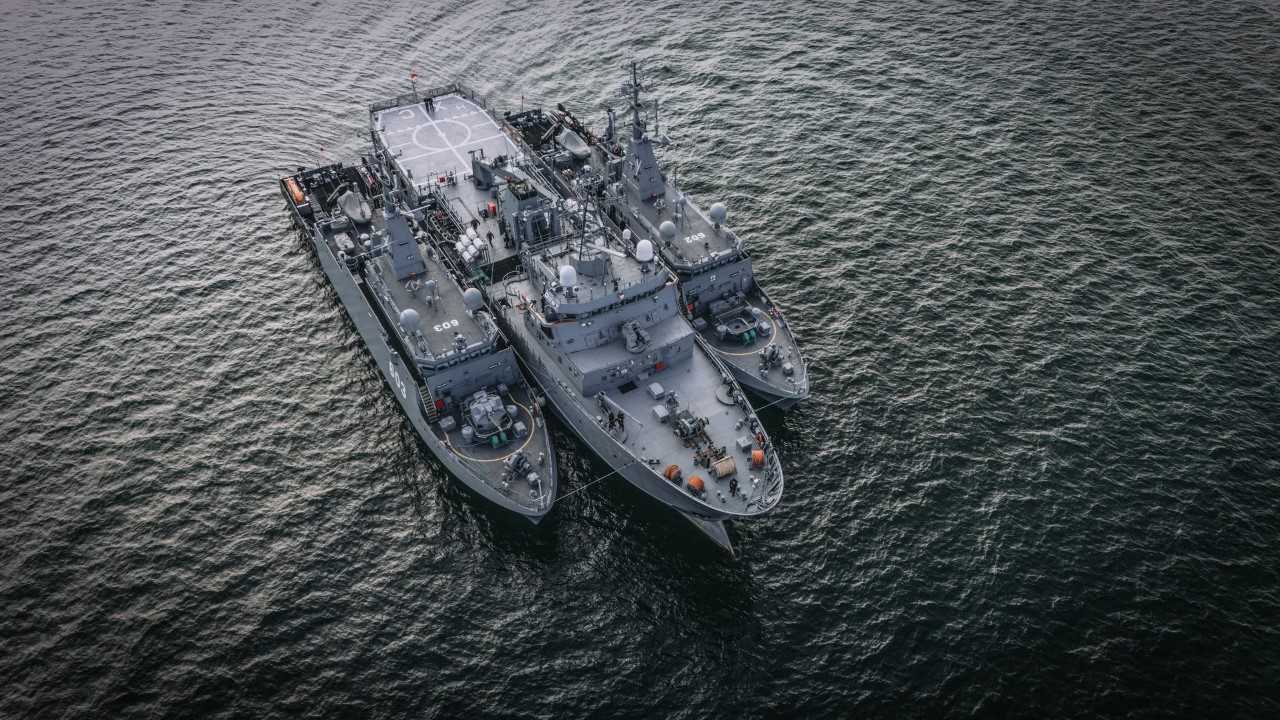


Chief of the General Staff of the Polish Armed Forces, Gen. Wiesław Kukuła, met with the commander and personnel of the Maritime Operations Centre – Maritime Component Command in Gdynia. The main purpose of the visit was to assess preparations for Poland to acquire the capability to assume responsibility in 2028 for the regional NATO command, Commander Task Force Baltic (CTF Baltic).
“Assuming responsibility for CTF Baltic will be another step in strengthening Poland’s role in NATO’s regional command system. We must be prepared not only to provide forces for allied operations, but also to plan, coordinate and command all forces assigned to operations by all participating nations. We are building a capability that has real significance for the deterrence and defence of the Alliance’s entire eastern flank” – Gen. Wiesław Kukuła said.
During the visit, the Chief of the General Staff of the Polish Armed Forces was briefed on the state of preparations by the Maritime Operations Centre – Maritime Component Command (COM-DKM) to establish a regional maritime forces headquarters that will provide Poland with the capability to assume responsibility for commanding allied maritime operations in the Baltic Sea.
The progress of organisational and training work, personnel preparations and the process of developing command capabilities in line with NATO standards were discussed. An important element of the preparations is the participation of Polish officers and non-commissioned officers in the currently operational CTF Baltic in Rostock, where they are gaining experience in planning, coordinating and conducting allied maritime operations.
“The Navy should have only one foot in salt water. The other must be firmly supported by the full spectrum of multidomain capabilities. Only such a balanced approach will give the Navy the ability to conduct successful operations in the future, where success in a maritime operation will require the ability to exert effects from land to sea, from sea to air, as well as to harness the potential of space and cyberspace. Modern warfare at sea is not conducted exclusively by warships. It is conducted by the entire system – sensors and effectors deployed at sea, on land and in the air, connected through a single command and data-exchange network. Warships remain an extremely important element of this system, but the advantage goes to whoever detects the adversary first, builds situational awareness, makes a decision and effectively employs an effector. Therefore, as we build the Navy’s capabilities, we must think in multidomain terms" – Gen. Wiesław Kukuła stressed.
CTF Baltic – NATO’s Regional Command in the Baltic Sea
Commander Task Force Baltic is NATO’s regional maritime command, operationally subordinate to Allied Maritime Command (MARCOM) in Northwood. Its tasks include planning and coordinating allied exercises and operations in the Baltic Sea, building a comprehensive maritime situational picture, and commanding NATO forces assigned to it.
CTF Baltic participates, among other activities, in operations conducted as part of “Baltic Sentry”, aimed at increasing security in the Baltic Sea, including the protection of critical maritime infrastructure and the safety of navigation.
The command was established in Rostock on the basis of the German DEU MARFOR. Polish naval personnel have also served within its structure since its establishment. Poland is preparing to assume responsibility for CTF Baltic in 2028, when the role is to be taken over by forces assigned from COM-DKM in Gdynia.
COM-DKM – Command of Operations in the Maritime Domain
The visit also provided an opportunity to assess the role of the Maritime Operations Centre – Maritime Component Command in the command system of the Polish Armed Forces.
COM-DKM is responsible for commanding forces assigned to conduct operations in the maritime direction during peacetime, crisis and war. The centre coordinates activities within Poland’s maritime area of responsibility, contributes to building situational awareness and provides the capability to plan and conduct operations in the maritime domain.
The centre also commands forces assigned from the General Command of the Branches of the Polish Armed Forces as part of the Armed Forces’ integrated reconnaissance system, as well as forces participating in rescue operations within Poland’s SAR area of responsibility, and cooperates in this field with the Maritime Search and Rescue Service.
In the event of a defensive operation, COM-DKM constitutes a key element of the command system in the maritime direction. Its task is to create the conditions for the coordinated employment of forces in the maritime domain and their cooperation with land and air components, as well as with allied forces.
The importance of this capability is increasing alongside the Baltic Sea’s strategic role. The body of water is crucial to the military security of Poland and NATO’s eastern-flank states, freedom of navigation, military transport, and the operation of energy and telecommunications infrastructure.
COM-DKM is already conducting operational activities related to protecting Polish interests at sea. Since 2022, it has commanded Operation “Zatoka”, whose objectives include monitoring shipping, identifying potential threats and observing areas where infrastructure important to national security is located. Maritime situational awareness is maintained around the clock and in close cooperation with allies.
From COM-DKM to CTF Baltic
Preparations to assume responsibility for CTF Baltic form part of a broader process of strengthening Poland’s command capabilities in the maritime domain. Over the next two years, COM-DKM will develop its structures and expertise and prepare personnel for the certification process.
Ultimately, Poland is to have a headquarters capable both of commanding a national operation in the maritime domain and of commanding allied forces assigned to operations in the Baltic Sea.
Acquiring this capability will mean increased Polish responsibility for regional security and further strengthen Poland’s position within NATO’s command system.
Concluding his meeting with COM-DKM personnel, the Chief of the General Staff stressed:
“We fight for the sea in order to protect what lies on land. Control of the Baltic is not an end in itself – it is a prerequisite for maintaining the resilience of the state and ensuring freedom of action for the Armed Forces as a whole. Strategic lines of communication run across the Baltic, critical infrastructure lies on its seabed, and allied support will also reach Poland by sea".
“We fight for the sea in order to protect what lies on land. Control of the Baltic is not an end in itself – it is a prerequisite for maintaining the resilience of the state and ensuring freedom of action for the Armed Forces as a whole. Strategic lines of communication run across the Baltic, critical infrastructure lies on its seabed, and allied support will also reach Poland by sea" - he added.
Photo: Polish Armed Forces press release
 DOWNLOAD PDF