

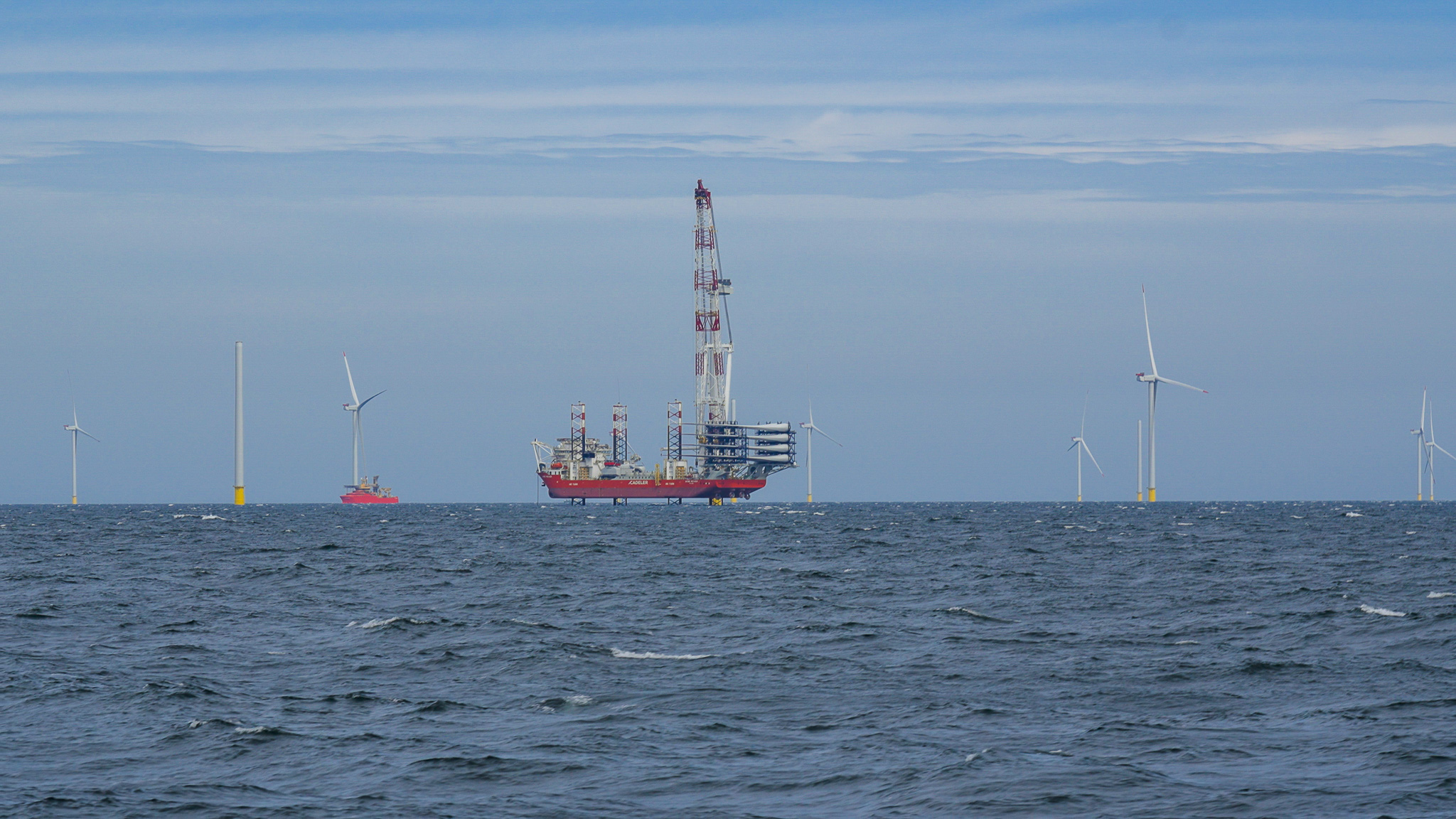


ORLEN’s Baltic Power offshore wind farm (a joint investment by the ORLEN Group and Northland Power) now has 68 fully assembled wind turbines, each with a capacity of 15 MW. Ultimately, there will be 76. This means that the project, located approximately 23 km offshore from the coast near Łeba, is now at an advanced stage of completion. The first power from the wind farm was fed into Poland’s National Power System in July this year. GospodarkaMorska.pl, together with other maritime industry news outlets, had an opportunity to see the project up close.
“At present, we have installed 68 wind turbines, with eight still to go. We expect to complete the installation within the next few weeks. At the same time, the commissioning process is under way. Others are at the testing stage and will be brought into operation successively” – said Maciej Wyrwicki, WTG Technical Project Manager at Baltic Power.
Each turbine is more than 260 metres high, including its foundation. An individual blade is approximately 115 metres long, while the rotor swept area is equivalent to around six football pitches. Interestingly, one minute of operation of a single wind turbine can generate enough energy to power an electric bus for 100 km.
How are the turbines installed?
The turbines are installed using a specialised jack-up installation vessel.
“Loading takes place at the port, where the components are loaded onto a jack-up installation vessel. Once the loaded vessel reaches the site, it lowers its legs onto the seabed. Once the hull is raised above sea level, the installation process begins on site. First, the turbine tower is installed, followed by the nacelle and then each of the blades. Weather conditions, particularly wind, are a very important factor affecting the speed of installation. They are the main limitation affecting the installation process itself” – the expert explained.
An installation vessel can carry components allowing several complete turbines to be assembled during a single voyage.
“The vessel can carry up to four turbine sets, meaning four towers, four nacelles and four sets of three blades – 12 blades in total” – Wyrwicki said.
Environmental protection
The construction of the wind farm was preceded by years of environmental surveys, which made it possible to establish the baseline condition of the area before the project began and prepare a report that subsequently formed the basis for the environmental decision.
“In the area of the wind farm, these included surveys of, among other things, the presence of harbour porpoises. Such surveys also had to be carried out in order to prepare a report, which then served as the basis for the environmental decision” – said Anna Jones, Consents & Environment Manager.
Environmental monitoring is carried out before construction begins, during the implementation of the project and after its completion. Once construction is finished, monitoring will continue for approximately five years, depending on the environmental element being monitored.
Bubble curtain limits noise
One of the biggest sources of noise during construction is piling – the installation of monopile foundations. A bubble curtain was used, among other measures, to reduce the impact of this process on the marine environment.
“This is a system in which compressed air is injected at high pressure into hoses laid on the seabed around the monopile being installed. The air bubbles rising from the hoses significantly reduce the noise generated during piling, namely the driving of the monopile into the seabed,” explained Michał Śmielak, Environment Lead.
Radars and cameras detect cranes
Another solution deployed at Baltic Power is an automatic turbine shutdown system that activates when cranes are detected flying through the area.
“Cranes have also been identified as a bird species that the wind farm could potentially affect. We have a system consisting of radars and cameras capable of detecting birds in flight. If the system identifies a bird as a crane, it can use data on its flight trajectory to sequentially shut down individual turbines for the duration of the bird’s passage.”
Once the birds have passed, the turbines are restarted.
“As for the automatic turbine shutdown system, it will operate from the moment the wind farm is commissioned and throughout its entire lifetime. What is more, it will be further improved during operation and will learn from the data collected as it operates, so that it can detect cranes even more effectively.”
Safety of technicians at sea
Operating the wind farm will also involve the daily work of technicians who will be transported from the port of Łeba to the wind farm aboard CTV (Crew Transfer Vessel) craft. The transfer takes approximately 40 minutes to one hour and depends, among other things, on wind speed and direction and wave height.
Technicians must have appropriate training and personal protective equipment.
“Each of our technicians, in addition to dedicated training authorising them to travel by CTV to work offshore, must of course be familiar with all the procedures we have prepared for emergency situations,” said Tomasz Cendrowski, HSE Coordinator for the Baltic Power Project.
Teams of technicians consist of between four and six people. In suitable weather conditions, including waves of approximately 1.2 metres or less, they can safely travel to the wind farm.
“The most important aspect of offshore work is the personnel transfer procedure. Every time a technician goes to a turbine, they have to use a ladder several dozen metres long. Naturally, we protect them with personal protective equipment, including harnesses with appropriate safety systems. They are also continuously secured by a person on board, so all aspects of their transfer are monitored at all times by a member of the crew.”
What happens in an emergency?
At sea, preparedness for situations requiring rapid evacuation is particularly important.
“There are situations when, of course, we need to speed up this process. These are emergency situations, when we need to provide first aid. Each team has a first aider trained in qualified first aid. In the offshore industry, this is known as Medical First Response.”
In the event of a serious accident, time is critical.
“There is what is known as the golden hour, when we need to get the injured person into the hands of a specialised rescue service – either an ambulance or the Maritime Search and Rescue Service. The aim is to transport the injured person within an hour in order to save their life.”
Exercises involving rescue services are also conducted as part of the project.
“At the Baltic Power project, we have carried out exercises with the Maritime Search and Rescue Service on numerous occasions. We have used different scenarios. Naturally, we always try to anticipate the worst-case scenario, namely a technician suffering an injury in the nacelle at the very top of the turbine and the issue of evacuating them.”
At present, evacuating an injured person from the nacelle is carried out first down through the turbine and then by sea.
Baltic Power is Poland’s most advanced offshore wind farm project and the first in which offshore installation work began. Once construction is complete, the wind farm will generate up to 4 TWh of electricity annually, equivalent to 3 per cent of Poland’s current electricity demand. The wind farm covers an area of 130 sq km and is located 23 km offshore, off the coast near Choczewo and Łeba.
Photo: GospodarkaMorska.pl
 DOWNLOAD PDF