



Construction of offshore gas infrastructure in the Baltic Sea is entering a peak phase of activity. This is one of the most technically demanding stages of the entire project. At Górki Zachodnie, preparatory works have begun on a key element of the FSRU programme — the floating LNG terminal — including the drilling of a more than one-kilometre-long microtunnel. The tunnel will connect the onshore facilities with the offshore section without disturbing the environmentally sensitive and tourist-valued coastal area. The terminal in the Gulf of Gdańsk will provide a regasification capacity of 6.1 billion cubic metres per year, significantly strengthening LNG import capabilities for Poland and the wider region.
The FSRU programme covers the construction of infrastructure for receiving liquefied natural gas (LNG) transported by sea, its storage, regasification, and delivery into the national transmission system. A key element will be the floating storage and regasification unit (FSRU) — a vessel functioning as a mobile LNG terminal. Gas delivered to the Gulf of Gdańsk will be fed into the transmission network via a subsea pipeline, whose landfall section will be installed using microtunnelling technology beneath the shoreline.
“We are currently in the most intensive phase of construction, both onshore and offshore. We now have a TBM drilling machine on site that will excavate the microtunnel, in which the subsea gas pipeline will be installed. In the coming days, vessels will also be deployed to prepare test pile locations so that from June we can begin driving the permanent piles for the jetty — the quay where the FSRU unit will berth,” said Maciej Wawrzkowicz, Offshore FSRU Project Manager at GAZ-SYSTEM.
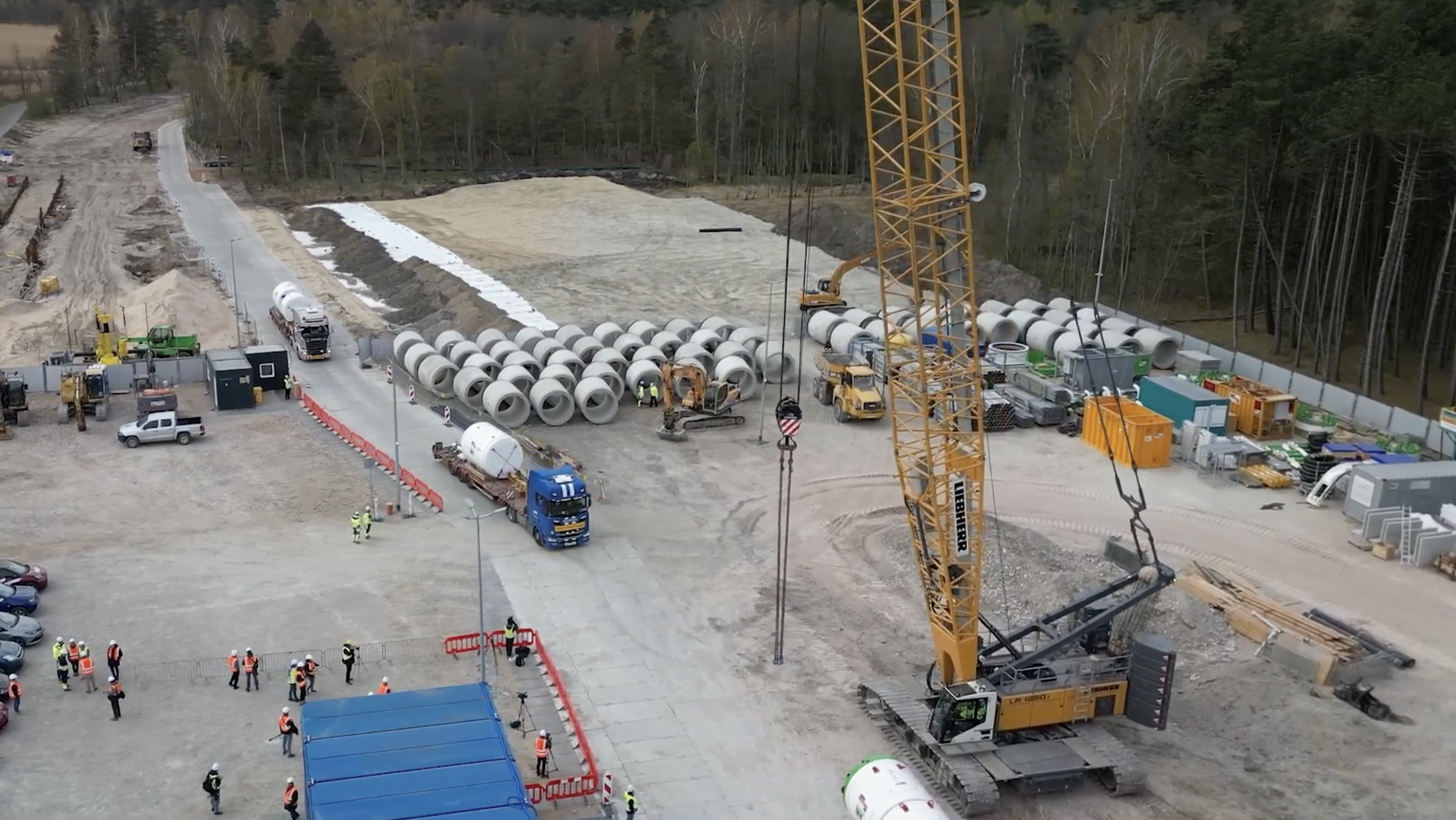
On 30 April, the cutterhead of the TBM machine arrived at Górki Zachodnie. From mid-May, it is scheduled to begin work on site. The use of this technology enables trenchless construction, allowing the tunnel to be drilled beneath coastal forest, dunes, beaches, and the seabed of the Gulf of Gdańsk without disturbing the surface. In practice, this ensures the protection of a highly valuable natural environment and uninterrupted public access to the beach during construction.
“Microtunnelling is the safest method for crossing such obstacles. GAZ-SYSTEM selected this approach to protect both the natural environment and public access to local infrastructure, including the beach,” explained Łukasz Radomski, Deputy Contract Director in the Gap Insaat – Fabe Polska – Unitek Insaat consortium.
“The TBM machine enables underground trenchless excavation. Its cutting head crushes the soil at the face, which is then transported as slurry back to the launch shaft for disposal,” added Paweł Ciomek, Deputy Site Manager.
Before drilling could begin, extensive design documentation had to be prepared, along with construction of the launch shaft and ground stabilisation works. This phase also included defining the tunnel’s route and depth.
“Preparation of the detailed execution design took around eight months. We have now received all necessary approvals, allowing us to order the concrete segments and the TBM machine itself. We are beginning installation of the machine in the launch shaft,” said Radomski.
Within two weeks, the TBM will be fully assembled and begin its approximately 1,100-metre drive toward the sea. The tunnel will form a critical part of the entire FSRU infrastructure system.
The microtunnel will be around 1,100 metres long and approximately 2.5 metres in external diameter. It will be constructed from precast reinforced concrete segments forming its structural lining. A subsea gas pipeline will be installed inside, connecting the terminal to the national transmission grid. Depending on geological conditions, advance rates may range from several to several dozen metres per day.
“Drilling will take around three months. Afterwards, the tunnel will be sealed and safely flooded with water. The TBM will then be removed by crane, offshore, about 800 metres from the shoreline at the exit pit. The next stage will involve preparing the launch chamber for installation of prefabricated subsea pipeline sections, which will be pulled from land toward the sea,” Wawrzkowicz explained.
The FSRU project (Floating Storage Regasification Unit — a floating LNG storage and regasification vessel) is entering its main offshore construction phase. Work will proceed simultaneously onshore and offshore in the coming months.
“This construction season is critical for the offshore component of the project and for achieving full synergy between all three segments of the investment,” Wawrzkowicz added.
The FSRU programme is divided into three parts: offshore works, onshore infrastructure, and the vessel and business model component. Alongside the microtunnel, offshore works include piling for the jetty located around 3 km from the shoreline and construction of LNG handling platforms. The onshore section covers approximately 250 km of gas pipelines linking the coast with central Poland.
“The offshore component of the FSRU project fits into the wider Port of the North strategy, aimed at creating a new gas entry corridor into Poland’s system from north to south,” Wawrzkowicz noted.
The LNG terminal in the Gulf of Gdańsk will complement the Świnoujście terminal as a second major import hub for maritime gas deliveries. Together, they are expected to significantly enhance Poland’s import capacity and system flexibility, including flows toward southern Europe. Commissioning is planned for 2027–2028.
The project is listed as a Project of Common Interest (PCI) by the European Union, underlining its strategic importance for energy security and market integration.
“I am most looking forward to the moment when we integrate the entire system. We are talking about a process that will take several months, but the key milestone will be connecting the subsea pipeline with the onshore terminal facilities, achieving full mechanical integrity of the infrastructure,” concluded Wawrzkowicz.
Source and photo: Newseria
 DOWNLOAD PDF