

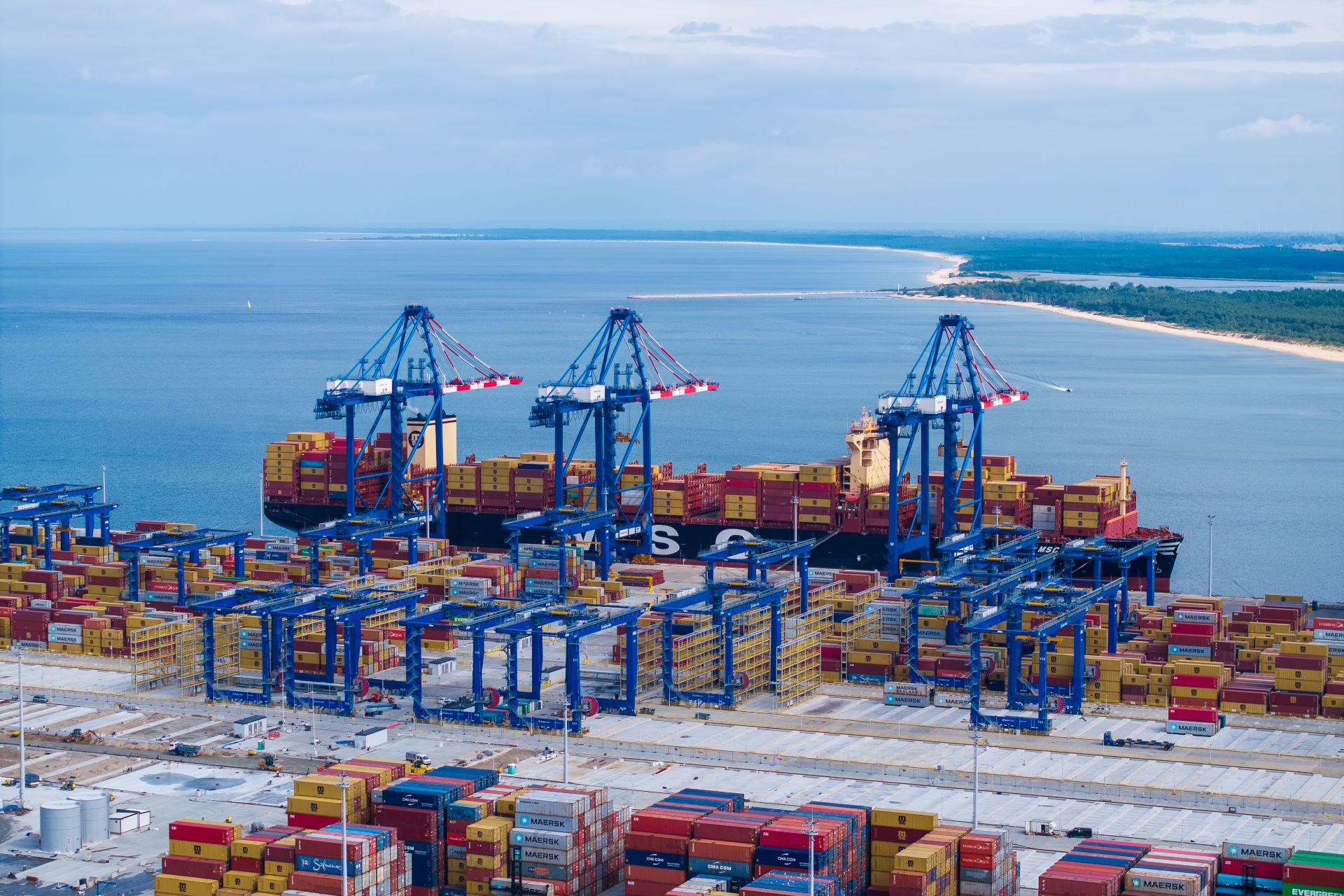


Polish seaports handled 20,300 ship calls in 2025, 1.3% more than a year earlier, according to government agency Statistics Poland (GUS). This translated into a 3.2% increase in cargo throughput, to 128.2 million tonnes. Poland’s inland waterway shipping sector recorded a weaker performance than in 2024, both in terms of cargo volumes and passenger numbers.
On 30 September, Statistics Poland published its annual comprehensive report, Transport – Activity Results in 2025. Among the latest data, which expand on the findings of the April report, is the combined deadweight tonnage of the vessels received, which amounted to 235.8 million tonnes, 4.6% more than in 2024. Among Polish ports, the largest number of calls was made by vessels flying the Polish flag (4,700), followed by those flying the Cypriot (3,400), German (1,600) and Dutch (1,200) flags.
Of the goods transported by sea, the largest volumes consisted of liquid bulk cargo (43.8%), dry bulk cargo (23.6%) and containers (20.6%). Among Poland’s major seaports, GUS confirmed the largest increases in cargo throughput in Szczecin, at 10.8%, Świnoujście, at 7.2%, and Gdańsk, at 6.1%. Gdynia recorded a decline in throughput of 11.2%.
In 2025, Gdańsk remained Poland’s largest port, handling 58.8% of all goods arriving by sea. Gdynia ranked second, with 16.1%, followed by Świnoujście with 15.4% and Szczecin with 8.6%. Statistics Poland also reported that in 2025 Polish shipowners and operators had a total of 83 vessels with a combined deadweight of 2.5 million DWT. The Polish merchant fleet carried 7.1 million tonnes of cargo, 6.3% more than in 2024, while transport work increased by 12.4%.
Inland shipping in weaker shape
The GUS report of 30 September states that Polish inland waterway shipping recorded a weaker performance in 2025 than in the previous year. Inland vessels carried 1.7 million tonnes of cargo in 2025, representing an annual decline of 0.1%. Transport work in the sector fell by 5.3%, to 364.5 million tonne-kilometres. The largest decline was recorded in international transport, at 10.5%.
“The largest decline concerned exported cargo, which fell by 39.3%. Its share of international transport decreased from 17.4% in 2024 to 11.8% in 2025. The transport of imported cargo fell by 10.3%, while its share of international transport remained at 2.5%. Cargo transport between foreign ports was 4.1% lower” – the GUS report states.
Despite the overall decline, domestic inland waterway transport increased by 26.1%, while the share of inland waterway transport in total transport rose from 28.4% in 2024 to 35.8% in 2025.
“Metal ores and other products of mining and quarrying; peat; uranium and thorium, as well as products of agriculture, hunting, forestry, fishing and fish farming accounted for the largest share of total inland waterway transport. In 2025, inland waterway transport carried 1,007.6 thousand passengers, i.e. 8.1% fewer than in 2024. Passenger transport work increased by 6.2% compared with 2024. As in the previous year, all passenger transport was carried out on domestic routes. The average distance travelled per passenger was 12.5 km” – says report
Coastal shipping performed better than in 2024.
“In 2025, coastal shipping carried 830.6 thousand passengers, i.e. 8.6% more than in 2024. Passenger transport work increased by 18.7%. All transport carried out by vessels of the maritime coastal transport fleet was domestic. The average distance travelled per passenger was 11.1 km" – GUS concludes.
Photo: Baltic Hub/ press release
 DOWNLOAD PDF