

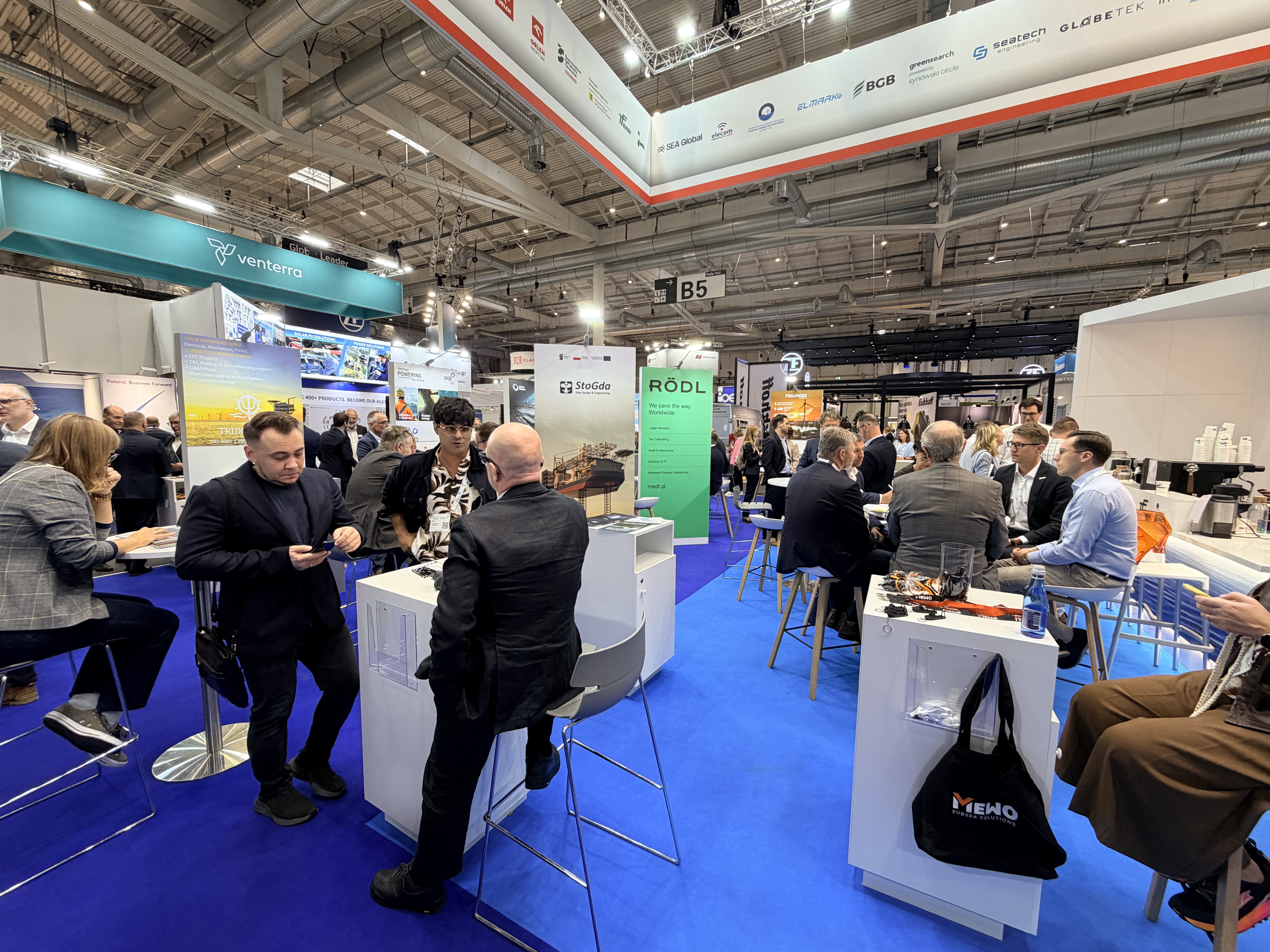


During WindEnergy Hamburg, held from 22 to 25 September, Poland’s offshore wind sector was represented in almost its full breadth. The event brought together not only investors and developers, but also ports, infrastructure providers, industry, technology companies, service providers and institutions that collectively make up the country’s offshore wind sector. For four days, the Polish Offshore Wind Industry Pavilion, organised by the Polish Offshore Wind Energy Society (PIMEW), served as a meeting place between the industry and the European market – and as an opportunity to demonstrate the breadth of the ecosystem that has developed around Poland’s offshore wind projects.
The Polish Offshore Wind Industry Pavilion covered 203 square metres and, over the four days, served not only as an exhibition space, but also as a venue for business meetings and a showcase for the Polish offshore wind industry in all its diversity.
In Hamburg, companies representing various links in the supply chain presented their offerings and capabilities. The 30 exhibitors and partners included SEA Global, ELECOM, El-mark, BGB Group Global, greensearch powered by Synowski Circle, Sea Tech, PROJMORS ASE Group, ORLEN, ORLEN Neptun, Baltic East, Świnoujście Offshore Terminal, PGE Baltica, Baltic Towers, Grupa Przemysłowa Baltic, the Industrial Development Agency (ARP), Trident BMC, PROFESEA, SKB Group, Baltic Diving Solutions, PM Ecology, Globetek, InvestGda, MEWO, Segula Technologies, Enstream, Stogda Ship Design & Engineering, RÖDL, the Pomeranian Development Agency, the Pomeranian Offshore Wind Energy Platform for the Baltic Sea coordinated by the Pomeranian Voivodeship, and TELE-FONIKA Kable.
Such broad representation was one of the strongest aspects of Poland’s presence in Hamburg. Poland’s offshore wind sector is now backed not only by investment potential, but by a tangible industrial base: design, technology, engineering and manufacturing companies, ports, infrastructure and specialised services. This is no longer a market that is only beginning to build its supporting base. A network of companies and capabilities has emerged around Polish projects that are ready not only to deliver domestic investments, but also to compete for a place in the European supply chain.
Industry leaders highlight Poland’s offshore potential
A particularly important role at the Polish Offshore Wind Industry Pavilion was played by its honorary patrons, the Pomeranian Voivodeship and the Polish Investment and Trade Agency (PAIH), as well as its ambassadors: PGE Baltica, ORLEN S.A., ORLEN Neptun, Baltic East and Świnoujście Offshore Terminal. Their presence made it possible to showcase Polish offshore wind from the perspective of major investments, portfolio development and the construction of the sector’s supporting infrastructure.
The official opening of the pavilion brought together representatives of Polish business, government administration and public institutions. Those attending included Aleksandra Krystek-Biernacka, Consul General of the Republic of Poland in Hamburg; Dagmara Ossowska, Vice-President of PGE Baltica; and Maciej Stryjecki, Head of Offshore Wind at ORLEN S.A.

Above all, the pavilion provided a platform for discussion about the current state of Poland’s offshore wind sector and the role it could play in the European supply chain.
“As the leader of Poland’s offshore market, we feel a particular responsibility for the development of the sector as a whole. That is why we look at offshore wind not only through the prism of building wind farms, but also in terms of its impact on the Polish economy and industry. This year’s WindEnergy Hamburg trade fair confirmed the considerable potential of Polish companies to play an increasingly important role in the European offshore wind supply chain,” said Piotr Dziubałtowski, Vice-President for Support and Development at PGE Polska Grupa Energetyczna.
“Talks with Tier 1 suppliers showed that there is scope for even greater involvement of Polish companies in the delivery of offshore wind farm projects. As the PGE Group, we want to consistently support this process, making use of the scale of our portfolio in the Baltic Sea. We want not only to increase the share of domestic companies in our investments, but also to strengthen their capabilities and position so that they can effectively compete for contracts in other markets as well. This is one of our key priorities,” Vice-President Dziubałtowski added.
Polish infrastructure increasingly important for offshore wind
Infrastructure required to deliver future projects was one of the issues that featured prominently in Hamburg. Świnoujście Offshore Terminal, Poland’s first installation terminal for offshore wind farms, presented its capabilities.
“Taking part in WindEnergy Hamburg was an excellent opportunity for us to present the potential of Świnoujście Offshore Terminal, Poland’s first installation terminal for offshore wind farms. The facility is already supporting projects on the European market, thereby confirming its role as a strategic hub for the developing Baltic Sea offshore wind sector. From our perspective, the trade fair was a valuable platform for discussions with developers, shipowners, manufacturers and partners from across Europe about opportunities for cooperation and the further utilisation of the terminal’s potential. We are convinced that the growing importance of modern port infrastructure will be one of the key factors supporting the development of future offshore wind projects in the region, and Świnoujście is already playing an important role in this process,” said Rafał Żendarski, President of the Management Board of Świnoujście Offshore Terminal.
The strong traffic at the PIMEW pavilion reflected growing interest in the Polish market and its supply chain.
“This year’s WindEnergy Hamburg trade fair confirmed that Poland is seen as one of the most promising offshore wind markets in Europe. During the event, we held many valuable discussions with representatives of public administration, offshore wind farm developers from other European countries, and suppliers of services and components for the sector. It was an excellent opportunity to exchange experience, establish new relationships and present the potential of ORLEN Neptun’s project portfolio and, more broadly, the Polish offshore wind market. We are particularly pleased by the strong interest in the domestic supply chain and the capabilities of Polish companies, which are increasingly regarded as reliable partners in the delivery of offshore wind projects in Europe,” said Joanna Sasak, Management Board Member for Finance at ORLEN Neptun.
More than a trade fair
Poland’s presence in Hamburg extended beyond the exhibition stand. An important part of the programme was a Garden Party held at the residence of Aleksandra Krystek-Biernacka, Consul General of the Republic of Poland in Hamburg, organised jointly by the Consul General, PIMEW and ORLEN S.A.
 The event was attended by representatives of developers, investors, suppliers, financial institutions and the public sector from across Europe. The evening opened with speeches by Consul General Aleksandra Krystek-Biernacka, Jakub Budzyński, President of PIMEW, and Marcin Szpak, Executive Director Energy at ORLEN S.A.
The meeting provided an opportunity to continue discussions that had begun at the trade fair, this time in a more informal setting and with representatives of different parts of the European market.
Another networking event was a cocktail reception co-organised with Technica Nova Baltica, a neighbour of the Polish Offshore Wind Industry Pavilion. The gathering brought together exhibitors, partners and trade-fair guests and provided another opportunity to discuss cooperation.
Pomerania on the international stage
Pomerania was also strongly represented among the exhibitors and partners of the Polish Offshore Wind Industry Pavilion. The presence of InvestGda, the Pomeranian Development Agency and the Pomeranian Offshore Wind Energy Platform for the Baltic Sea, coordinated by the Pomeranian Voivodeship, demonstrated the region’s importance to the development of the sector as a whole.
For years, the Pomeranian Voivodeship has been working to increase the participation of local companies in the offshore wind sector. The region’s participation in WindEnergy Hamburg was another element of these efforts, aimed at connecting Pomeranian companies with the international market.
“When we established the Pomeranian Offshore Wind Energy Platform for the Baltic Sea in 2020, one of our objectives was to increase the participation of local companies in the supply chain. At this year’s WindEnergy Hamburg trade fair, we were able to see how this objective is being delivered: Pomeranian companies presented their capabilities and established contacts with international partners. We are determined to continue supporting their development and participation in offshore wind projects,” said Leszek Bonna, Deputy Marshal of the Pomeranian Voivodeship.
Poland’s offshore wind sector has reached a tangible scale
The aim of Poland’s presence in Hamburg was to showcase both individual companies and the broader picture of the Polish market.
“WindEnergy Hamburg enabled us to present Polish offshore wind in a broad context – not only through the prism of individual projects, but of the entire market that has developed around them. We have investors, ports and infrastructure, manufacturers, engineering and technology companies, as well as specialised service providers. An increasing number of Polish companies have the experience and capabilities to compete effectively outside Poland as well. This is an important change – Polish offshore wind is ceasing to be solely an investment market and is also becoming a source of expertise, technologies and solutions that can be applied in other markets. It was precisely this dimension of the Polish sector that we wanted to showcase in Hamburg,” said Jakub Budzyński, President of PIMEW.
During the four days of the trade fair, the coffee bar sponsored by TELE-FONIKA Kable was one of the event’s natural meeting points – a place where exhibitors, partners and visitors came together. The final tally? 12 kilograms of coffee, 35 litres of lemonade and around 2,000 cups of coffee and matcha served. Quite a tangible indication of the number of conversations held at the pavilion bar.
The four days passed quickly. They left behind numerous business cards and new contacts, as well as the satisfaction and awareness that Polish offshore wind had successfully made its presence felt and attracted attention at one of the world’s most important industry events.

Photos: PIMEW press release
 DOWNLOAD PDF