The planned corvettes were intended to mark a return to the concept of acquiring smaller combat vessels. In the past, the navy had considered small missile craft, but due to their limited defensive capabilities, the concept was revised in favour of corvettes. Importantly, the programme had previously been known under the codename “Murena”, but has now been renamed “Ostrosz”, after a species of fish found in European waters, including the Baltic Sea, and regarded as one of the most venomous fish species in European waters.
If the plan remains unchanged and the navy is to acquire four corvettes by 2035, then preliminary market consultations connected with the selection of a contractor should begin this year or next in order for the timeline to remain realistic. At present, it is not yet known what the vessels will look like. However, as the Commander of the Maritime Operations Centre – Maritime Component Command, quoted by Polska Zbrojna, emphasised, the ships will be larger than the Orkan-class vessels and capable of operating effectively in the demanding conditions of the Baltic Sea. This approach is largely shaped by the operational experience of sailors serving aboard small missile craft and the recognition that corvette-sized vessels are required for operations in such a challenging maritime environment.
Many announcements, new promises
All of the new procurement projects form part of the Polish Navy’s force development concept extending to 2039, meaning that both the future composition and operational capabilities of the service have already been outlined, although the plan itself has undergone revisions in the past. It should be recalled that, alongside the three frigates currently under construction under the “Miecznik” programme, work is also underway on three additional Kormoran II-class minehunters, two signals intelligence vessels under the “Delfin” programme, as well as the rescue vessel being built under the “Ratownik” programme.
By June this year, an executive agreement is expected to be signed with Sweden for the delivery of three new submarines and one interim vessel under the “Orka” programme. Outside the naval shipbuilding domain, this year will also see the start of implementation of the contract for equipment intended for the planned coastal missile squadrons armed with NSM anti-ship missiles. In total, four such groupings are planned. This will effectively transform the Naval Missile Unit based in Siemirowice into a full brigade structure. It will also result in the unit being separated from the 3rd Ship Flotilla, to which it has thus far been subordinate.
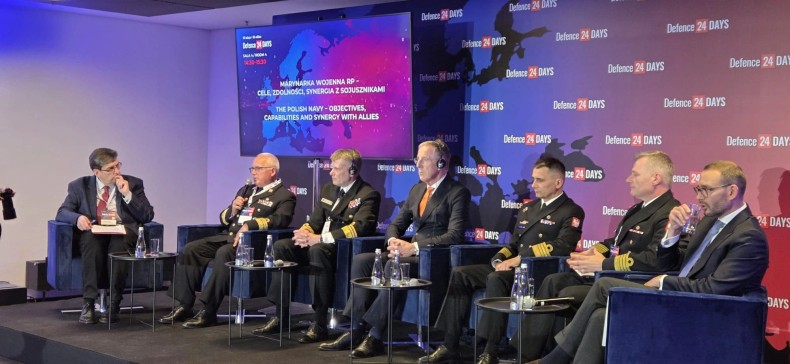
During the conference, naval representatives also indicated that the next programme expected to enter implementation will involve the acquisition of two hydrographic vessels under the “Hydrograf” programme. Preliminary market consultations for the project were launched back in 2024, meaning that a contractor could potentially be selected later this year or in 2027. More on the subject was discussed in the article entitled: Polish Navy seeks new hydrographic vessel. Preliminary market consultations begin.
In the following years, and with the objective of completing the planned fleet structure by 2039, the Naval Inspectorate also intends to acquire five new transport and minelaying vessels, as well as two new tankers and a logistics support ship. Preliminary market consultations are currently ongoing for the tanker project under the “Supply” programme.
New unmanned systems are also expected to support maritime operations, complementing manned platforms. These systems are intended for multi-domain operations – on the surface, underwater and in the air. The vehicles will be designed both for reconnaissance and surveillance missions as well as combat tasks.
New vessels – yes, but when and at what cost?
In previous years, naval leadership repeatedly highlighted its development ambitions, but these declarations were not followed by the launch of significant new programmes. Despite the clear acceleration witnessed in recent years – the largest in decades – the navy’s requirements remain enormous. At the same time, the gradual withdrawal of vessels that are already 30, 40 or more years old remains unavoidable, while in many cases their successors have yet to be clearly defined. Whether this time will prove different, commentators note – including even the more optimistic observers – will depend not only on declarations, but on concrete actions, beginning with the signing of executive contracts and the commencement of construction on new vessels.
Another issue concerns financing. It should be recalled that the SAFE programme was expected to provide, through European loans, the funds necessary to implement these plans. At the time, discussions included not only additional minehunters and many other naval vessels, but also other categories of military equipment. The navy’s requirements also include the urgent acquisition of anti-submarine warfare and search-and-rescue helicopters.
Photo Courtesy of Polish Navy Maritime Operations Centre




 DOWNLOAD PDF