

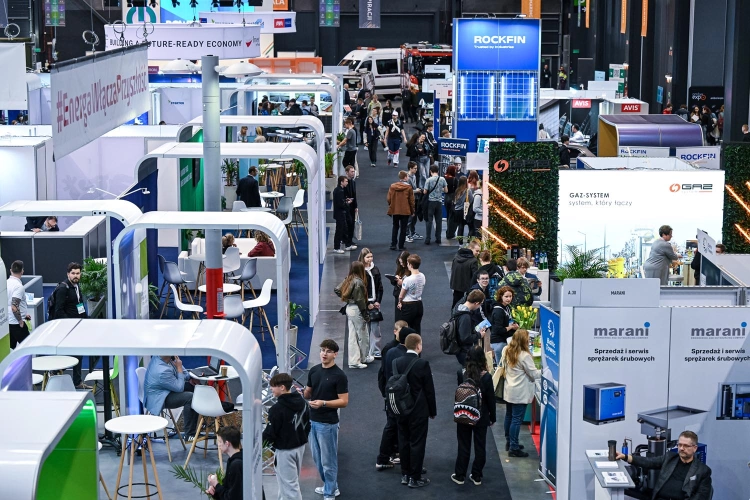


The PowerConnect Energy Summit in Gdańsk has reinforced its position as one of the most important gatherings for the energy sector in Poland and the wider Baltic Sea region. Yet the event was far more than a trade fair and technology showcase. Just as significant were the concrete decisions, agreements signed and projects launched — initiatives that are set to influence the country’s economy and energy security in the years ahead.
One of the most tangible outcomes of the summit was the signing of an agreement to establish a Baltic Sea Monitoring Centre in Gdańsk. The initiative brings together public administration, academia and industry, with the aim of developing satellite technologies and applying them to environmental monitoring, infrastructure protection and security.
The new centre is intended to integrate data and expertise, strengthening national resilience while creating opportunities for innovative companies, particularly in the space-technology sector. It stands as an example that PowerConnect was not merely a forum for discussion, but a platform for genuine cooperation and the launch of strategic projects.
Another key theme was the collaboration between science and industry in developing new technologies, including autonomous underwater systems. Such initiatives demonstrated that the energy transition and the growth of the maritime economy require not only infrastructure investment but also innovation and effective knowledge transfer.
According to experts, Poland’s energy sector is now shifting northwards. This trend reflects the construction of the country’s first nuclear power plant on the Baltic coast, major investments in offshore wind, and accompanying projects such as large-scale energy storage facilities being built across northern Poland.
Europe’s Largest Energy Construction Site
A strong political dimension was also present at the event, with speeches delivered by senior government representatives, including Polish Prime Minister Donald Tusk.
Opening the summit, the prime minister highlighted the scale of the transformation under way, stating that Poland has effectively become “Europe’s largest energy construction site”. His remarks outlined a vision of massive investments — potentially reaching one trillion złoty over the next decade — covering nuclear energy, offshore wind, transmission networks and emerging technologies.
Tusk also stressed that energy security remains a cornerstone of national sovereignty and positioned Poland as a future leader of the energy transition in Central and Eastern Europe.
His address reflected the broader themes discussed throughout the summit’s debates. One of the key topics was local content — the participation of Polish companies in energy supply chains. Discussions indicated that domestic industry involvement is no longer merely an aspiration but is becoming a tangible element of major projects, from nuclear energy to offshore wind.
Speakers emphasised that Polish firms are already involved in hundreds of contracts and are building capabilities that could eventually be exported to international markets.
Piotr Czopek, Vice-President of the Polish Wind Energy Association, argued during the local-content debate that the current level of Polish industry participation in offshore renewable projects should be seen as a success.
“Considering that we developed this sector from scratch, we have achieved quite a lot in terms of local content. And it continues to grow alongside new projects. The sector is still being built. Colleagues working on second-phase developments say that the domestic share will be even higher. This shows that a gradual, organic development path delivers results,” Czopek said.
Sławomir Staszak, a member of the management board at Orlen, explained why Poland cannot isolate itself from international cooperation or attempt to deliver such investments using only domestic companies.
Only a limited number of firms worldwide possess the necessary technologies, he noted. However, he argued that partnerships with these companies should be used to acquire know-how that can later be exported to other markets.
Staszak also pointed to financial liquidity as a crucial factor in project development, noting that barriers to the growth of local supply chains still remain.
“Public procurement procedures are a major issue,” he said, adding that companies commissioning projects often impose internal rules that can be difficult for local suppliers to meet.
He revealed that Orlen is currently revising its procurement policy.
“We need to address the cash-flow issue in contracts. For small suppliers, payment terms of 60 days from large companies like Orlen can be devastating,” Staszak said.
The debate on local content was moderated by Mateusz Kowalewski, publisher of the industry portals Gospodarka Morska and Zielona Gospodarka.
Demand for Skilled Specialists
Workforce challenges were another prominent theme throughout the event. Experts warned that even the largest investments will fail without adequately trained personnel.
The energy transition requires not only highly qualified engineers but also specialists in emerging technologies, alongside changes to the education system and a new approach to developing professional skills.
PowerConnect 2026 made it clear that Poland’s energy transition is entering a new phase — moving from strategy and planning to implementation. The Gdańsk summit has become a meeting place for investors, government officials and industry leaders, but above all a forum where decisions are taken and partnerships forged that will shape the country’s energy future.
 DOWNLOAD PDF