

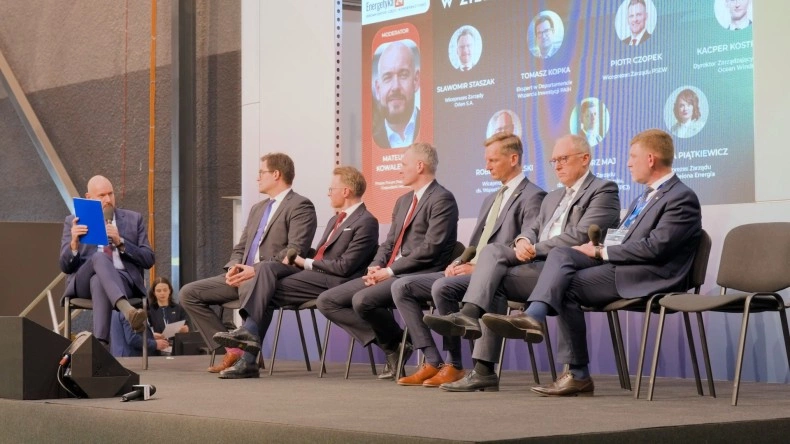


Poland’s energy transition is progressing steadily, and it is difficult to imagine a scenario that could halt it entirely. However, Polish industry is still searching for its place within the supply chains of the country’s largest energy projects. Representatives of major players in the sector discussed where they see opportunities and what obstacles still lie ahead for domestic companies during the Power Connect 2026 energy fair, held at AmberExpo.
Just when it might seem that everything has already been said about local content, the situation continues to evolve. Each year of progress in large-scale energy projects in Poland brings new opportunities but also new challenges for both small and large domestic firms seeking to enter supply chains.
During the Power Connect energy fair in Gdańsk, representatives of energy companies responsible for some of these projects discussed the participation of Polish firms in green supply chains. The panel was moderated by Mateusz Kowalewski, publisher of the industry portals GospodarkaMorska.pl and ZielonaGospodarka.pl.
One conclusion highlighted early in the discussion was that local content does exist. Contrary to the complaints often heard from various sectors, many companies have indeed prepared – and continue to prepare – to participate in supply chains for major energy projects.
Grzegorz Maj, board representative for market development support at Polskie Elektrownie Jądrowe, noted that the database of the main contractor for Poland’s first nuclear power plant – the **Westinghouse–Bechtel consortium – already includes more than 1,000 Polish companies that have passed the first stage of certification, while six of the country’s largest construction firms have reached the final stage of the process.
“If a nuclear energy supply chain emerges in Poland, it is difficult to imagine that it would not follow the general contractor when it seeks opportunities in other European markets,” Maj said.
In his view, Polish companies have the greatest opportunity to enter the nuclear sector in areas such as conventional construction works, steel structures and cabling.

Robert Kowalski, Vice-President for Support and Development at PGE, added that some areas of supply chains where Polish firms can participate can be defined in the short term, while others are longer-term prospects. He recalled that PGE was the first company to introduce so-called third-country guidelines even before similar provisions were introduced into the Public Procurement Law.
Under these guidelines, contractors for major investments were selected. Kowalski also argued that local content may include companies such as LG, which, although a global corporation, operates a factory near Wrocław employing around 7,000 people.
“We should not be afraid of public procurement law. Many people claim that because of procurement regulations nothing can be done. The Polish economy today expects bold decisions. At PGE we are not afraid of them – and Polish entrepreneurs are waiting for them. If someone lacks such courage, they should change their job as soon as possible,” Kowalski said.
The foreign investor represented on stage at AmberExpo was Kacper Kostrzewa, Managing Director of Ocean Winds Poland, which is developing the BC-Wind offshore wind farm in Polish waters. Kostrzewa stressed that the company has done a great deal to support local content.
“Our supply chain shows that this is a priority for us, also with a view to potentially using it in the future,” he said.
Kostrzewa also described his experience in building supply chains during the development phase. According to him, lengthy discussions with potential Polish partners were crucial in contract negotiations, as they allowed both sides to better understand each other’s expectations, competencies and capabilities.
Often these discussions do not result immediately in a specific contract, but they enable companies to understand what requirements they must meet to participate in future tenders.

Piotr Czopek, Vice-President of the Polish Wind Energy Association, believes that the current level of participation by Polish companies in offshore renewable energy projects can already be considered a success.
“Despite the fact that we developed this sector from scratch, quite a lot has been achieved in terms of local content. It is also growing along with the projects themselves. The sector is being built. Colleagues working on second-phase projects indicate that the share will increase further. This shows that the path of gradual, organic development is delivering results,” Czopek said.
Sławomir Staszak, member of the management board at Orlen, explained why Poland cannot isolate itself from cooperation with foreign companies and carry out investments solely with domestic resources. Only a limited number of companies worldwide possess the necessary technologies, he noted.
However, he argued that Poland should focus on leveraging cooperation with such partners in order to acquire know-how and later export it to other markets.
The panel also included representatives of the Polish Investment and Trade Agency, whose role is somewhat the opposite – attracting Western capital to Poland, encouraging foreign companies to invest in the country and helping them navigate the local business environment.
Tomasz Kopka, an expert in the agency’s Investment Support Department, pointed out that this is also crucial for building local content. Foreign investment in Poland increases employment in specific industries, creates new supply chains and facilitates the transfer of know-how. As examples he cited investments by Vestas, GRI Renewable Industries, and Windar Renovables.
He also argued that thanks to the development of renewable energy in Poland, Polish companies will increasingly be able to rely on green electricity, which is becoming an increasingly important factor for contractors selecting suppliers.
At the same time, the presence of numerous smaller companies can itself be an advantage when attracting foreign investors.
“In many sectors, a well-developed ecosystem and a large number of suppliers are additional assets. A strong subcontractor chain – for example a robust automotive sector – also provides a large pool of experienced and well-trained workers,” Kopka said.
Nevertheless, barriers to the development of local supply chains remain.
“Public procurement procedures are to a large extent part of the problem,” said Staszak from Orlen. However, he noted that companies themselves often impose internal restrictions that can make it harder for local firms to compete. Orlen, he said, is currently revising its procurement policy.
“It is necessary to address the issue of cash flow in contracts. For small suppliers, payment terms of 60 days used by large companies like Orlen can be devastating,” he said.
Another limitation, in his view, is conducting tender procedures in English, which can shape the direction of cooperation and also affects the legal regimes applied in contracts.
“Different foreign entities choose different legal systems. We must allow ourselves to be the ones being courted. If someone has a problem with Polish law governing a contract or with Polish courts resolving disputes, then they should not submit a bid,” he argued.
Staszak also referred to what he described as excessive contract security requirements, as well as the growing importance of using green energy in production processes.
“Very often, to even enter the contracting process, a certain level of renewable energy usage must be demonstrated. For some contractors this is simply impossible,” he said.
Czopek added that a major issue lies in “mindset and planning”.
“Not everything depends on regulations – a lot depends on corporate procurement policies and their flexibility. Planning is also crucial. The world’s twentieth-largest economy does not have an industrial policy. We have more than a hundred different strategies adopted at the Council of Ministers level, but none focused on industry,” he said.
In his view, the current level of local content in Poland is already relatively strong, but this should not be the end of the journey. The next step should be exporting this experience abroad, enabling Polish companies to secure contracts on international markets based on domestic experience.
“Polish companies lack a bit of a conquering instinct – they do not expand into other markets. The government should also facilitate this through industrial policy, but such a policy does not exist,” he said.

Kostrzewa also mentioned barriers arising from a lack of understanding of the specific nature of the relatively new offshore wind sector.
“With many companies we spoke to, the dialogue lasted a year or two. Sometimes we jointly concluded that a company was not yet ready to supply this market. But the dialogue works – companies now understand what they were lacking and where they need to improve their capabilities. And we can already see this changing,” he said.
Access to the appropriate technology is another significant challenge for Polish companies wishing to participate in energy sector tenders.
According to Robert Kowalski from PGE, this illustrates how important it is to shorten supply chains and build technological capabilities locally.
“Today, because of the conflict in the Middle East, everyone wonders whether measurement systems or other equipment will arrive on time for us to complete projects. If production were located in Poland – ideally with Polish manufacturers – this problem would not exist. We cannot afford to become dependent on others,” he said.
Closing the discussion, Maj from Polskie Elektrownie Jądrowe called for greater attention from investors to the local supply chain.
“The further down the supply chain you go, the greater the care required,” he said.
“Local content is not only about Polish companies but also Polish workers and Polish science. Our owner will not forgive us – nor will the public forgive the owner – if at the peak of construction there are 10,000 foreign workers on site instead of 10,000 Poles,” Maj said.
Yet this is easier said than done. Maj acknowledged that Poland faces shortages in certain professions, including welders.
“We must build this human resource base,” he said. “We need to open a dozen new classes for welders and fitters, prepare them for the safety culture required in nuclear projects, and teach them technical English. Polish academia can help upgrade the skills of workers, and if research institutes can establish laboratories and materials science facilities near construction sites, that will also provide an advantage for Polish companies.”
 DOWNLOAD PDF