

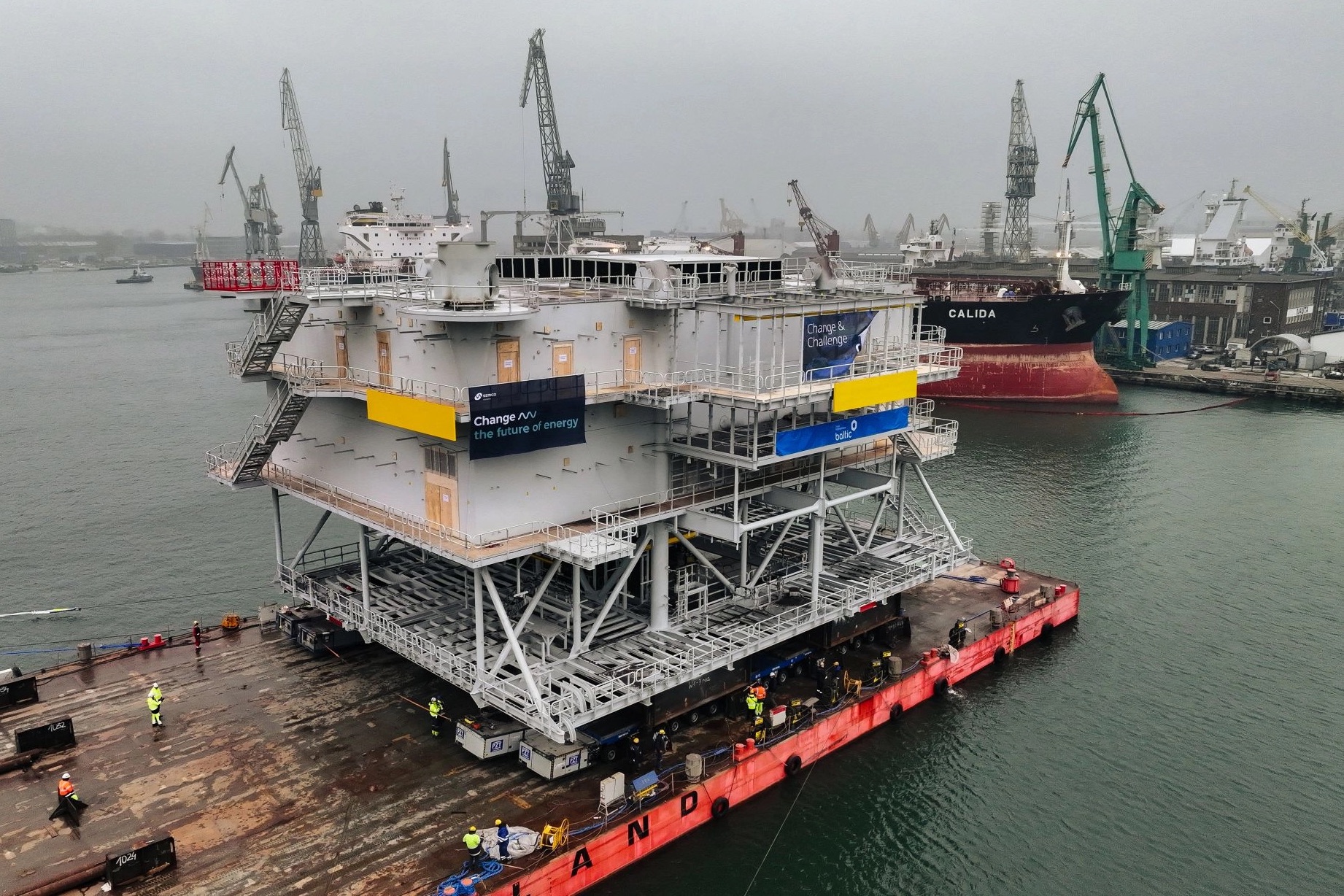


Grupa Przemysłowa Baltic (Baltic Industrial Group) has launched a comprehensive rebranding process under which the entire capital group will operate as Stocznia Gdańska – Gdańsk Shipyard. The move is intended not only to highlight the historic legacy of the birthplace of the Solidarity movement, but also to capitalise on one of the world's most recognisable brands associated with the Polish shipbuilding industry. According to CEO Tomasz Szymczak, the rebranding process is expected to be completed at the turn of 2026 and 2027.
"Gdańsk Shipyard is a globally recognised brand, not only because of its historical and social significance, but also as a symbol of heavy industry, shipbuilding and the maritime sector. Our Western partners regard the name Gdańsk Shipyard as a significant added value," said Tomasz Szymczak, CEO of Baltic Industrial Group.
He also emphasised that, in today's economy, the term "heavy industry" should no longer be viewed as carrying negative connotations.
A Shipyard Building More Than Ships
As Tomasz Szymczak explains, the decision to revive the historic Gdańsk Shipyard name was taken jointly with the group's owner, the Industrial Development Agency (ARP). The objective is to leverage a globally recognised brand that has, for decades, been synonymous not only with pivotal moments in modern European history but also with one of the continent's leading centres of shipbuilding and heavy industry.
The rebranding process is already under way. The Baltic Operator brand is being phased out and replaced by Gdańsk Shipyard, with the entire holding eventually adopting the new identity. The group's Energomontaż Północ Gdyniasubsidiary, however, will retain its current name and preserve its separate corporate identity.
The new Gdańsk Shipyard will focus its operations on three core pillars of heavy industry. The largest business segment will remain the energy sector—primarily offshore wind—covering the production of offshore substation structures, secondary steel components and other specialised steel fabrications. Land-based power engineering will also continue to represent an important part of the company's portfolio.
At the same time, the group has no intention of abandoning shipbuilding. According to Szymczak, the maritime business is expected to account for around 20–25% of total operations, including the production of hull sections and other shipbuilding structures. Manufacturing will continue in cooperation with long-standing partners at Western European shipyards, with whom the company intends to further strengthen long-term business relationships.
Although parts of the former Gdańsk Shipyard site have been transformed into Young City (Młode Miasto)—a new urban district featuring residential, office and commercial developments—a substantial portion of the historic complex remains an active industrial hub. It is home to facilities belonging to today's Baltic Industrial Group, soon to become Gdańsk Shipyard, as well as the state-of-the-art Baltic Towers factory, which manufactures offshore wind turbine towers. As a result, the historic shipyard continues to combine its unique heritage with modern heavy industry serving both the energy and maritime sectors.
A Brand Shaped by Industry and Freedom
The history of Gdańsk Shipyard has long been intertwined with the history of modern Poland.
In December 1970, workers protesting against price rises were brutally suppressed by the communist authorities. The protests along Poland's Baltic coast claimed dozens of lives and left hundreds injured.
Ten years later, in August 1980, it was at Gdańsk Shipyard that the strike began which culminated in the signing of the August Agreements and the creation of Solidarity (Solidarność)—the first independent trade union in the Soviet bloc. A further wave of strikes in 1988 became one of the key catalysts leading to the Round Table Talks and Poland's democratic transformation.
Alongside its political significance, Gdańsk Shipyard was for decades one of Europe's most recognisable industrial enterprises. Hundreds of vessels—from general cargo ships and bulk carriers to specialised maritime units—were built there and exported to shipowners around the world. The Gdańsk Shipyard name became synonymous with the capabilities of the Polish shipbuilding industry and one of the country's strongest industrial brands internationally. According to the group's management, it is precisely this industrial reputation, reinforced by its historic legacy, that is expected to become one of the foundations for strengthening the company's position in Europe's energy and maritime industries.
The final vessel built by the historic Gdańsk Shipyard S.A. was launched in 1996, shortly before the company entered bankruptcy proceedings. That did not, however, mark the end of shipbuilding on the site. Following the acquisition of its assets by new owners, the construction and launching of ships and hulls continued for many years under companies operating within the Gdynia Shipyard Group. As a result, despite profound ownership changes, the historic Gdańsk Shipyard site has retained its industrial character to this day.

 DOWNLOAD PDF