

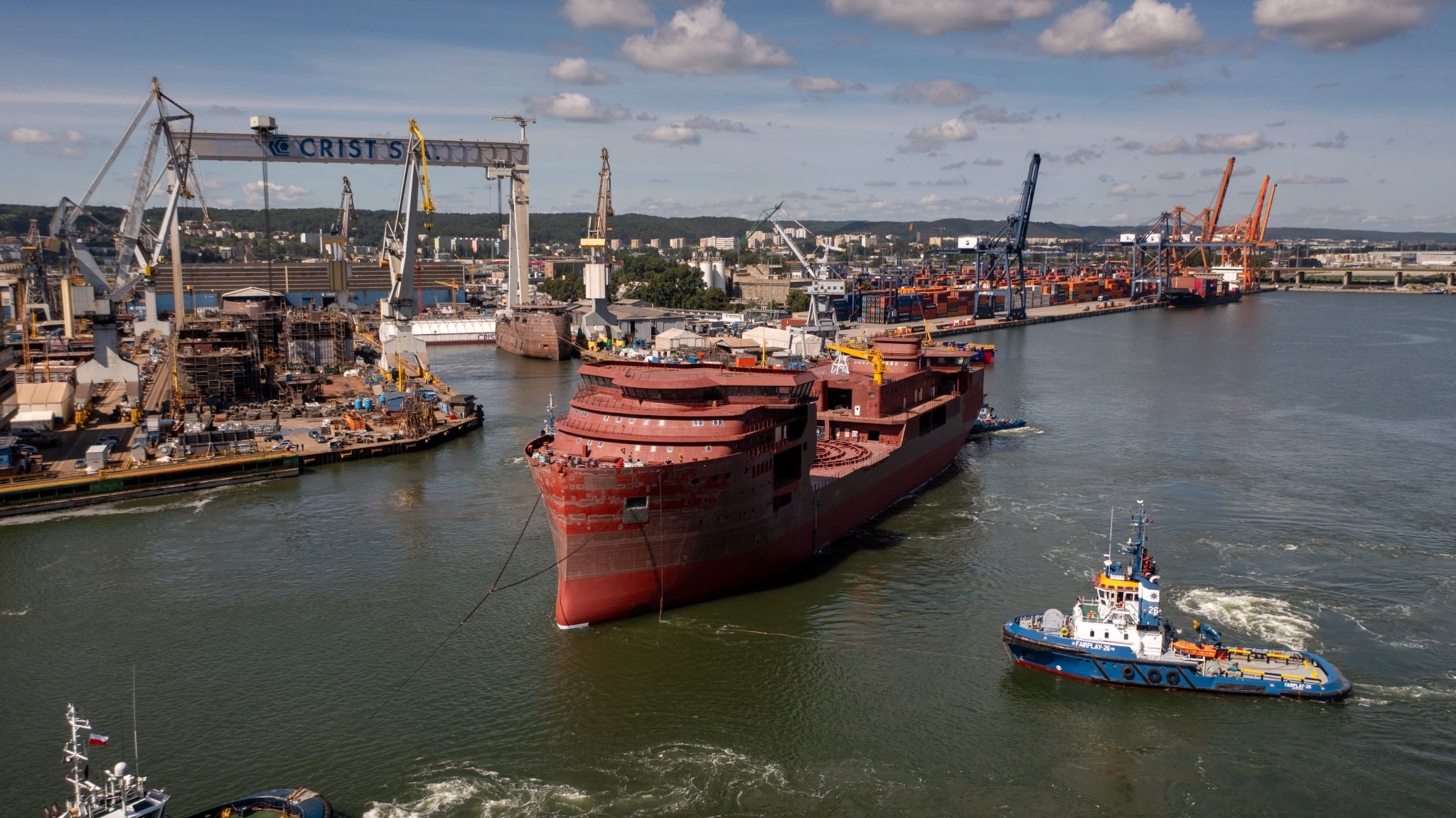


CRIST Shipyard in Gdynia has completed the construction of the partially outfitted hull of an advanced cable-laying vessel – NB 317. The vessel was built on behalf of the Norwegian shipyard Ulstein Verft, with its end customer being Nexans, a global leader in subsea cable systems and a key player in sustainable electrification.
Work at CRIST commenced on 29 January 2024, with the keel laying taking place on 4 April the same year. After just under 15 months, the vessel was officially handed over and departed Gdynia to undergo final outfitting in Norway. The ceremonial assembly of the hull in the dry dock took place in September 2024, marking the start of an intensive and efficiently executed construction schedule. The main contractor for the project is Ulstein Verft, while the client is Nexans, a leader in subsea cable systems and a specialist in sustainable offshore electrification. As highlighted by CRIST, the vessel belongs to the so-called “third generation,” featuring an additional cable carousel that enables the transport of nearly 14,000 tonnes of cable.
The future cable-laying vessel (CLV) will be named Nexans Electra. Its primary role will be the installation and maintenance of subsea cables, including both power and fibre-optic lines. NB 317 is a third-generation unit and a sister ship to NB 314, also previously built at CRIST. The vessel measures 155.2 metres in length and 31 metres in beam. It was specially designed by Skipsteknisk and enhanced with an additional 3,500-tonne carousel and extended cable-handling capabilities. In total, the vessel will be capable of transporting almost 14,000 tonnes of cable: 10,000 tonnes on the main carousel, 450 tonnes of fibre-optic cable, and 3,500 tonnes on the secondary carousel.
In addition to transporting and laying various types of subsea cables (including up to four simultaneously), the vessel will be equipped for cable retrieval and repair operations. It is designed to operate effectively in challenging weather conditions, offering exceptional manoeuvrability and station-keeping capabilities. A key feature is the modern dynamic positioning system, allowing the vessel not only to maintain position without deploying anchors but also to rotate on its own axis when required.
The construction of NB 317 further demonstrates CRIST’s capabilities in executing complex offshore structures and reflects strong collaboration with international partners in the offshore and renewable energy sectors. The vessel leaves the shipyard as a robust platform for final outfitting, which will continue at Ulstein’s facilities in Norway.
 DOWNLOAD PDF