

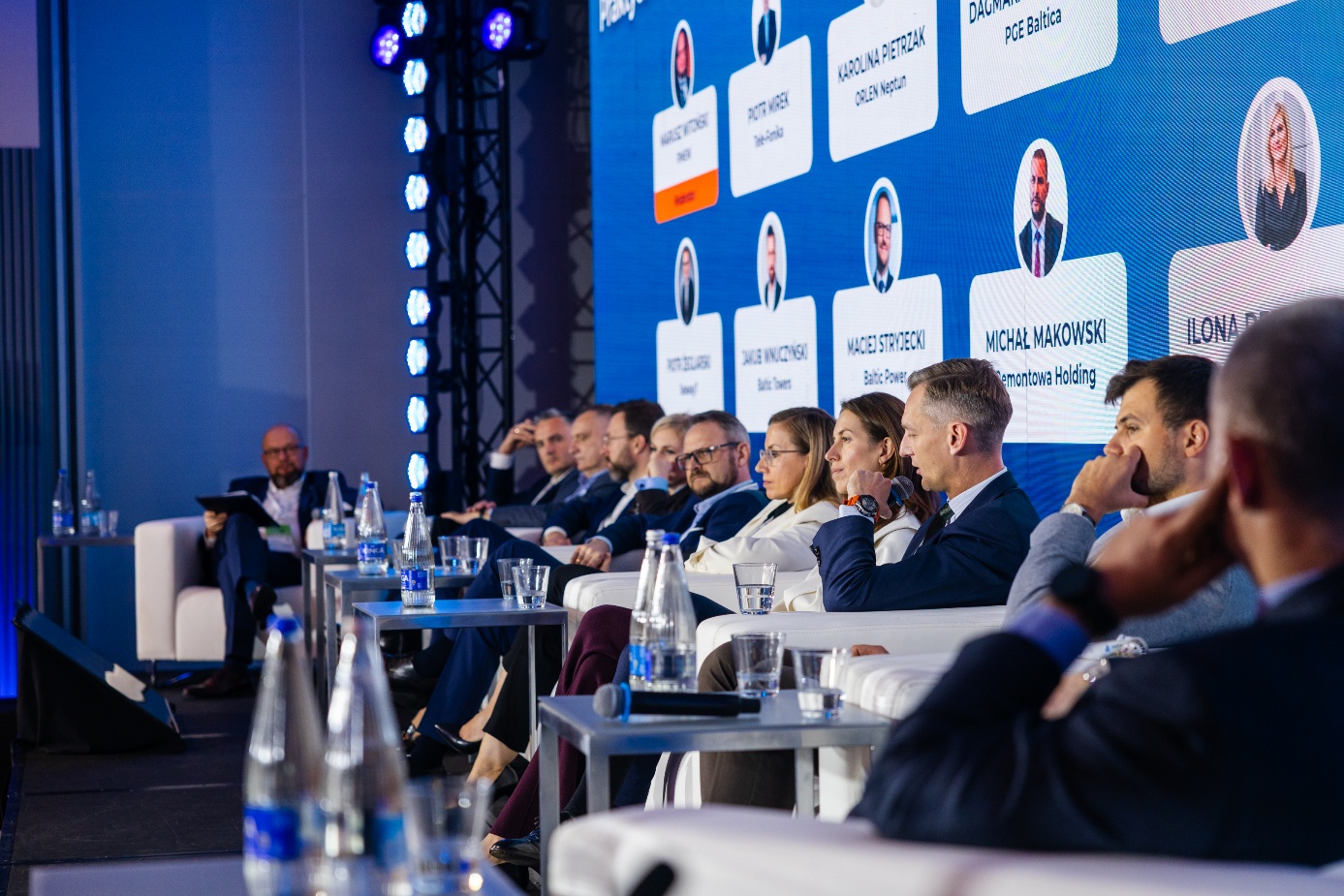


The 15th International Offshore Wind – Logistics & Supplies Conference (OWLS), organised by the Polish Offshore Wind Industry Chamber (PIMEW), took place in Gdańsk on 21–22 October 2026. The event brought together representatives of investors, contractors, suppliers, public institutions and the financial sector, providing a forum for discussions on the key challenges facing the development of the European offshore wind market.
15 years of offshore wind market development
Since its inception, OWLS has focused on one of the key areas in the development of offshore wind – the supply chain. Over the years, the conference has evolved alongside the market, attracting an increasingly broad range of companies and institutions involved in the sector’s development.
As Jakub Budzyński, President of PIMEW, pointed out, the event began with meetings attended by a relatively small group of people who recognised the potential of offshore wind in Poland – not only as a source of electricity, but above all as a catalyst for the development of domestic industry and the economy.
Today, OWLS is a platform for meetings and the exchange of experience among representatives of the entire offshore industry. Its programme is developed on the basis of current market observations and the challenges facing businesses. The conference is intended not merely to identify problems, but, above all, to seek solutions and initiate action in response to the sector’s actual needs.
From the outset, PIMEW has played a role in this process as an organisation representing the interests of industry, supporting companies in gaining market knowledge, establishing business relationships, reaching decision-makers and understanding the regulations and requirements involved in delivering offshore wind projects.

Local content: from ambition to practical implementation
One of the main events on the first day of the conference was the opening debate, which focused on the practical aspects of local content policy. Topics included mechanisms for cooperation between public administration, industry organisations and businesses; incentives for contracting authorities to involve domestic companies; and challenges associated with public procurement law. The discussion also covered methodologies for calculating local content levels and good practices applied by the Ministry of State Assets.
The participation of Polish companies in offshore wind projects was also discussed in subsequent sessions. During an ORLEN Neptun panel and workshop, participants examined opportunities for domestic companies to become involved in the cable package for the Baltic East offshore wind farm. Particular attention was paid to building a supply chain while meeting requirements for safety, quality, timely delivery and competitiveness, as well as developing partnerships between Polish companies and experienced international players.
O&M, contracting and cooperation throughout the project lifecycle
Another area of discussion was the operation and maintenance (O&M) phase of offshore wind farms. During a session devoted to this subject, participants examined the scope of work that could be carried out by Polish companies, opportunities for involving domestic suppliers in the servicing of turbines, Balance of Plant infrastructure and support structures, as well as the potential for modifying standard contract models to increase local content.
A Seaway7 workshop was held in parallel, focusing on the role of the supplier in a project. Discussions covered supply chain management throughout the investment lifecycle, the contribution of individual suppliers to the success of a project, and the services and materials required to deliver projects in Poland.
An important complement to these topics was a session on contracting services and supplies between Tier 1 companies and subcontractors. Participants examined the most challenging aspects of contractual relationships, clauses requiring particular attention, companies’ readiness to enter into agreements and the principles governing the resolution of disputes. The discussion also covered the importance of appropriate provisions on insurance and financial guarantees.
The practical nature of these discussions made it possible to consider the development of the domestic supply chain not only in terms of companies’ potential, but also the conditions under which they will participate in the delivery of major offshore wind projects.
PIMEW and PKO Bank Polski join forces to support offshore wind financing
One of the most important events on the first day of the OWLS Conference was the signing of a cooperation agreement between the Polish Offshore Wind Industry Chamber and PKO Bank Polski.
The agreement was signed on behalf of PKO Bank Polski by Michał Stępniewski, its representative for local content, and Marek Wasilewski, Director of the ESG Product Sales Support Office. PIMEW was represented by Jakub Budzyński, President of the Board, and Mariusz Witoński, Vice-President of the Board.
The partnership aims to jointly identify the needs of companies operating in the offshore wind sector and develop financial solutions that take account of the industry’s specific characteristics and the actual conditions under which contracts are delivered.
For companies in the domestic supply chain, access to appropriately tailored financing has a direct bearing on their ability to secure and fulfil orders. Businesses must not only have the necessary expertise and technological capabilities, but also finance contract preparation, provide security for their commitments, maintain liquidity and invest in expanding their production and service capabilities.
Cooperation between PIMEW and PKO Bank Polski will cover issues relating to contract and working capital financing, guarantees required for order fulfilment, solutions supporting companies’ financial liquidity and financing for investments aimed at developing the capabilities of Polish suppliers. An important element will also be the exchange of knowledge and educational activities concerning energy efficiency, the energy transition, opportunities to obtain funding, ESG and local content.
A PKO Bank Polski workshop entitled “How to Prepare Your Company for a Discussion about Offshore Financing” was also held on the same day. It was aimed at entrepreneurs planning to expand their operations, invest or fulfil orders within the supply chain.
Participants learned about the practical aspects of preparing for discussions with a bank, including how to define financing requirements, what information is needed to assess a project, and which contractual terms should be analysed before submitting a bid and signing an agreement.

Preparing companies to participate in the market
An important part of the first day's programme was also an Industrial Development Agency (ARP) workshop devoted to the “Ready for Offshore” programme. The session presented its objectives, how it operates, eight areas in which companies can build their readiness, and the ways in which businesses interested in joining the supply chain can use the programme.
The session formed part of the conference’s broader message: developing Poland’s offshore wind sector requires not only investment in infrastructure and the delivery of further projects, but also systematic preparation of domestic companies to meet the requirements of investors and international contractors.
She Winds – diversity as part of the sector’s development
The first day's programme was complemented by the SHE WINDS. THEY POWER. accompanying event, devoted to diversity, cooperation and the role of women in the offshore, nuclear energy and major infrastructure project sectors.
Topics discussed included gender balance in business, resilience and preparedness for crisis situations, the design of protective clothing that takes women's needs into account, and the importance of different perspectives in teamwork and leadership.
The event provided a forum for discussing how diversity of experience and expertise can be harnessed to build strong, effective teams delivering complex infrastructure projects.
Safety and common standards for the Polish offshore sector
The second day of OWLS XV focused, among other things, on HSEQ – health, safety, environment and quality.
The first part of the panel entitled “Government and Business – Are We Ready for Offshore?” was devoted to cooperation between public administration, investors and offshore wind farm contractors. The discussion covered responsibility for workplace safety, the experience of public institutions, legal and organisational barriers, and the readiness of individual stakeholders to support the sector’s development.
The second part of the panel, entitled “From Experience to Common Solutions – A Safety Standard for the Polish Offshore Sector”, took the form of a workshop. Its aim was to move beyond identifying problems and seek concrete solutions, including the harmonisation of HSE requirements, recognition of qualifications and medical examinations, and improved cooperation between the industry and public administration.
Particular attention was paid to PIMEW’s work on the Polish QHSE Standard and the concept of the Offshore Ready Passport. These initiatives form part of efforts to develop a more consistent approach to safety and qualification requirements across the sector.
Technical knowledge and risk management in practice
The second day's programme also included workshops devoted to the technical and business aspects of project delivery.
NKT presented issues relating to the repair of export cables, using a case study to discuss the successive stages of the process – from the initial damage assessment and selection of a repair scenario, through the mobilisation of a service vessel, to the execution of the work. Participants also learned about cable monitoring solutions, including DTS, DoB, DAS and AIS systems, and options for the preventive protection of infrastructure.
Meanwhile, an STBU workshop on offshore wind insurance focused on the practical consequences of errors, delays and damage in offshore projects. Case studies were used to examine the limits of civil and project liability, claims for lost equipment and potential gaps in insurance cover.
An important part of the second day's programme was also a presentation of the proposed Development Strategy for the Pomeranian Voivodeship 2035.

PIMEW Awards
The first day of the conference concluded with a gala dinner and the presentation of the PIMEW Awards. For the second time, the Chamber recognised companies and institutions whose activities and achievements have particular significance for the development of Poland’s offshore wind sector.
Awards were presented in five categories:
Grand Prix – Baltic Power – for the delivery of Poland’s first offshore wind farm project.
Investment of the Year – the SPIE Energy Poland S.A. and ELFEKO S.A. consortium – for the delivery of the 400 kV Choczewo substation project.
Development – Technica Nova Baltica – for the impressive pace of growth in its offshore wind services.
Industry Support – the Ministry of State Assets – for implementing a procurement policy that supports the development of Polish industry.
Special Award – ZRB Janicki – for its achievements in the construction of offshore wind farms in Poland.
The PIMEW Awards recognise organisations which, through their investments, the development of expertise, business activities and institutional support, contribute to building Poland’s domestic offshore wind capabilities.

PIMEW OWLS – a common platform for the development of the sector
The 15th edition of the International Offshore Wind – Logistics & Supplies Conference confirmed the need for a broad perspective on the development of Poland’s offshore wind market. The participation of domestic companies in offshore projects depends not only on the scale of investment, but also on the availability of financing, contractual conditions, expertise, safety, production capacity and the quality of cooperation between all market participants.
That is why, for 15 years, PIMEW has consistently developed OWLS as a platform for dialogue, the exchange of experience and the search for solutions that address the needs of the sector. The conference brings together representatives of public administration, investors, contractors, suppliers and financial institutions, enabling different perspectives to be compared and discussions translated into concrete courses of action.
As the PIMEW President points out, the Chamber does not limit itself to observing changes in the industry – it actively participates in shaping them. Fifteen editions of OWLS also represent 15 years of building relationships and supporting the development of a market whose potential extends far beyond energy production itself. It is also an opportunity to develop Polish industry, services, technologies and expertise.
The organisation of this year's PIMEW OWLS Conference was made possible by the involvement of partners and institutions supporting the development of the offshore wind sector. The event was held under the honorary patronage of the Ministry of State Assets, the Minister of Infrastructure, the Ministry of Energy, Deputy Prime Minister and Minister of Digital Affairs Krzysztof Gawkowski, the Ministry of Climate and Environment, the Ombudsman for Small and Medium-sized Enterprises Agnieszka Majewska, Pomeranian Voivode Beata Rutkiewicz, Marshal of the Pomeranian Voivodeship Mieczysław Struk, the Polish Investment and Trade Agency and the Embassy of the Kingdom of Denmark in Warsaw. Tele-Fonika was the conference ambassador.
The Strategic Partners were PKO Bank Polski, Baltic Power, ORLEN Neptun, Ocean Winds, PGE Baltica, Seaway7 and Smulders Projects Poland.
The Main Partners were the Industrial Development Agency, Grupa Przemysłowa Baltica, Remontowa Holding, NKT, DEME, Vestas and Norwegian Energy Partners.
The Partners included ELECOM, DP IDEA, Morska Agencja Gdynia, MAG Offshore, Wind & Water Legal Zbroja, Rumia Invest Park, Trident BMC, HSE Energy, Power Connect, STBU, Technica Nova Baltica, SciTeex and FALCK.
The Sponsors were Pracownia Projektowa Krzysztof Broż, Spedman Global Logistics, Baltic Towers, Assisteo, Velaros, COMADE and COS Lifting.
The event was also supported by the Industry Partners: the Maritime Economy Employers' Forum, Gdańsk Entrepreneurship Foundation STARTER, windhunter academy, the Pomeranian Platform for the Development of Offshore Wind Energy in the Baltic Sea and the Shipbuilding Forum.
Photos: Natalia Kuna
 DOWNLOAD PDF
