

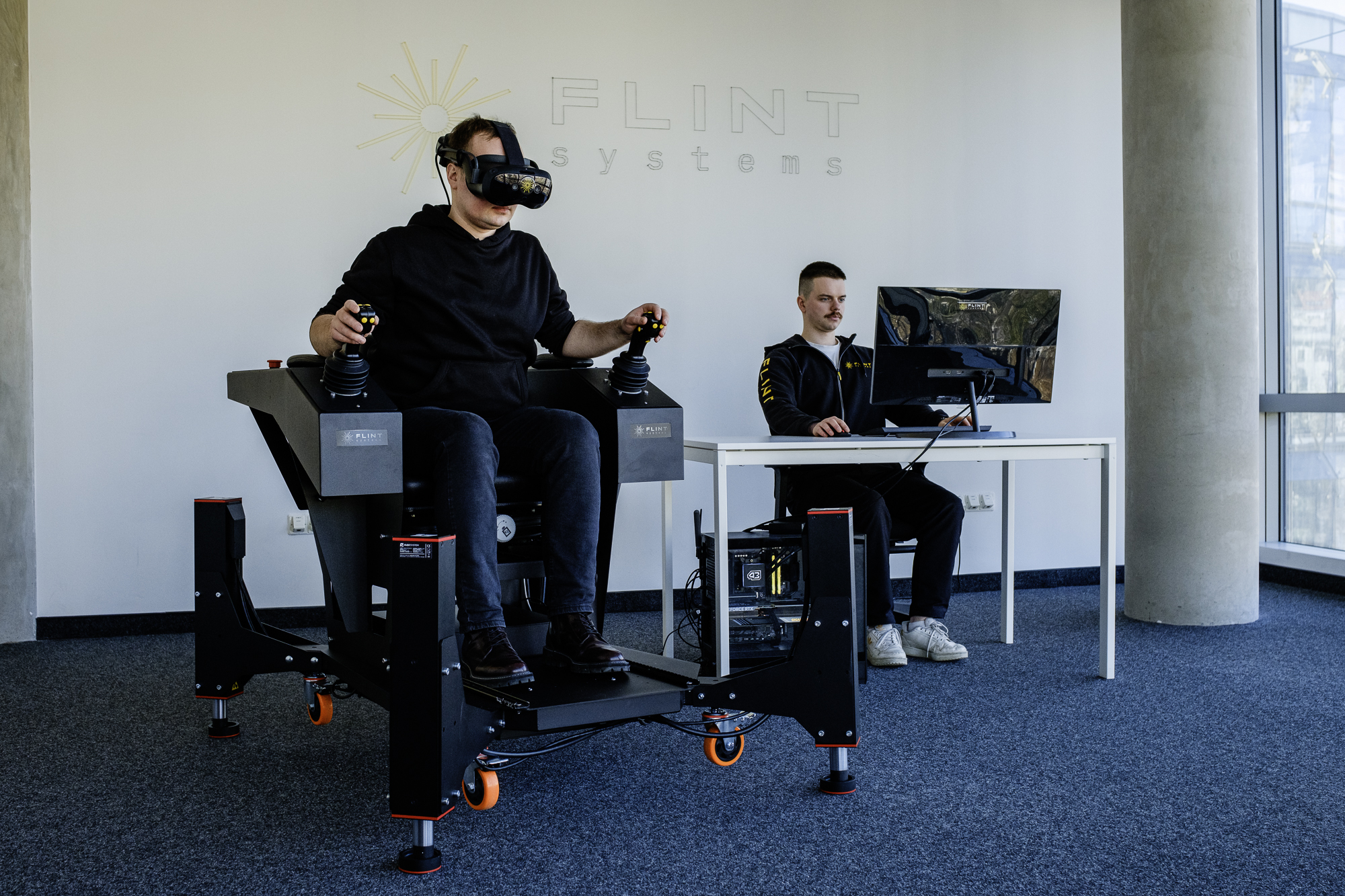


In the second half of October 2026, Flint Systems delivered and commissioned a Perun Experience simulator at the Faculty of Transport Engineering and Economics of the Maritime University of Szczecin. This is already the second VR simulator manufactured by Flint Systems that the Maritime University of Szczecin has purchased to support the education of future specialists.
The new simulator enables students to train in the operation of three types of machinery used in ports and container terminals:
- STS (Ship-to-Shore) crane – used for loading and unloading container ships.
- RTG (Rubber Tyred Gantry) crane – used for moving and stacking containers in terminal yards.
- Mobile harbour crane – used for various cargo handling operations in ports.
Thanks to virtual reality technology, students can familiarise themselves with the structure, operating principles, and controls of port machinery, practise cargo handling operations, and develop their skills in a safe, controlled environment.
The simulator allows exercises to be repeated multiple times without the need to use actual port equipment. This enables students to combine theoretical knowledge with practical training, making the learning process more effective and engaging.

A second faculty, another simulator
The cooperation between Flint Systems and the Maritime University of Szczecin began earlier. In 2025, the Faculty of Mechanical Engineering decided to purchase our simulator, ordering a solution that included four training modules:
- Deck crane simulator
- RTG crane simulator
- Working at heights simulator
- Wind turbine maintenance simulator
The project, with deliveries carried out throughout 2025 and 2026, expanded the university’s practical training capabilities in areas related to maritime transport, port cargo handling, and wind energy.

Virtual reality in higher education
The use of VR simulators in higher education allows students to gain practical experience not only in operating machinery but also in understanding its structure and operating principles.
This is particularly important when training involves large, expensive, and difficult-to-access equipment, such as container cranes, harbour cranes, and offshore or onshore wind turbines.
For us, this is not only a sign of trust but also further confirmation that our VR solutions deliver high-quality training experiences and are finding increasingly widespread practical applications in technical education.
Flint System expresses their pride to have contributed to the education and professional development of future specialists in the maritime, port, and offshore industries.

Photos: Flint Systems
 DOWNLOAD PDF
