

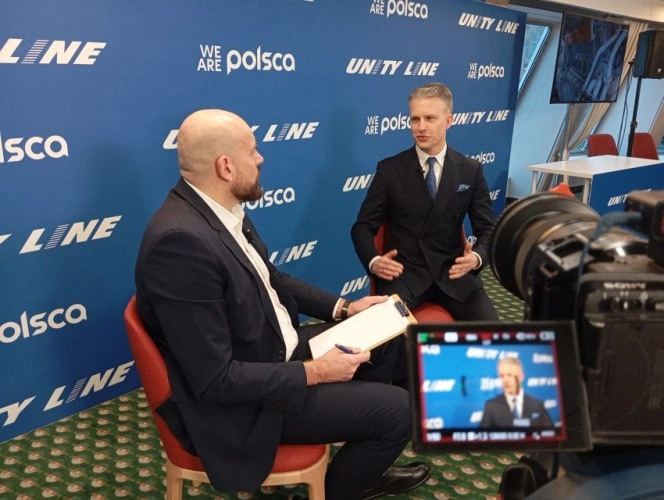


Shortly before the naming ceremony of the new Polish ferry Jantar Unity, we met on board with Arkadiusz Marchewka, Secretary of State at the Ministry of Infrastructure with responsibility for maritime economy and inland navigation, to reflect on the past twelve months in Poland’s maritime sector.
Minister, each year we have the opportunity to record a summary of the previous twelve months. We have usually done so in Warsaw, in your ministerial office. Today, however, we are in rather different surroundings — on board the ferry Jantar Unity, berthed at Wały Chrobrego in Szczecin. It feels like a landmark moment not only for the city, but for the maritime economy as a whole. From your perspective, how has this project progressed in recent months?
It is a major achievement. After two years of extremely intensive work, I can say with real satisfaction: we have delivered. When I took responsibility for maritime affairs two years ago, the project was burdened with debt, without financing, and perilously close to ending like the keel that still lies rusting on the slipway in Szczecin. I am convinced that what has been accomplished is the result of placing competent professionals — people who understand the industry — at the helm of maritime policy. After two demanding years, we can state clearly that we are ready to regain our position on the Baltic, a position that had been weakened in recent years by poor decisions.
Public interest has been evident. Over the past two days residents have gathered in large numbers; social media has been filled with images and footage. This is clearly being recognised as a significant event — not just for Szczecin, but for the entire maritime sector.
It matters for two reasons. First, it showcases advanced engineering, innovation and state-of-the-art technologies, delivered in Poland by a private Polish shipyard and its workforce. Second, it demonstrates that the Polish state is investing boldly and ambitiously in its future on the Baltic Sea. The Government committed PLN 1.3 billion to this undertaking. That enabled completion of this vessel, finalisation of financing for the second — already launched and due for delivery in around six months — and the opening of discussions on a third.
For the wider maritime economy, considering the scale of involvement from subcontractors, shipyard workers and project management teams, this is an exceptional day. After several very difficult years, we can say with satisfaction: the project has been completed.
A very important point that was not fully articulated during the press conference is the so-called multiplier effect. There are public voices arguing that these ferries are more expensive and could have been built in China. But every złoty spent in a Polish yard, for a Polish owner and with Polish suppliers, circulates within the domestic economy and multiplies its value.
My position is clear: it was worth it. Building the ferry in Poland was the right decision. Investing public funds — funds belonging to the State Treasury — was the right decision, and we took it consciously.
This vessel will operate on the Baltic for perhaps 40 years. That is a very long time horizon. The involvement of shipyard workers from multiple companies and across many branches of the maritime economy — not only hull fabrication, but advanced systems integration, electrical and electronic engineering, modern propulsion technologies — builds competence. It strengthens production capability. That added value for the shipbuilding sector may not be immediately visible, but it is significant. Those who take a different view should consider the long-term perspective.
The last new ferry acquired by a Polish shipowner was built in 1995, in Norway. After three decades, we once again have a new vessel — built domestically. In 30 years’ time, when none of us remains in office, this ferry will still be carrying passengers, lorries and cargo across the Baltic. The debate will not be about whether it was worthwhile, but about pride in operating an efficient, modern unit.
The discussion of shipping inevitably leads to the question of the Polish flag. At the conference there were important remarks about competitiveness in the international market and about enabling at least part of the fleet to return under the Polish register.
That is correct. It is one of the priority initiatives announced by the Government of Prime Minister Donald Tusk. The Prime Minister himself stated at the Maritime Congress that restoring the Polish flag is a key component of our broader “Polish Sea” programme. The aim is to create competitive conditions for conducting shipping business from Poland. For nearly 30 years our fleet has been reflagged. In 2004, the last vessel belonging to PŻM lowered the Polish flag. Shipowners seek jurisdictions offering lower charges and operating costs, because they compete globally. Our vessels trade worldwide; if operators elsewhere benefit from lower taxation while we impose higher burdens, our companies would be forced to charge more and would lose competitiveness.
We are therefore taking concrete steps to reverse this trend. First, social insurance arrangements for seafarers have been adjusted to reduce labour costs. Legislation has already been adopted to introduce lower contributions than under the general regime. Secondly, we are preparing the Act on Support for Shipping Enterprises, which will facilitate operation under the Polish flag. It proposes replacing corporate income tax with tonnage tax, calculated on vessel size and set at a competitive level. This will also improve conditions for seafarers who currently find it more advantageous to sail under flags such as Portugal or Cyprus, where personal income tax exemptions apply. Our ambition is to submit the legislation to Parliament this year and to begin the process of restoring the red-and-white ensign to Polish merchant vessels next year.
This is not a simple undertaking. It cannot be resolved at the snap of a finger after three decades of inaction.
Consultations with the Polish Shipowners’ Association and shipping companies revealed, step by step, numerous structural barriers — including, for example, the inability to supply medicines to vessels in Polish ports before they sail internationally. These are practical obstacles that have had to be identified and addressed. The draft legislation is now well advanced and is expected to be presented to the Council of Ministers’ Standing Committee shortly.

Maritime policy, of course, is not limited to shipping. We are still awaiting the formal annual results conferences of the ports, but is there already an outline of how Polish ports performed in 2025?
It was a strong year. Cargo throughput across the three largest ports — Gdańsk, Gdynia and Szczecin-Świnoujście — increased by several percentage points compared with the previous year. Detailed figures will be presented in the coming weeks.
Container handling reached an all-time high, up by more than 15%. Never before have Polish ports handled so many containers.
While 2024 was record-breaking, 2025 is significantly stronger still. This confirms the growing role of Polish ports within global supply chains, which is precisely why we continue to invest.
Key projects have commenced to reinforce economic, energy, food and military security. Construction of the Pomerania Cape development in Świnoujście — the largest port investment on the western coast — is under way, creating 186 hectares of new land. It is the largest project in the 75-year history of the Szczecin and Świnoujście Ports Authority. Technical infrastructure permits have been secured, and seabed clearance works in the port basin and approach channel have begun.
Energy security is being strengthened through a new berth at Naftoport in Gdańsk, a liquid fuels facility in Gdynia, and an offshore wind installation terminal in Gdańsk nearing completion. These are substantial, multi-million investments.
The 2026 state budget allocates record funding to maritime affairs — nearly 50% higher than the previous year. That underlines that the maritime economy is a strategic priority.
Turning to shipbuilding, Jantar Unity is a success for the entire sector. The project involved numerous shipyards and private subcontractors. But it is only one element of a broader industrial landscape: Wulkan, Gryfia, PGZ Naval Shipyard, Remontowa Nauta, Crist and the developing defence programmes — Miecznik, the concluding Kormoran programme, the Delfin and Ratownik vessels, and recent decisions regarding the Orka submarine programme. This represents a substantial pipeline of work for years to come.
Shipbuilding development is future-oriented and closely linked to national security. Defence contracts under Orka and Miecznik demonstrate that such projects can be executed domestically by qualified professionals. Cooperation between PGZ Naval Shipyard and other yards, including Szczecin’s Wulkan, shows strong potential for synergy. PGZ has orders stretching several years ahead, and distributing work among state-owned and private yards is a priority to maximise efficiency.
I directly supervise Wulkan and Gryfia. We have recapitalised them with PLN 240 million. Gryfia is constructing its largest-ever dry dock, capable of accommodating the biggest vessels calling at Szczecin following dredging to 12.5 metres. Wulkan is expanding production capacity with new halls and plate-cutting equipment.
Beyond that, the Government has launched the largest investment programme in the history of Poland’s maritime universities — nearly PLN 1 billion for new training and research vessels, including a sailing ship for the Maritime University in Gdynia and a research and training vessel for the Maritime University of Szczecin.
In plain terms, the maritime economy is on a steady course. Public-sector orders confirm readiness to invest — in shipping, in shipbuilding and across the sector.
The year 2025 has also seen installation of the first offshore wind turbines in the Baltic. Components are being manufactured in Szczecin and Gdańsk, forming a new supply chain and industrial segment.
Energy security is increasingly centred on the Baltic — not only fuel terminals and nuclear power, but offshore wind capable of supplying millions of households with renewable electricity. Ensuring that value creation takes place along our coastline is essential. The local content team established by Minister Balczun demonstrates growing involvement of Polish firms, though regulatory frameworks must continue to evolve to facilitate participation.
Under the National Recovery Plan, nearly PLN 1 billion is funding the Gdańsk installation terminal, from which wind farm components will be deployed offshore. Smaller ports — Ustka, Łeba and Darłowo — are being modernised, with more than PLN 700 million invested in rebuilding century-old breakwaters equipped with modern safety technologies.

The government must develop long-term strategies for the maritime economy and for Poland’s ports. There is a series of investments of genuine strategic importance that require delivery. I am referring, of course, to the Red Road project in Gdynia, the second rail connection to the Northern Port in Gdańsk, and the development strategy for the ports of the central coast, including proposals such as “Port Haller”, which has recently been put forward by opposition politicians. Which projects will ultimately be included in the maritime strategy?
In my view, all investments of this kind must be grounded in sound economic calculation and clear commercial justification. I have read about the opposition’s “Port Haller” proposal and, frankly, I believe the only commendable element of that project is its patron. The concept itself has already been strongly criticised by experts within the maritime sector.
As for the most pressing priorities, at the Ministry of Infrastructure we are working on legislation designed to shorten the preparatory processes for strategic investments. The aim is to streamline the procedure for obtaining environmental permits and completing the documentation required under environmental protection regulations. The Red Road project in Gdynia is explicitly included in the draft legislation and is treated as a key undertaking for the Port of Gdynia.
At the same time, proceedings are under way to select an investor for the construction of the Outer Port in Gdynia, with a decision expected by mid-year. In the case of the Port of Gdańsk, the priority remains additional rail links to the Northern Port. PKP PLK, together with the Port of Gdańsk Authority, is preparing the necessary documentation, and a joint agreement has been signed to define the technical parameters essential to the delivery of this project.
Looking to the western coast, we are modernising the Nadodrzanka line — railway line C59 — running from Świnoujście towards Wrocław. This programme, worth nearly 700 million złoty, partly financed under the National Recovery Plan, is aimed at improving safety at level crossings, removing bottlenecks and increasing line speeds.
We cannot look at a port in isolation — as a single point on the map — but must consider its connections deep into the hinterland. The S3 expressway was opened to traffic several weeks ago, creating a continuous transport corridor from Świnoujście on the Baltic coast all the way to the Polish–Czech border in the south. The Czech Republic has also begun construction of its corresponding motorway section, opening up entirely new opportunities along this corridor.
Our approach is comprehensive: roads, rail, ferry services, connections to Scandinavia and the expansion of ports. The maritime economy holds enormous potential, and we must harness it.
Are there areas where you are not entirely satisfied, where the pace of progress has fallen short of expectations?
One particularly challenging area, from a procedural standpoint, concerns inland navigation — notably investments on the Border Odra section. The Odra Waterway is crucial to the accessibility of the Port of Szczecin. Barges remain an important mode of transport. Although cargo volumes carried by inland waterways have declined in recent years, the annulment by the court of the environmental decision for this project has required us to restart the approval process.
This year we are allocating approximately 5 million złoty to prepare the documentation necessary for a new environmental decision for the second stage of works on the Border Odra. It is a procedure we must complete before implementation can proceed. If progress in this sector were as swift and uncomplicated as it has been in port development, it would undoubtedly be more efficient. However, we operate within a regulatory reality that requires us to address delays and advance projects at the pace the law permits.
On Tuesday, the ferry Jantar will sail her first scheduled commercial voyage, entering service on the Świnoujście–Trelleborg route. In six months’ time, we expect to meet again for the christening of the second Polish ro-pax vessel in the series, Bursztyn.
The first is Jantar, the second Bursztyn. The vessel has been launched and is currently being fitted out. As this is series production, work is progressing more quickly than on the lead ship. We therefore expect her to enter service in the second half of the year. We hope that construction proceeds in line with schedule.
 DOWNLOAD PDF