

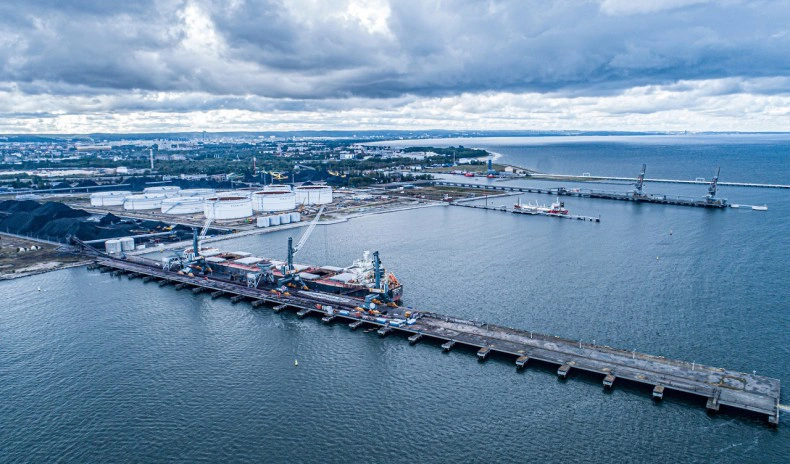


The Port of Gdańsk has published its operational summary for 2025, reporting a further year-on-year increase in cargo throughput, once again exceeding the 80 million tonne mark. The port therefore remains the most dynamically developing port in the region.
According to the Zarząd Morskiego Portu Gdańsk (Port of Gdańsk Authority), total throughput in 2025 reached 80.4 million tonnes, representing a 4% increase compared with 77.4 million tonnes in 2024. The Authority emphasised that this performance consolidates Gdańsk’s leading position among the fastest-growing ports in the region. The port continues to serve as a key transport and logistics hub for Central and Eastern Europe.
Vessel traffic also increased, with 4,394 port calls recorded in 2025, up 4.2% year on year. Of these, 3,650 calls were by commercial vessels, representing a 2.5% increase compared with 2024. The average gross tonnage of commercial vessels calling at Gdańsk rose by 3.8%, indicating enhanced utilisation of the port’s deep-water infrastructure.
Liquid Bulk Remains the Principal Cargo Segment
As in previous years, liquid bulk cargo accounted for the largest share of total throughput. In 2025, 39.6 million tonnes of liquid fuels were handled, a marginal increase of 0.4% year on year, representing 49.3% of total port throughput.
At Naftoport, 37.4 million tonnes of crude oil were handled — an increase of 0.8 million tonnes compared with the previous year and a record performance for the terminal. The facility handled 379 crude oil tankers and 84 product tankers during the year.
Containerised Cargo Again at Record Levels
General cargo ranked second among all cargo groups, following liquid bulk. Throughput in this segment increased by 16.6% year on year, rising from 23.3 million tonnes to 27.2 million tonnes, accounting for 33.8% of total throughput.
Particularly strong growth was recorded in containerised cargo, described by the Port Authority as the principal growth driver. In 2025, container terminals in Gdańsk handled nearly 2.8 million TEU, representing a 23% increase compared with 2024. The majority of this volume was handled at Baltic Hub, which accounted for 2,766,475 TEU. The total tonnage of containerised cargo also increased, reaching 24 million tonnes — up 18% year on year.
Coal and Timber Down; Passenger Traffic Up
Performance across other cargo categories was mixed. Coal throughput declined by 10.8%, falling to approximately 7 million tonnes — roughly half the volume recorded in 2022 — and accounting for 8.7% of the port’s total throughput. The port attributes this decrease to the declining role of coal in the national energy mix.
Timber throughput fell sharply by 56.5% to 31,200 tonnes, while grain volumes decreased by 14.8% to approximately 2.5 million tonnes. Ro-ro operations also recorded lower volumes, with 118,000 vehicles handled — a 15% year-on-year decline. Conversely, ore throughput increased by 12% to 326,700 tonnes, while other bulk cargo rose by 8.5% to 3.7 million tonnes.
Passenger traffic also recorded growth. A total of 171,400 passengers were handled in 2025, up 3.1% compared with the previous year. The port recorded 266 ferry calls and 57 cruise vessel calls.
Dorota Pyć, President of the Port of Gdańsk, stated that the 2025 results demonstrate the port’s capacity to adapt and strengthen resilience amid changing conditions affecting international maritime trade and supply chains. She emphasised that the Port Authority continues to invest sustainably in port infrastructure and to diversify cargo streams, reinforcing Gdańsk’s position in the Baltic Sea region and across Europe, particularly in liquid bulk and containerised general cargo.
Investment Programme
The Port Authority also highlighted key investment projects initiated or completed in 2025. Among the most significant is the construction of a new liquid bulk handling berth at Naftoport, designed to accommodate the largest crude oil tankers.
At Baltic Hub, construction is under way on the T5 terminal, dedicated to the offshore wind sector. Infrastructure works are also progressing in support of the planned FSRU terminal in the Gulf of Gdańsk.
Further quay modernisation works continue within the Inner Port. In 2025, the Bytom Quay was commissioned, along with the T3 facility at Baltic Hub, which increased the container terminal’s annual handling capacity by 1.5 million TEU.
 DOWNLOAD PDF