

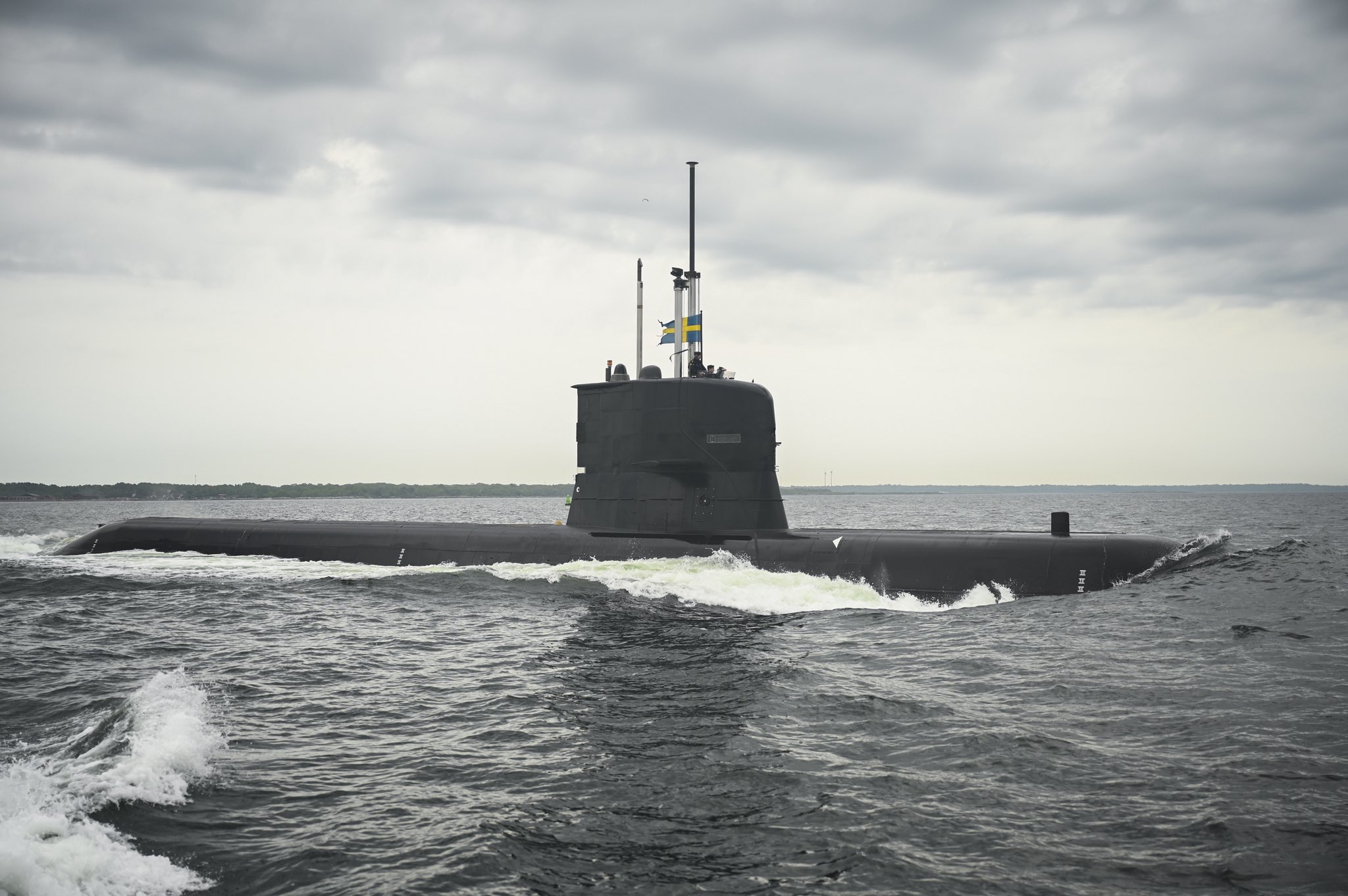


As was planned by the Navy, sailors from the 3rd Submarine Squadron of the 3rd Flotilla of Ships have arrived in Sweden to train under the supervision of their Swedish counterparts in preparation for operating the submarines that Poland will acquire under the “Orka” programme. At the beginning of 2028, they will take over an A17-class vessel, HMS Södermanland, which will serve as an interim solution until the new A26-class submarines enter service under the Polish flag.
The training of Polish sailors was announced by Poland’s Ministry of National Defence as well as the Royal Swedish Navy (Svenska Marinen). The latter noted that 49 days after the signing of the executive agreement for the delivery of the new submarines, the future crew of the leased vessel began training in Karlskrona. The city is home both to a Swedish naval base and to Saab Kockums shipyard, where the Polish vessels are to be built. The sailors were welcomed by Peter Östbring, Deputy Commander of the 1st Submarine Flotilla.
"We look forward to the start of the training and to deeper cooperation with our Polish submarine colleagues. As Poland has chosen Sweden as its strategic partner in the submarine domain, extensive planning and preparations have been carried out in the Swedish Navy and the 1st Submarine Flotilla. Being a partner that contributes to strengthening the capabilities of an ally in our immediate region will enhance both our own and allied security and freedom of action” – he said.
A difficult road
The “Orka” programme has been the most high-profile and widely discussed project involving the acquisition of equipment for Poland’s maritime armed forces. This was largely because the process had effectively dragged on for almost 30 years. Successive governments either postponed the issue, unwilling to spend billions on new vessels, or broke off ongoing negotiations in an attempt to secure a different offer. During that time, the situation of the 3rd Submarine Squadron of the 3rd Flotilla of Ships was far from satisfactory and gradually deteriorated further, particularly in light of failures and accidents involving ORP Orzeł and, later, the withdrawal of the Kobben-class submarines that Poland had acquired free of charge from Norway at the beginning of the 21st century, incidentally also as gap fillers.
At present, only the aforementioned ORP Orzeł remains in service. The nearly 40-year-old Project 877 (NATO code: Kilo) submarine, built in the Soviet Union, is nearing the end of its service life due to a series of accidents – the most serious being a fire in 2016 – as well as the lack of access to spare parts. The vessel’s condition even prompted its crew to issue an appeal published in Gazeta Wyborcza, in which they expressed concerns about the safety of their service. For several years, the submarine’s main task has been to maintain continuity in the training of personnel. This has been far from easy, as experienced officers, non-commissioned officers and sailors have either left the service or moved to other posts, while there have been relatively few people willing to join. Being repeatedly told to hope that the squadron would one day receive new submarines did little to boost morale. This only began to change in 2023.
“Orka” breaks the surface
The announcement of preliminary market consultations for the acquisition of submarines under the “Orka” programme once again raised hopes that something might finally change in the matter of these vessels, although many specialists remained sceptical, given the promises repeated over the years and the failures of successive projects.
A number of companies sought the lucrative contract, estimated at between PLN 10 billion and PLN 20 billion. Ultimately, six contenders entered the final race: France’s Naval Group (Scorpène), Spain’s Navantia (S-80), South Korea’s Hanwha Ocean (KSS-III Batch II plus KSS-I as a gap filler), Germany’s TKMS (212CD plus 210/Ula-class gap filler) and Sweden’s Saab (A26 plus A17 gap filler). The final decision was made in November last year. The Ministry of National Defence announced that Poland would purchase submarines from Sweden.
Cautious optimism
The decision to purchase the submarines, followed by the signing of the executive agreement, marked a moment that had been awaited not only by sailors but also by observers and commentators interested in maritime affairs and defence. It should be stressed, however, that this was only the beginning of a new journey, as it will be years before three new submarines become part of the Polish Navy. The plan is for all three to be in service by 2038.
It will also be several years before the first submarine reaches Poland, and specialists doubt the assurances concerning the originally announced 2030 delivery date. This is particularly significant given that Sweden’s own A26 programme has also encountered problems and has been under development for more than a decade. The scepticism and caution surrounding the project therefore appear understandable.

Photos: Swedish MoD press releases
 DOWNLOAD PDF