

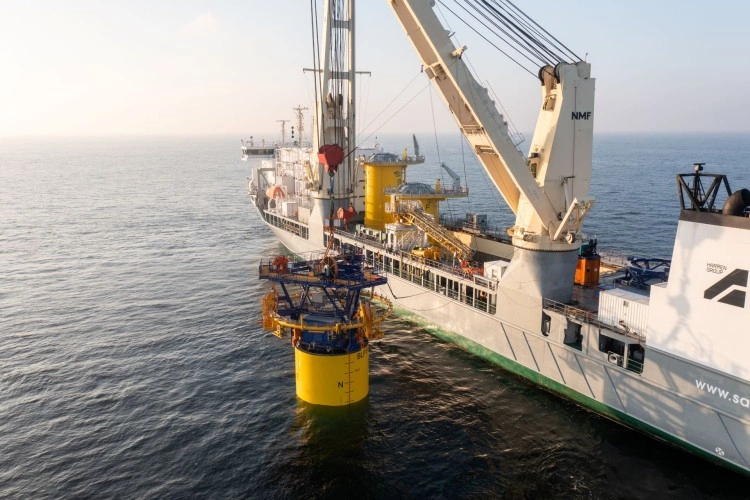


All transition pieces connecting the foundations to the turbines at the Baltic Power offshore wind farm have now been installed. In parallel, work continues on the installation of turbines as well as export and inter-array cables on the marine construction site. Electricity from Poland’s first offshore wind farm is expected to flow before the end of this year.
The installation of the transition pieces (TPs) was completed one month after the last of the 78 monopile foundations — which support the turbines and offshore substations — was driven into the seabed.
Components Made in Poland
Transition pieces link the monopile foundations with the wind turbines and offshore substations. Each structure measures around 20 metres in length, weighs up to 350 tonnes, and is custom-designed for its specific location. In addition to the main cylindrical structure, the pieces include walkways for safe crew access, deck cranes for transporting tools and components, and internal electrical installations to power the turbines.
Manufacturing of the TPs took place in Polish factories in Żary, Niemodlin and Łęknica, primarily using steel sourced from domestic mills.
Construction Continues at Sea
Completion of the main foundation package does not mean the offshore site has become quiet. Around 20 vessels operate daily, installing turbines, export cables and inter-array cables. Preparatory work is also ongoing for commissioning and testing of over 30 installed turbines and both offshore substations.
The installation campaign, scheduled for completion in the second half of 2026, has so far involved more than 80 vessels and 4,500 crew members, technicians, contractors, and Baltic Power team members.
A Landmark Project for Poland
Baltic Power is Poland’s most advanced offshore wind project and the first in the country to begin marine installations. Once fully operational, the 1.2 GW farm will generate up to 4 TWh of electricity annually, supplying around 3% of national demand.
The wind farm is located approximately 23 km off the coast near Choczewo and Łeba, covering an area of 130 km², with commercial operations expected to start by the end of 2026.

 DOWNLOAD PDF