

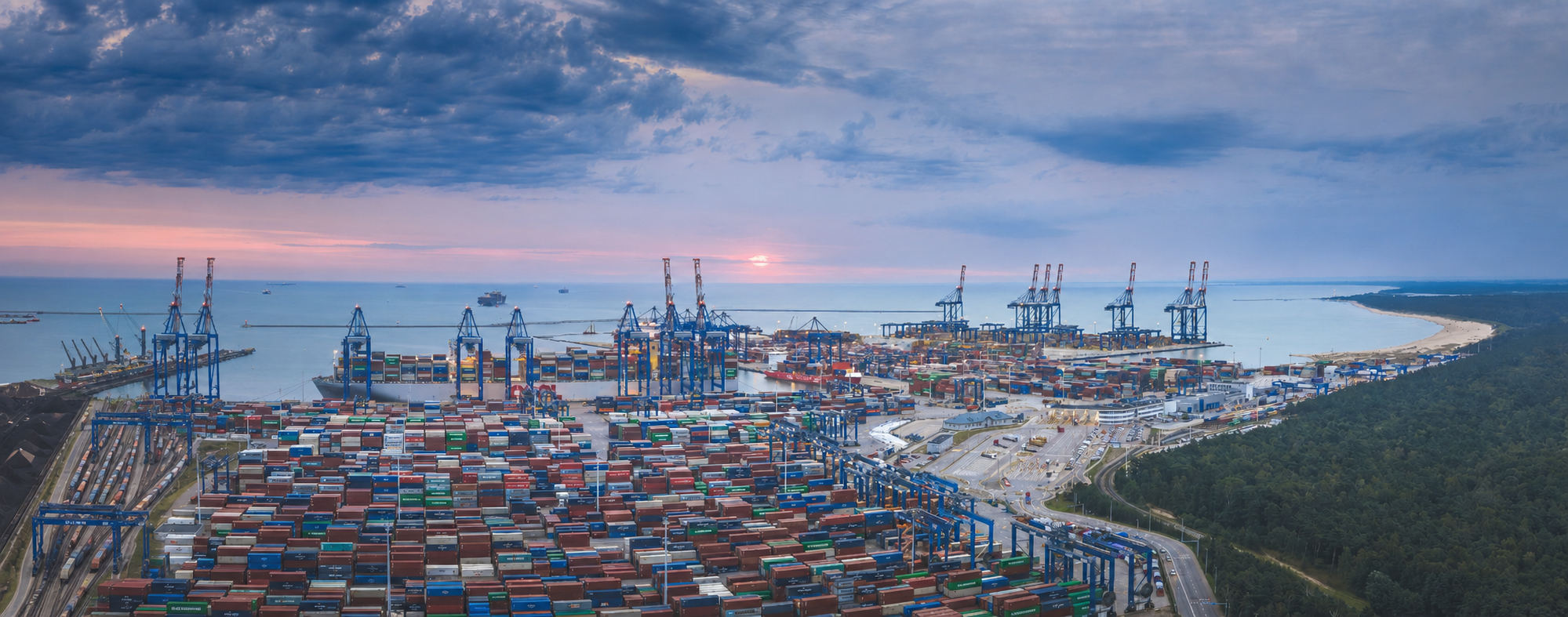


A 26-hectare site with deep-water access and part of the existing Ore Pier at the Port of Gdańsk, located immediately adjacent to the Baltic Hub container terminal, has a new tenant. Baltic Hub Container Terminal has signed a long-term lease agreement with the Port of Gdańsk Authority, securing one of the last major development areas within the port's deep-water zone.
The site, situated directly behind the perimeter of the Baltic Sea's largest container terminal, is set to support the continued expansion of Baltic Hub's container handling operations. The lease follows a competitive tender organised by the Port of Gdańsk Authority, with the agreement now formally signed by both parties.
Referred to in port documentation as the "Deepwater" site, the plot consists of a relatively narrow strip of land located between Baltic Hub and neighbouring bulk cargo terminals. It also includes part of the Ore Pier on the south-eastern side, directly adjoining the container terminal.
The Last Major Deep-Water Development Site
– This is an important agreement for the Port of Gdańsk because it concerns the last large development site within the port's deep-water area. We are delighted that Baltic Hub will be able to continue its expansion thanks to this land. It is another step that allows us to look confidently towards the future – said Dorota Pyć, President of the Port of Gdańsk Authority.
Pyć added that the Port Authority's objective is not only to strengthen the port's competitiveness and market position but also to enhance the resilience of cargo flows amid the growing importance of maritime transport and an increasingly challenging geopolitical environment.
The site's attractiveness lies primarily in its size and advanced level of preparation. Although the available quay frontage is relatively limited—measuring approximately 70 metres—the plot widens considerably inland, providing substantial space for storage yards and supporting logistics operations. The property also benefits from a valid construction permit covering, among other elements, hydrotechnical infrastructure.
New Rail Siding and Extended Quay
The existing 70-metre waterfront is insufficient for constructing a completely new deep-water container berth capable of accommodating large ocean-going vessels. Likewise, the section of the Ore Pier included in the lease is not directly suited to container operations.
However, because Baltic Hub's Quay II is located immediately adjacent to the site, the terminal plans to extend the existing berth, rather than develop an entirely new one.
– We will build an additional approximately 70 metres of quay. Alongside the quay extension and the rail infrastructure project, we will also expand our container storage yards – said Jan Van Mossevelde, CEO of Baltic Hub.
The planned quay extension will provide Baltic Hub with additional operational flexibility, allowing the terminal to use the extra berth length for activities such as positioning ship-to-shore cranes or accommodating two vessels simultaneously—a larger ship alongside a smaller one.
The narrow strip of land leased from the Port of Gdańsk, immediately adjacent to Baltic Hub's existing facilities, is also ideally suited for the construction of a new rail yard, which constitutes the terminal's primary development objective for the site.
– Our plans for this area are driven by the continuously growing cargo volumes we are handling. This applies not only to deep-sea services—rail traffic serving the port hinterland is also increasing steadily. We therefore need to continue expanding our rail transport capacity. We are already enhancing the throughput of the existing terminal through the addition of cranes No. 5 and 6. The new lease agreement will enable us to build an additional rail yard comprising seven tracks, each 750 metres long. This will significantly strengthen the Port of Gdańsk's rail connectivity with its extensive hinterland – said Jan Van Mossevelde.
According to Dorota Pyć, President of the Port of Gdańsk Authority, the investment is also aligned with the port's sustainability objectives.
– The project supports our sustainable development strategy by creating conditions for shifting a greater share of cargo from road to rail transport. This will help establish more efficient and environmentally friendly supply chains while strengthening the Port of Gdańsk's competitive position in attracting cargo destined for Central and Eastern European markets, including the Czech Republic, Slovakia and Ukraine – she said.
Rail Access Remains a Strategic Priority
Baltic Hub's plans to develop a new rail yard at the Baltic Sea's largest container terminal further underline the long-standing need for improved rail infrastructure serving the Port of Gdańsk, particularly the Northern Port, where Baltic Hub is located.
Jan Van Mossevelde acknowledged that the development of the newly leased site will take many months, but stressed that the terminal has no intention of delaying the project.
– The sooner, the better, because the need for additional quay capacity, storage yards and rail infrastructure is urgent – he said.
The Port of Gdańsk Authority also maintains that, for both logistical and supply chain resilience reasons, it is essential to establish an additional rail connection to the port island, which is separated from the mainland by the Dead Vistula River.
Last year, the Port Authority and PKP Polish Railway Lines (PKP PLK) signed a cooperation agreement to prepare a concept for improving both rail and road access to the Northern Port.
– The procurement documentation is now in its final stage of preparation. A tender will soon be launched to select a contractor responsible for preparing the feasibility study for the construction of new rail access infrastructure serving not only the existing deep-water terminals but also those that will be developed in the Port of Gdańsk in the future. Our ambitions are considerable—we intend to continue expanding the port, building new terminals and strengthening those already in operation – said Dorota Pyć, President of the Port of Gdańsk Authority.
One should not expect the new rail connection to materialise quickly. The conceptual design phase alone could take up to two years, reflecting both the complexity of the project and the extensive consultations required with numerous stakeholders. Only once that stage has been completed will it be possible to proceed with detailed engineering documentation and obtain the necessary administrative permits. Construction works can begin only after those steps have been completed.
Speaking at the signing of the cooperation agreement between the Port of Gdańsk Authority and PKP Polish Railway Lines (PKP PLK) in November last year, Marcin Mochocki, Member of the Management Board and Director for Investment Delivery at PKP PLK, estimated that the administrative process alone could take at least seven to eight years. At the same time, deputy infrastructure ministers suggested that the timetable might be accelerated if the new railway line were designated as a strategic national security project.
Such a classification would not be unjustified. As emphasised not only by the Port of Gdańsk Authority, but also by numerous terminal operators and companies operating within the port, all rail traffic serving the port currently relies on a single railway bridge and a single road bridge. Any maintenance work, failure or unforeseen incident affecting either crossing could severely disrupt access to the port.
Second Tender Attempt
The Deepwater site was offered to the market twice.
The first tender was launched in early 2024, covering a site of nearly 24 hectares. It marked the Port's first attempt to commercialise the area. The original concept envisaged the construction of a deep-water agricultural cargo terminal. The tender documentation required bidders to declare a minimum annual cargo throughput of 2 million tonnes, including at least 500,000 tonnes of grain.
However, the tender was cancelled in May 2024 following the launch of the Gdańsk Agro Terminal project in the Inner Port by Port Gdański Eksploatacja.
In December 2025, the Port of Gdańsk Authority launched a new tender under revised conditions. The site offered had been enlarged to approximately 27 hectares, while the mandatory grain-handling requirement was removed. The submission deadline was extended after prospective bidders submitted nearly 30 requests for clarification, arguing that they needed additional time to prepare their offers.
Ultimately, only one bid was submitted.
– One offer was received and, following the tender procedure conducted in accordance with the applicable legal regulations, Baltic Hub Container Terminal was selected as the successful bidder – said Dorota Pyć, President of the Port of Gdańsk Authority.
The companies signed the preliminary agreement on the final day of 2025, launching the process of obtaining all the required administrative and corporate approvals. The final agreement was signed this summer, making Baltic Hub the lessee of the site for a period of 30 years. The area is partially developed and includes, among other facilities, an old warehouse, a battery of silos and several structures classified as having cultural value, including historic military buildings.
One of the site's greatest advantages is its transport accessibility. In recent years, landside access has been significantly improved, including the road and rail network in the Northern Port, modernised by the Port of Gdańsk Authority. Meanwhile, PKP Polish Railway Lines (PKP PLK) has upgraded more than 70 kilometres of railway tracks and 13 road-rail level crossings. On the maritime side, the approach channel has been widened and deepened to 18 metres, enabling the unrestricted navigation of the largest container ships operating in the Baltic Sea. A new turning basin for these vessels has also been constructed. Responsibility for maritime access lies with the Maritime Office in Gdynia.
 DOWNLOAD PDF