

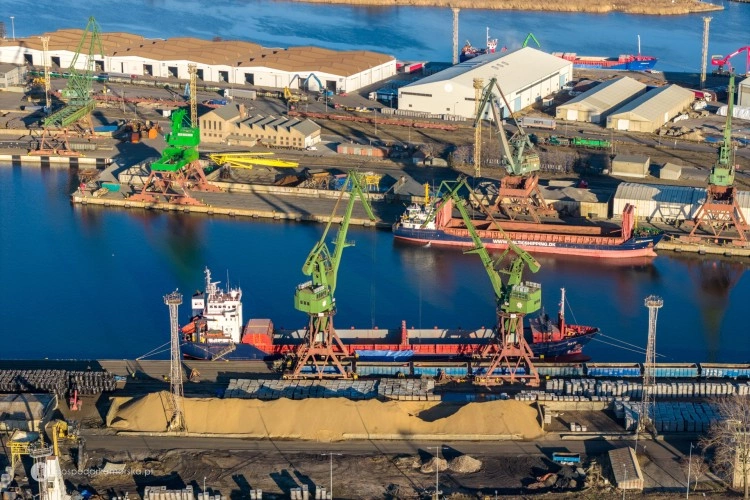


Following a change in ownership at the Bulk Cargo – Port Szczecin terminal, the company recorded a marked increase in cargo throughput in 2025. Previously announced investments in infrastructure and terminal equipment have also begun to take shape.
The year 2025 proved to be a turning point in the history of the Szczecin-based bulk handling terminal. At the start of the year, logistics operator Rhenus Group acquired a 98% stake in the company, becoming its majority shareholder. The remaining shares are held by minority investors, largely employees of the terminal.
In line with the new owner’s announcements, significant changes have been implemented across the company. According to Adam Czarnul, President of Bulk Cargo – Port Szczecin, the past year was devoted primarily to restructuring, organisational changes and improving operational efficiency.
From an operational perspective, however, the terminal has been navigating a stable yet challenging situation in the bulk cargo handling sector. At Bulk Cargo – Port Szczecin, these volumes have been successfully replaced by general cargo.
“Thanks to this, we managed to increase throughput year-on-year by 11%, which has had a significant impact on our financial performance,” Czarnul said. The increase has been driven primarily by activity in the general cargo segment.
“We have taken over some cargo flows from ports in southern Europe, as well as from the west. Poland is becoming an increasingly attractive gateway for imports, particularly steel coils and other general cargo,” he explained.
According to the company’s chief executive, the current condition of the bulk cargo market comes as little surprise.
“We have already come to terms with it. Coal has effectively disappeared over the past two years and is unlikely to return, particularly in this part of Europe. Instead, we are entering the market with other cargo groups and trying to attract new customers in order to fully compensate for this loss,” Czarnul said.
General cargo operations, he noted, require greater labour input and more complex handling processes, which inevitably has a different impact on the company’s financial results.
The terminal’s current handling capacity is estimated at between 3.5 and 4 million tonnes per year. Czarnul added that further volume growth is expected in 2026.
“Our outlook is quite positive. In discussions with freight forwarders we can see that the cargo segments currently expanding on the market are also growing in our terminal,” he said.
Plans for 2026 are focused primarily on investments. Following the company’s internal reorganisation, investment projects have already begun, including the construction of two new warehouses on the quay.
“One of them will be dedicated to general cargo, while the other will serve as a multi-purpose warehouse. We are expanding our storage capacity by 12,000 square metres, which represents around 22% of our current warehousing capacity,” Czarnul said.
The first warehouse is expected to be completed in the fourth quarter of this year. The second, a more complex universal facility, is scheduled to enter service approximately two months later.
In December last year the company also signed a contract for the delivery of a new crane that will operate on the modernised Katowicki Quay. The equipment will be supplied by Ardelt in cooperation with Polish subcontractors.
“It is extremely important for us that the raw materials used to manufacture the crane that will eventually operate in Szczecin will come from Poland. This gives the project a strong local content,” Czarnul emphasised.

The new crane will replace three units currently operating at the terminal. It will be a portal-type quay crane with a lifting capacity of up to 65 tonnes on the hook. It will not be the only new piece of equipment arriving at Bulk Cargo – Port Szczecin.
“We have ordered a new mobile crane, a heavy-duty stacker and new tractor units. More equipment should arrive here every month in line with the investor’s commitments,” Czarnul said.
“At present, the first phase of the investment programme amounts to nearly €18 million — and that is not our final word.”
One particularly notable moment for the terminal came during the recent severe winter. According to Czarnul, ice conditions in the port basin disrupted cargo operations for what may have been the first time in three decades.
“We had a day when everything in Szczecin froze over — not only the city streets, but also our cargo,” he recalled. “At that point operations had to be halted and secured, as the safety of our workforce is paramount.”
Rail loading operations were temporarily suspended, and difficulties emerged with the delivery of wagons to the terminal and the operation of locomotives. Rail disruptions were in fact felt across the country. However, the interruption to terminal operations itself proved short-lived.
Barge operations, on the other hand, were suspended for several weeks. Inland shipping plays an important role in the terminal’s logistics chain, particularly for customers in Germany.
“We had to replace raw material shipments for one of our clients, switching from barges to rail wagons and road haulage. We are now returning to normal operations, which means handling two to three barge convoys per day,” Czarnul said.
The harsh winter also led to a noticeable drop in water levels. Czarnul noted that fluctuations in water levels in Szczecin occur relatively frequently and are typically linked to wind conditions, with backflow events not uncommon.
When water levels in the Oder River fall, levels in the port basins connected to the river decline as well.
“Fortunately, we have a depth of 12.5 metres alongside the quay, which means we can handle the largest vessels calling at the port. However, it can sometimes create minor technical complications, particularly when vessels are loaded close to their maximum draft,” the terminal chief concluded.
 DOWNLOAD PDF