



One of the debates held during this year's Polish Ports 2030+ Congress in Sopot, focused on infrastructure construction. Participants unanimously stressed that Polish companies possess the expertise and capabilities required to deliver ambitious hydrotechnical and energy projects. Infrastructure contractors are successfully completing some of the country's most demanding development schemes. To continue expanding, however, they primarily need one thing: visibility of future investment plans.
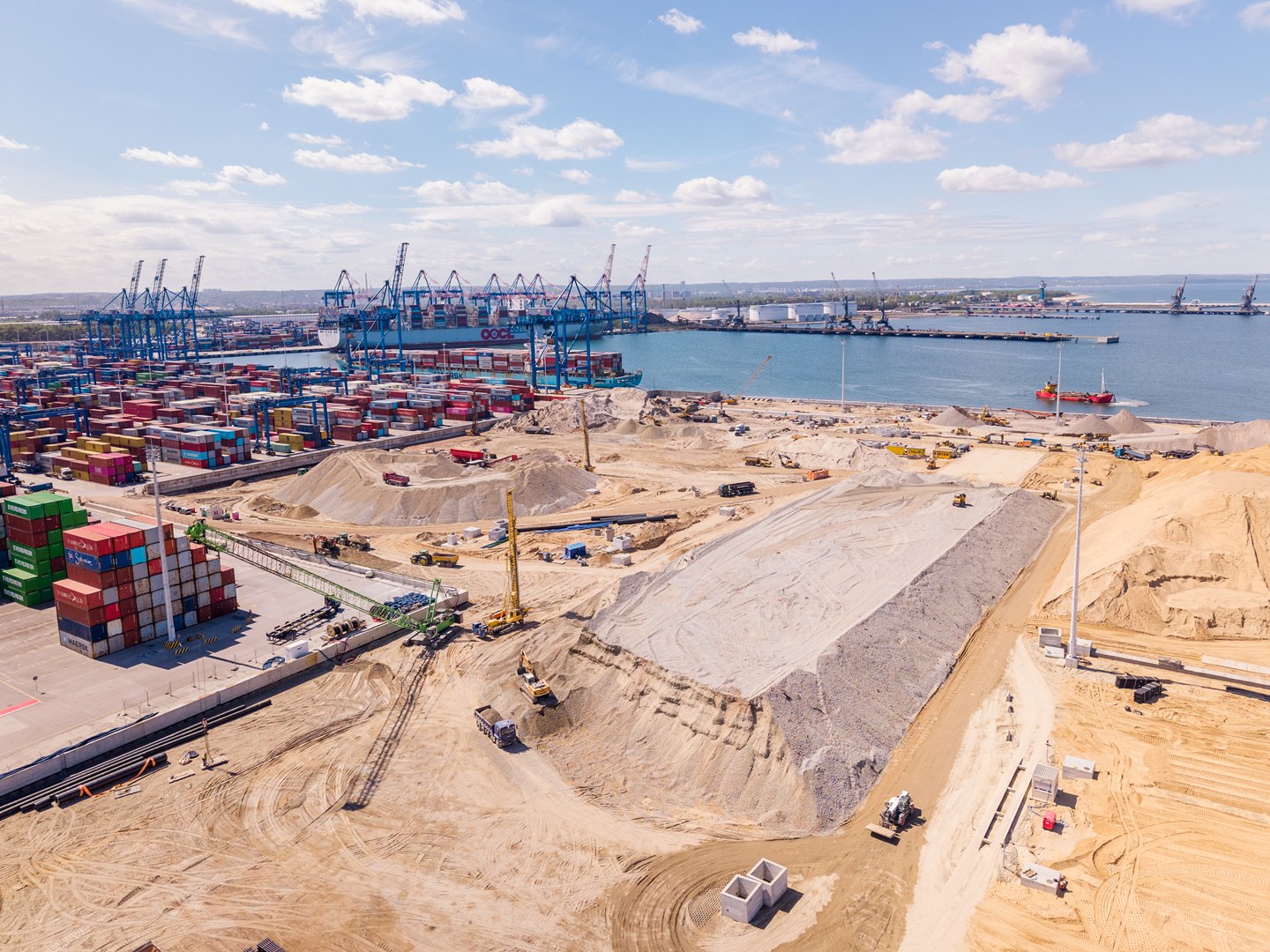
Over recent years, Polish companies have delivered a series of major infrastructure projects, with the vast majority completed on schedule and within budget. They have been responsible for expanding Polish ports, including the construction of breakwaters, while Polish contractor NDI is currently building the T5 terminal at Baltic Hub and Doracois constructing the operations and maintenance base for the Baltica 2 offshore wind project. The list of ongoing developments could be extended considerably. Notably, none has experienced delays comparable to those of Berlin Brandenburg Airport, which opened approximately 12 years behind schedule.
Today, the key question is how to support the industry's continued growth.
Companies operating in the infrastructure construction sector have long argued that stable development depends not only on understanding investment plans for the next two or three years, but above all on having a long-term outlook extending 15 to 20 years ahead. They are not calling for detailed schedules or precise expenditure figures, but rather for a clear indication of the state's strategic direction and the approximate scale of future investment in areas such as roads, railways, seaports and airports. Such information would enable companies to assess the future potential of the market and prepare for upcoming investment challenges.
– We would like the government to define long-term investment prospects, not as a binding commitment down to the last million zlotys, but as strategic guidance indicating the trends we can expect. This makes it easier for companies to prepare for future projects, estimate when they need to invest in equipment and recruitment, and when they can focus on stabilisation – said Adam Mańka, Director at Doraco.
Long-term predictability of public spending has a direct impact on employment decisions. Companies can plan workforce development, invest in specialist training and build the capabilities required to deliver future projects. In the infrastructure sector, recruiting and preparing qualified personnel takes many years. Sudden fluctuations in the volume of public contracts therefore result either in labour shortages or in companies maintaining underutilised resources. A planning horizon spanning more than a decade would help reduce these risks and improve the efficiency of the entire market.
Planning is critically important
Łukasz Małkiewicz, Director of Marine Hydrotechnics at PORR, also stressed that long-term planning enables companies to develop steadily while strengthening their capabilities. Beyond workforce planning, it allows businesses to optimise investment and procurement strategies for equipment that is often extremely expensive. Knowing the expected timetable for future expenditure also makes it possible to plan leasing arrangements or other forms of acquiring specialist equipment.
This is particularly important in the maritime sector. The T5 terminal currently under construction at the Port of Gdańsk has been designed for a service life of 75 years. Maintenance planning and the associated costs should already be capable of being budgeted for—at least in part. Unfortunately, this is currently not possible.
Benefits for everyone
Investment decisions concerning equipment, technical facilities and business development are equally important. Purchasing modern machinery, building logistics bases or implementing new technologies requires years of planning and substantial financial resources. Knowing the approximate scale of future public investment—even without precise figures—would enable companies to manage capital more efficiently and make decisions that strengthen their competitiveness. Ultimately, not only businesses but also the state would benefit by having access to a strong, stable and well-prepared contracting sector.
The industry's equipment requirements are enormous. Modern technologies make it possible to prepare and execute construction projects more quickly, more safely and at lower cost.
– Today I cannot imagine a major construction project without drone inspections. This technology enables us to monitor various processes and verify the quality of work. At the same time, it improves productivity and enhances worker safety by allowing employees to focus on more important tasks than routine monitoring – said Łukasz Jagalski of NDI.
He stressed, however, that digital and technological tools are designed to support skilled workers rather than replace them.
Finding the right strategy
Industry representatives also emphasised that Polish companies have succeeded in the infrastructure sector because they have been able to identify the most important strategic directions for development.
Jakub Długoszek of Budimex explained that the company had deliberately scaled back a significant part of its residential construction business to focus on infrastructure, including critical infrastructure projects. At the same time, he did not rule out seeking additional revenue abroad, although Poland remains by far the company's primary market. Expanding internationally involves considerable costs arising from different legal and regulatory frameworks. Consequently, while not excluding new markets, Budimex remains focused on Poland and, like the rest of the industry, hopes for long-term planning of strategic investments.
– We do not want to rely on guessing what the market will look like. What we need is strategic guidance – he said during the debate.
The approach is similar at Gdańsk-based PRCiP, where exporting services is not considered a priority.
– Our priority is to expand our services in Poland. We are gradually broadening our expertise by complementing dredging operations with services such as subsea pipeline installation and other highly specialised offshore works. This is our response to market demand and to the scale of investments currently being carried out in Polish ports – said Hubert Sidorowicz, Production Director at PRCiP.
Public administration wants to help
Part of the debate focused on the quality and efficiency of public administration.
– The efficiency of public administration depends not only on the number of officials or the procedures in place, but also on the quality of the documentation submitted. Well-prepared studies, comprehensive analyses and clearly presented information enable applications to be assessed much more quickly – argued Andrzej Ryński, Director at the Gdańsk Regional Office of the State Water Holding Polish Waters.
According to Ryński, the difference can be substantial. Where documentation is incomplete or contains errors, administrative proceedings can take six or even seven months. When the documentation is complete, decisions are typically issued within 30 to 60 days.
Meanwhile, Wojciech Zdanowicz, Director of the Maritime Office in Szczecin, noted that the quality of dialogue between public authorities and businesses during public procurement procedures has improved significantly in recent years. According to Zdanowicz, public officials increasingly recognise that constructive dialogue benefits both contracting authorities and potential contractors.
– If a potential contractor asks a substantive question and receives either no answer or an incomplete one, they will include an appropriate financial contingency to cover potential uncertainties. That drives prices up. If, however, they receive a competent answer, they can optimise costs, benefiting both the contractor and the contracting authority – said Zdanowicz.
Both Zdanowicz and Ryński also pointed out that public administration is currently struggling with a shortage of highly qualified specialists, who are expected to possess extensive professional expertise while receiving salaries that remain significantly lower than those offered by the private sector.
Photo: NDI Group Press Release
 DOWNLOAD PDF